Whaling ships set sail as Japan resumes commercial hunts

1 / 5
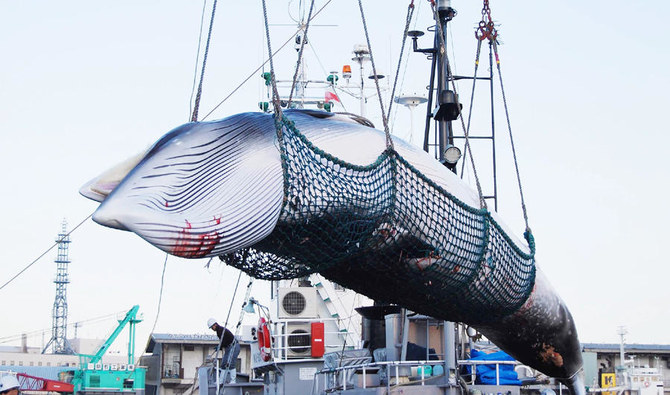
This September 4, 2017 picture shows a Minke whale being lifted by a crane during the North Pacific research whaling programme at the Kushiro port in Kushiro, Hokkaido prefecture. (AFP)
2 / 5
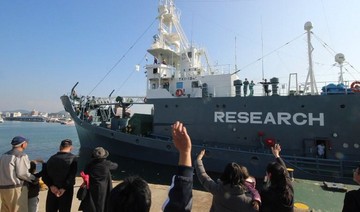
A whaling ship departs from a port in Kushiro, Hokkaido Prefecture on July 1, 2019. (AFP)
3 / 5
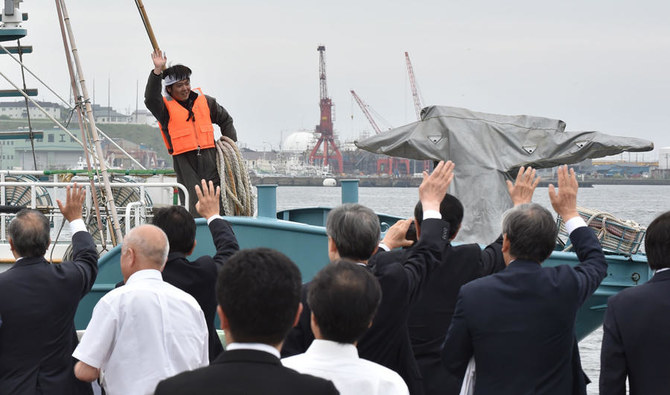
A fisherman waves to well-wishers on a whaling ship as they depart from a port in Kushiro, Hokkaido Prefecture on July 1, 2019. (AFP)
4 / 5
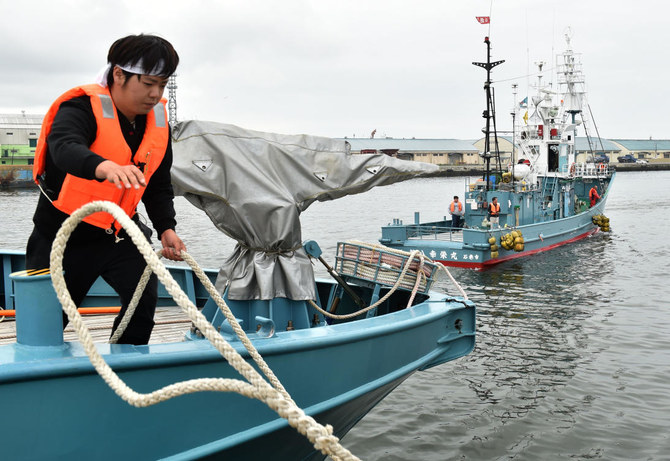
This picture taken on June 30, 2019 shows a fisherman on a whaling ship anchored at a port in Kushiro, Hokkaido Prefecture. (AFP)
5 / 5
A whaling ship departs from a port in Kushiro, Hokkaido Prefecture on July 1, 2019. (AFP)
Updated 01 July 2019
Follow

Whaling ships set sail as Japan resumes commercial hunts

  • Activists said the hunts had no scientific value, and Japan made no secret of the fact that meat from whales caught on those hunts ended up sold for consumption

KUSHIRO, Japan: Whaling ships set sail on Monday from Japan as the country resumed commercial hunts for the first time in decades after withdrawing from the International Whaling Commission.
Five ships from whaling communities around the country left port in northern Japan’s Kushiro with their horns blaring and grey tarps thrown over their harpoons.
Japan’s decision to withdraw from the IWC was slammed by activists and anti-whaling countries, but the resumption of commercial hunts has been welcomed by Japanese whaling communities and the departure from Kushiro was celebrated with a send-off ceremony.
“My heart is overflowing with happiness, and I’m deeply moved,” said Yoshifumi Kai, head of the Japan Small-Type Whaling Association, addressing a crowd of several dozen politicians, local officials and whalers.
“This is a small industry, but I am proud of hunting whales. People have hunted whales for more than 400 years in my home town.”
Whaling vessels will also leave Monday morning from other ports including in Shimonoseki in western Japan.
The country’s Fisheries Agency said Monday it had set a cap for a total catch of 227 whales through the season until late December.
The quota includes 52 minke, 150 Bryde’s and 25 sei whales, the agency said.
“I’m a bit nervous but happy that we can start whaling,” 23-year-old Hideki Abe, a whaler from Miyagi region in northern Japan told AFP before leaving.
“I don’t think young people know how to cook and eat whale meat any more. I want more people try to taste it at least once.”
Whaling has long proved a rare diplomatic flashpoint for Japan, which says the practice is part of the country’s tradition and should not be subject to international interference.
As an IWC member, Japan was banned from commercial hunts of large whales, though it could catch small varieties in waters near its coastline.
But it also exploited a loophole in the body’s rules to carry out highly controversial hunts of whales in protected Antarctic waters under the banner of “scientific research.”
Activists said the hunts had no scientific value, and Japan made no secret of the fact that meat from whales caught on those hunts ended up sold for consumption.
With its withdrawal from the IWC, Tokyo will now carry out high-seas whale hunting off Japan, but will end the most controversial hunts in the Antarctic.


Essex man takes on charity endurance challenge for children in Gaza

Updated 03 January 2026
Follow

Essex man takes on charity endurance challenge for children in Gaza

  • Mark Watson, 63, is undertaking a “virtual Sumud” journey from his Essex home town in Harlow to Gaza, covering 2,287 miles

LONDON: A man in England has launched a demanding charity challenge to raise funds for children affected by the war in Gaza.

Mark Watson, 63, is undertaking a “virtual Sumud” journey from his Essex home town in Harlow to Gaza, covering 2,287 miles through running, walking, swimming, cycling and rowing.

He is raising money for Medical Aid for Palestinians, a UK-based humanitarian organization providing healthcare to Palestinians in Gaza and the occupied territories.

“I have felt helpless day after day seeing images of countless children in Gaza with broken bodies and missing limbs and witnessing their unbearable suffering,” Watson said on his JustGiving page.

“I have been inspired by the courage of those who took part in the global Sumud flotilla and all of the activists who have put their lives and freedom at risk supporting the Palestinian people and so I am raising funds for Medical Aid for Palestinians.

“My challenge is to complete a virtual Sumud from Harlow, where I live, to Gaza. Running, walking, swimming, cycling and rowing I will cover the 2,287 miles as quickly as I can.

“I am an unfit, overweight 63-year-old, so I’m not going to break any records, but the Arabic word Sumud means steadfastness and perseverance and I will give it my all.

Watson added: “I hope to be joined by people I love and admire along the way, so please support my fundraiser. Every donation, however small, will help save the lives of Palestinians.”

As of January 3, his fundraiser had reached 12 per cent of its £5,000 target.

The war in Gaza began after the October 7, 2023, attack by Hamas on southern Israel, in which around 1,200 people were killed and more than 200 taken hostage, according to Israeli authorities.

Israel responded with a large-scale military campaign in Gaza, which local health authorities say has resulted in the deaths of more than 71,000 Palestinians, widespread destruction of civilian infrastructure and a severe humanitarian crisis.

International aid agencies have repeatedly warned that children have been among the most affected, facing injury, displacement, malnutrition and limited access to medical care.

Watson said he was inspired by activists and humanitarian efforts supporting Palestinians and hopes his challenge can make a small contribution toward saving lives.