

9-month OPEC+ extension most likely, says Al-Falih

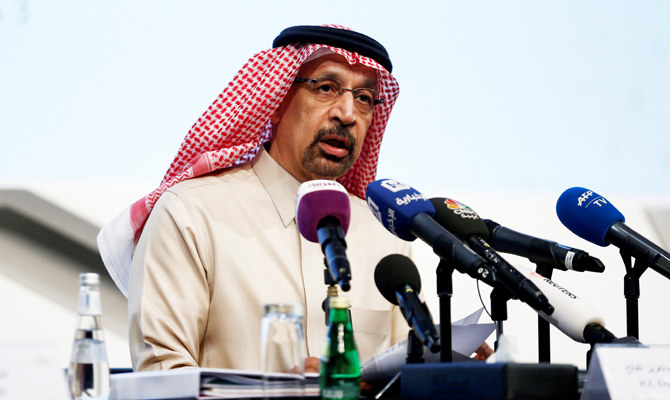
Saudi Energy Minister Khalid al-Falih. (REUTERS/File Photo)
Updated 30 June 2019
Follow

9-month OPEC+ extension most likely, says Al-Falih

  • A nine-month extension would mean the deal runs out in March 2020
  • Oil ministers from OPEC meet on Monday in Vienna, followed by talks with non-OPEC oil producers on Tuesday

VIENNA: Saudi Energy Minister Khalid Al-Falih said on Sunday that the Organization of the Petroleum Exporting Countries (OPEC) and its allies led by Russia would most likely extend their oil output-cutting deal by nine months and that no deeper reductions were needed.

“I think most likely a nine-month extension,” Falih told reporters when asked about Saudi preferences.

Asked about a deeper cut, he said: “I don’t think the market needs that.”

“Demand is softening a little bit but I think it’s still healthy,” he said, adding that he expected the market to balance in the next six to nine months.

Russia has agreed with Saudi Arabia to extend the deal with OPEC, Russian President Vladimir Putin said earlier, as oil prices come under renewed pressure from rising US supplies and a slowing global economy.

Demand is softening a little bit but I think it’s still healthy.

Khalid Al-Falih, Saudi energy minister

Oil ministers from OPEC meet on Monday in Vienna, followed by talks with non-OPEC oil producers on Tuesday. 

The US, the world’s largest oil producer ahead of Russia and Saudi Arabia, is not participating in the pact.

The UAE energy minister said on Sunday he hoped for a productive outcome from the Vienna meetings, according to his official Twitter account.

“Confident the alliance will reach a decision that will restore oil market balance,” Suhail bin Mohammed Al-Mazroui tweeted.

A nine-month extension would mean the deal runs out in March 2020. 

Russia’s consent means the so-called OPEC+ group may have a smooth meeting if OPEC’s third-largest producer Iran also endorses the arrangement.

New US sanctions on Iran have reduced its exports to a trickle as Washington seeks to change what it calls a “corrupt” regime in Tehran. 


UAE homebuilders to prioritize cash conservation amid regional conflict: Fitch

Updated 7 sec ago
Follow

UAE homebuilders to prioritize cash conservation amid regional conflict: Fitch

RIYADH: UAE homebuilders are expected to pivot toward preserving liquidity in the wake of the recent geopolitical shock in the Middle East, according to Fitch Ratings.

The credit ratings agency noted that while the immediate impact on the sector has seen a drop in on-site viewings, a substantial backlog of pre-sales and funds held in escrow should provide a cushion for rated companies in the near term.

The escalation of regional hostilities is presenting the first significant challenge to the UAE’s property boom.

Since Feb. 27, the last day of trading before the conflict began and subsequent market closure, shares of major developers have trended downward. Aldar Properties has seen its share price decline by 22.2 percent, while Emaar Properties has dropped 21.9 percent to date.

Fitch’s analysis focused on a portfolio of UAE developers clustered at the “B+” and “BB-” rating levels.

“Even before the conflict, the region was exposed to geopolitical risks. Booming housing construction was already reliant on overseas demand, which we expect to be subdued due to the conflict,” Fitch said.

Citing data from Property Monitor, the agency noted that resident demand constitutes only 40 percent of end-users in Dubai, highlighting the market’s exposure to fluctuations in global investor confidence.

“Housing demand in some cities, such as Dubai or Sharjah, partly aligns with new business infrastructure and locations, while other housing demand is more investment-focused,” the report added.

The rated homebuilders operate primarily on an off-plan sales model, where purchaser funds are held in escrow and released to developers upon achieving construction milestones. Fitch noted that projects already substantially pre-sold are likely to reach completion, even if broader supply chains face disruptions.

The agency expected the more agile construction firms to deliver these projects on time and on budget.

The feasibility of future developments is now under scrutiny as these projects typically rely on debt as seed capital and are vulnerable to potential declines in average selling prices.

“The main cash outflow and need for debt is for funding land — 20 percent of end-value — and initial infrastructure spend,” the report stated.

Developers generally require a pre-sale threshold of 60–65 percent to begin construction viably. While end-profit margins for these projects remain healthy at a minimum of 20 percent, Fitch emphasized that capturing those profits is currently secondary to ensuring group-wide liquidity.

Looking ahead, Fitch indicated that future rating actions will depend heavily on how companies manage cash conservation and the visibility they have before committing to new debt-funded investments.

The agency anticipated that UAE authorities would step in to support the crucial real estate industry, which is integral to various cities’ strategies for infrastructure growth and investment.

Potential government measures could include deferred payment plans for land purchases, greater flexibility in escrow mechanisms, or financing initiatives to attract buyers.

Fitch cautioned that in past downturns, homebuilders have resorted to providing direct financing or loosening payment plans for purchasers, measures that ultimately increased the developers’ own debt burdens.