

Russia agrees with Saudi Arabia to extend OPEC deal by 6-9 months 

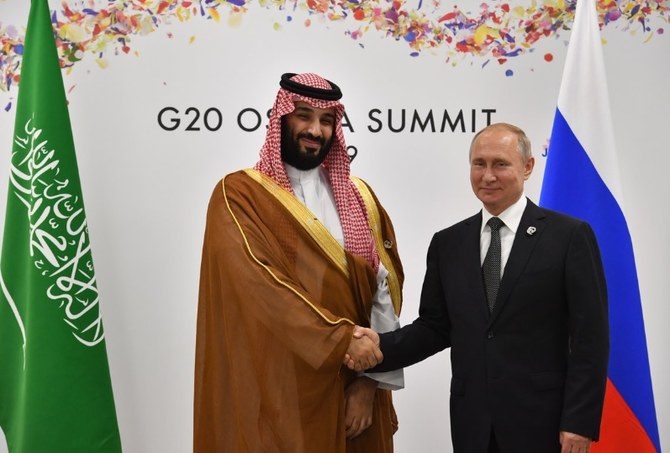
Putin, speaking after talks with Saudi Crown Prince Mohammed bin Salman, told a news conference the deal would be extended in its current form and with the same volumes. (SPA)
Updated 30 June 2019
Follow

Russia agrees with Saudi Arabia to extend OPEC deal by 6-9 months 

  • A nine-month extension would mean the deal runs out in March 2020

OSAKA: Russia has agreed with Saudi Arabia to extend by six to nine months a deal with OPEC on reducing oil production, Russian President Vladimir Putin said.
Putin, speaking after talks with Saudi Crown Prince Mohammed bin Salman, told a news conference the deal would be extended in its current form and with the same volumes.
The Organization of Petroleum Exporting Countries, Russia and other producers, an alliance known as OPEC+, meet on July 1-2 to discuss the deal that involves curbing oil output by 1.2 million barrels per day (bpd). The pact expires after June 30.

HIGHLIGHTS

• Deal to be extended in current form, same volume.

• Pact brought Russia extra $110 billion in revenues.

• OPEC meets on Monday amid rising US pressure on Iran.

“We will support the extension, both Russia and Saudi Arabia. As far as the length of the extension is concerned, we have yet to decide whether it will be six or nine months. Maybe it will be nine months,” said Putin said, who met the crown prince on the sidelines of a G20 summit in Japan.
A nine-month extension would mean the deal runs out in March 2020.
Kirill Dmitriev, the chief executive of Russian Direct Investment Fund who helped design the OPEC-Russia deal, said the pact in place since 2017 has already lifted Russian budget revenues by more than 7 trillion roubles ($110 billion).
“The strategic partnership within OPEC+ has led to the stabilization of oil markets and allows both to reduce and increase production depending on the market demand conditions, which contributes to the predictability and growth of investments in the industry,” Dmitriev said.
Benchmark Brent has climbed more than 25 percent since the start of the 2019. But prices could stall as a slowing global economy squeezes demand and US crude floods the market, a Reuters poll of analysts found.


Saudi ministry launches private sector tender to operate sports venues in Makkah region

Updated 7 sec ago
Follow

Saudi ministry launches private sector tender to operate sports venues in Makkah region

RIYADH: New investment opportunities in athletic facilities across the Makkah region have been launched as Saudi Arabia looks to expands private sector participation in the sports economy and improve the commercial performance of its stadiums.

The Kingdom’s Ministry of Sport announced the offering under its “Sports Facilities Investment” initiative, inviting qualified companies to bid for a three-year contract to operate and manage multiple venues, including King Abdullah Sports City Stadium in Jeddah, Prince Abdullah Al-Faisal Stadium in Jeddah, King Abdulaziz Stadium in Makkah, and the indoor arena at King Abdullah Sports City.

The initiative comes amid a wider push by Saudi Arabia to maximize the commercial value of its sports infrastructure as the Kingdom prepares for major international tournaments and expands its domestic sports economy.

Under the proposed arrangement, the selected operator will manage matches, events, and daily venue services to enhance fan experiences and operational quality, while the ministry will retain responsibility for maintenance and oversight. The model is designed to expand partnerships with the private sector and improve the year-round utilization of sports infrastructure.

The investment opportunity offers multiple revenue streams, including ticket sales, food and beverage concessions, and hospitality services, as well as advertising and venue naming rights, excluding King Abdullah Sports City Stadium, and the ability to host non-sporting events and community activities.

Francesca Petriccione, an international sports lawyer and professor at the University of Milan, said the initiative reflects a broader strategy to transform stadiums into long-term economic assets rather than facilities used only for sporting competitions.

“These stadiums are being developed as long-term economic assets rather than simply event venues,” Petriccione told Arab News. “The infrastructure strategy is not only about match-day capacity but also about commercial activation outside football.”

Petriccione advises leading international football clubs on strategic expansion projects in the Middle East, particularly in Saudi Arabia. Her work focuses primarily on football club acquisitions and cross-border investment in the sports sector.

She explained that the Kingdom’s broader sports infrastructure program, linked to its 2034 FIFA World Cup bid, demonstrates a portfolio approach to stadium development.

“Saudi Arabia’s plan is built around 15 proposed stadiums across five cities, including four existing venues, three already under construction and eight planned new builds,” Petriccione said. “The ministry is trying to avoid the classic white elephant problem by embedding stadiums within a broader utilization model.”

According to the professor, the Kingdom’s stadium program is designed to support both international tournament hosting and long-term infrastructure development.

“The ministry is not simply refurbishing legacy stock but selectively creating a next-generation venue network for top-tier international events,” she said.

Petriccione added that the nation’s approach emphasizes multi-purpose venues capable of hosting concerts, conferences and other large-scale events in addition to football matches, improving utilization rates and strengthening the financial model of sports infrastructure.

“Modern stadiums are financially stronger when they function as experience and events platforms rather than simply football grounds,” she said.

Some venues are also being integrated into larger urban development strategies and tourism ecosystems rather than built as standalone athletic projects, aligning sports infrastructure with broader real estate and destination planning. 

Petriccione noted that the ministry’s decision to invite private companies to operate and manage facilities signals a gradual shift toward commercially driven management structures. 

“The value is not only in construction — it also lies in operations, facility management, venue technology, hospitality, naming rights, premium seating and non-match-day monetization,” Petriccione said.

The ministry said the investment initiative aims to create a scalable operating model that could later be applied to additional sports facilities across the Kingdom, while increasing financial efficiency, enhancing commercial rights activation and generating new revenue streams for the sports sector.