

Lebanon and Jordan urge Kazakhstan to protect oil-field workers after mass brawl injures dozens

1 / 3
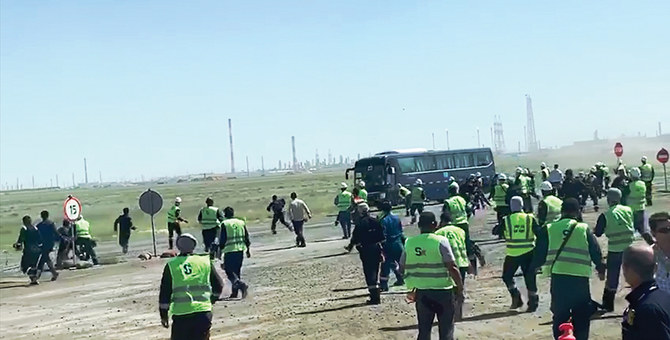
Video footage showed the Arab workers being kicked and punched by large numbers of local colleagues in Kazakhstan. (Social media photo)
2 / 3
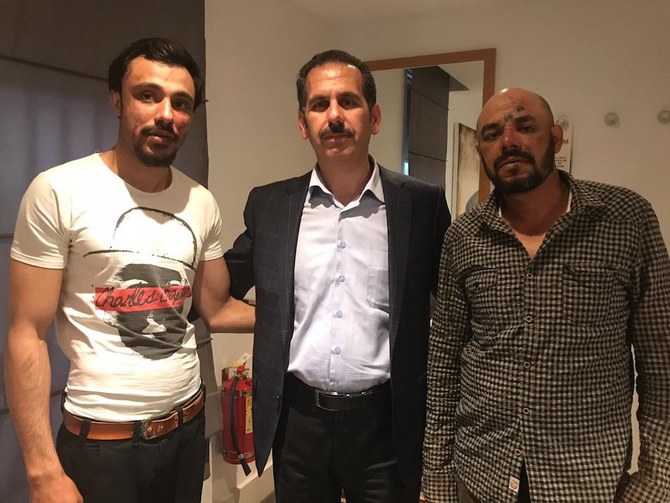
The Jordanian ambassador to Kazakhstan poses with injured workers after he traveled to the oil field. (Jordanian Foreign Ministry)
3 / 3
(A screengrab from one of the many videos of the violence circulated on social media. (Twitter)
Updated 01 July 2019
Follow

Lebanon and Jordan urge Kazakhstan to protect oil-field workers after mass brawl injures dozens

  • Videos of the attacks on Arab engineers and workers were widely circulated on social media in Arab countries
  • Jordan’s ambassador travels to the oil field to meet the injured workers

JERUSALEM/MOSCOW: A brawl between Kazakh workers and their Arab colleagues in one of Kazakhstan's largest oil fields injured 30 people and sparked an outcry in Jordan and Lebanon.

Videos of the attacks on Arab engineers and workers were widely circulated on social media in Arab countries. The scenes showed them being kicked and punched by large numbers of local colleagues. Some of those attacked were covered in blood and their faces suffering serious bruises.

The attacks happened after Eli Daoud, an engineer from Lebanon, posted a short video on social media featuring a Kazakh woman.  He put his hand over the woman’s mouth while he was speaking on his walkie-talkie, which some locals felt was insulting to their country.

Later Daoud said: “I apologize to my friends and the people of Kazakhstan, a country I have been working in for two years. The video was not meant to be insulting to my colleagues.”

The engineers work for CCC, the Middle East’s largest construction company, which employs more than 100 Jordanian, Palestinian and Lebanese staff in Kazakhstan. The attack  on Saturday appears to have been a reprisal targeting all CCC’s Arab staff.

Interfax-Kazakhstan reported Sunday that the oilfield is managed by Tengizchevroil, TCO, a joint venture that includes Chevron and ExxonMobil.

Nurlan Nogayev, the governor of Atyrau region, said during a meeting with company management that the brawl resulted from disparities in working conditions between foreign contractors and local Kazakh employees.

Lebanese Prime Minister Saad Hariri ordered Secretary General of the High Relief Committee, Maj. Gen. Mohammad Kheir to follow the case.

Lebanon’s Defense Minister Elias Bou Saab also called his counterpart in Kazakhstan to discuss protecting the Lebanese workers.

Kheir told the local MTV television that the situation now is under control. He added that a total of 17 Arabs, including one Lebanese and six Palestinians using Lebanese travel documents, were among the injured.

Lebanon's ambassador to Kazakhstan Jescar Khoury told local media that all Lebanese citizens who worked at the oil field are now under police protection in a hotel in a nearby city.

In Jordan, Crown Prince Hussein asked the country's prime minister and minister for foreign affairs to follow the case of Jordanian citizens.

The Kingdom’s ambassador traveled to the oil field to meet the injured workers.

A foreign ministry spokesman said Saturday they requested that the Kazakh authorities provide “all necessary measures to provide immediate security protection for the Jordanian citizens.” Jordan’s ambassador to Kazakhstan, Yousef Abdel Ghani, met the engineers on Sunday.

Jordanian MP Khalil Attiyeh called on Prime Minister Omar Razzaz to lodge an official complaint with the Kazakh government. “This is an unacceptable attack and I call on the government to send an official delegation to follow up on the case of Jordanians in general, and those injured in particular, and ensure their safe return to the homeland,” he said.

(With AP)


Sudan paramilitary used mass graves to conceal war crimes: ICC deputy prosecutor

Updated 2 sec ago
Follow

Sudan paramilitary used mass graves to conceal war crimes: ICC deputy prosecutor

UNITED NATIONS: Sudan’s paramilitary Rapid Support Forces carried out mass killings in Darfur and attempted to conceal them with mass graves, the International Criminal Court’s deputy prosecutor said on Monday.
In a briefing to the UN Security Council, Nazhat Shameem Khan said it was the “assessment of the office of the prosecutor that war crimes and crimes against humanity” had been committed in the RSF’s takeover of the city of El-Fasher in October.
“Our work has been indicative of mass killing events and attempts to conceal crimes through the establishment of mass graves,” Khan said in a video address, citing audio and video evidence as well as satellite imagery.
Since April 2023, a civil war between the Sudanese army and the RSF has killed tens of thousands, displaced 11 million and created the world’s largest displacement and hunger crisis.
Reports of mass killings, sexual violence, abductions and looting emerged in the wake of the RSF’s sweep of El-Fasher, which was the army’s last holdout position in the Darfur region.
Both warring sides have been accused of atrocities throughout the war.
Footage reviewed by the ICC, Khan said, showed RSF fighters detaining, abusing and executing civilians in El-Fasher, then celebrating the killings and “desecrating corpses.”
According to Khan, the material matched testimony gathered from affected communities, while submissions from civil society groups and other partners had further corroborated the evidence.
The atrocities in El-Fasher, she added, mirror those documented in the West Darfur capital of El-Geneina in 2023, where UN experts determined the RSF killed between 10,000 and 15,000 people, mostly from the Massalit tribe.
She said a picture was emerging of “appalling organized, widespread mass criminality.”
“It will continue until this conflict and the sense of impunity that fuels it are stopped,” she added.
Khan also issued a renewed call for Sudanese authorities to “work with us seriously” to ensure the surrender of all individuals subject to outstanding warrants, including former longtime president Omar Al-Bashir, former ruling party chairman Ahmed Haroun and ex-defense minister Abdul Raheem Mohammed Hussein.
She said Haroun’s arrest in particular should be “given priority.”
Haroun faces 20 counts of crimes against humanity and 22 war-crimes charges for his role in recruiting the Janjaweed militia, which carried out ethnic massacres in Darfur in the 2000s and later became the RSF.
He escaped prison in 2023 and has since reappeared rallying support for the Sudanese army.
Khan spoke to the UN Security Council via video link after being denied a visa to attend in New York due to sanctions in place against her by the United States.