ABU DHABI: UN chief Antonio Guterres said climate-related devastation was striking the planet on a weekly basis and warned Sunday that urgent action must be taken to avoid a catastrophe.
“We are here because the world is facing a grave climate emergency,” Guterres told a two-day Abu Dhabi Climate Meeting to prepare for a Climate Action Summit in New York in September.
“Climate disruption is happening now... It is progressing even faster than the world’s top scientists have predicted,” the UN secretary general said.
“It is outpacing our efforts to address it. Climate change is running faster than we are,” he said.
“Every week brings new climate-related devastation... floods, drought, heatwaves, wildfires and super storms,” Guterres said.
He warned the situation would only deteriorate unless “we act now with ambition and urgency,” but some of the world’s decision-makers still did not realize the dangers.
The UN chief held out hope in the Paris Agreement to cut harmful emissions and reduce global warming.
“But we know that even if the promises of Paris are fully met, we still face at least a three-degree temperature rise by the end of the century — a catastrophe for life as we know it,” Guterres said.
He was convening the Climate Action Summit because many countries were not even keeping pace with their promises under the Paris Agreement.
Under the Paris Agreement, the world is required to keep temperature rise under 2 degrees Celsius by the end of the century.
A landmark report last year by the Intergovernmental Panel on Climate Change (IPCC) said a safer cap of a 1.5 degree rise would see nations rapidly slash planet-warming greenhouse gas emissions via a sharp drawdown of fossil fuel use.
But some high-polluting nations, led by Saudi Arabia, have questioned the IPCC’s findings, leading to angry exchanges at closed-door talks in Bonn.
It is thought that $300 billion will be needed annually by 2030 to help nations deal with climate-related disasters.
IPCC warned in October that warming was on track toward a catastrophic 3C or 4C rise, and that avoiding global chaos would require a major transformation.
“The Climate Action Summit is an opportunity for political, business and civil society leaders to set an example,” Guterres said.

UN chief urges action to avert climate change ‘catastrophe’
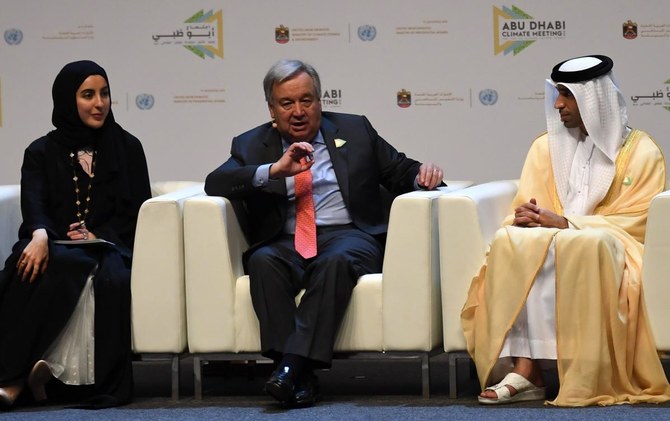
- The UN chief held out hope in the Paris Agreement to cut harmful emissions and reduce global warming
- Under the Paris Agreement, the world is required to keep temperature rise under 2 degrees Celsius by the end of the century
Chinese visitors to Japan slump as spat rumbles on
TOKYO: Mainland Chinese visitors to Japan tumbled 60.7 percent in January year-on-year, figures showed Wednesday, in the continued fallout from the countries’ diplomatic spat.
“Last year, the lunar new year began in late January, but this year it fell in mid-February,” the Japan National Tourism Organization said as it published the data.
“Additionally, the Chinese government issued a warning advising against travel to Japan. Factors such as reduced flight frequencies also contributed to the number of foreign visitors to Japan falling below the level of the same month last year,” a statement said.
Previously Chinese visitors were the biggest contingent, contributing to a tourism boom in the land of cherry blossom and Mount Fuji that was fueled by a weak yen making shopping cheap.
But in January this year, South Korea was the biggest source with 1.2 million visitors, up 21.6 percent, compared with 385,300 from mainland China, down from 980,520 in January 2025.
Visitors from Hong Kong also tumbled 17.9 percent.
Overall the number of visitors to Japan fell 4.9 percent to 3.597 million in January compared to the same period last year.
Prime Minister Sanae Takaichi suggested in November that Japan could intervene militarily if Beijing sought to take Taiwan by force.
China, which regards the democratic island as part of its territory and has not ruled out force to annex it, was furious.
Beijing summoned Tokyo’s ambassador and on November 14 warned Chinese citizens against visiting Japan, citing “significant risks to the personal safety and lives of Chinese citizens.”
The number of Chinese visitors to Japan already tumbled 45 percent in December to 330,000.
In December, J-15 jets from China’s Liaoning aircraft carrier twice locked radar on Japanese aircraft in international waters near Okinawa, according to Japan.
China also tightened controls on exports to Japan for items with potential military uses, fueling worries that Beijing may choke supplies of vital rare-earth minerals.
Japan’s last two pandas were even returned to China last month.
Takaichi, 64, was seen as a China hawk before becoming Japan’s first woman prime minister in October.
She won a landslide victory in snap elections on February 8, putting her in a strong position for the next four years to stamp her mark on Japanese domestic and foreign policy.
Takaichi said after her election win that Tokyo would bolster its defenses and “steadfastly protect” its territory.
She also said she was “open to various dialogues with China.”
But China’s foreign ministry said “genuine dialogue should be built on respect for one another.”
“Proclaiming dialogue with one’s mouth while engaging in confrontation — no one will accept this kind of dialogue,” foreign ministry spokesman Lin Jian said Tuesday.
Beijing’s top diplomat Wang Yi told the Munich Security Conference on Saturday that forces in Japan were seeking to “revive militarism.”


