At least 15 killed in western India wall collapse

1 / 3
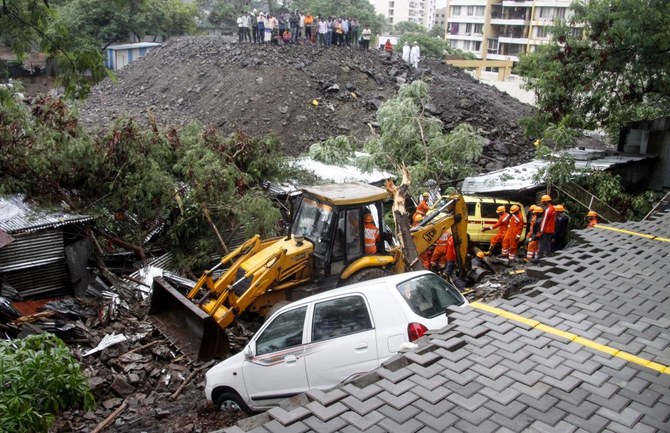
Indian rescue workers look for survivors at the site of a wall collapse in Pune on June 29, 2019. (AFP)
2 / 3
A damaged vehicle is seen at the site of a wall collapse in Pune on June 29, 2019. (AFP)
3 / 3
This handout photo taken on June 29, 2019 and released by the Pune Fire Brigade shows Indian rescue workers searching for survivors at the site of a wall collapse in Pune. (AFP/Pune Fire Brigade)
Updated 29 June 2019
Follow

At least 15 killed in western India wall collapse

  • Most of those who died were sleeping when the 3 meter (10-foot) high brick wall came crashing down on several tin cabins built for a group of laborers
  • Two people were also injured in the accident and are “undergoing treatment at a hospital”

NEW DELHI: At least 15 people, including four children, were killed when a wall collapsed on shacks outside an apartment complex in western India, police said.
Most of those who died were sleeping when the 3 meter (10-foot) high brick wall came crashing down on several tin cabins built for a group of laborers who had work at a nearby construction site, according to police.
Two people were also injured in the accident and are “undergoing treatment at a hospital,” a local police official told AFP.
He said a search was on to find any survivors.
The shacks, located in the city of Pune in Maharashtra state, were mostly occupied by migrant workers from India’s north.
Authorities have ordered an inquiry into the incident and announced a cash compensation to the families of those killed.
The city has seen two days of heavy rains.
India’s millions of laborers and their families often live either on construction sites or in temporary huts nearby to save on accommodation costs.
It is the latest in a series of deadly building accidents in India that mostly occur during the rainy season that runs from June to September.
More than a dozen devotees were killed on Sunday after a tent collapsed on them during a religious event in western Rajasthan state.
In 2017, a wall collapsed collapse onto guests celebrating a wedding in Rajasthan state, killing two dozen people.


Taiwan says Chinese drone made ‘provocative’ flight over South China Sea island

Updated 11 sec ago
Follow

Taiwan says Chinese drone made ‘provocative’ flight over South China Sea island

TAIPEI: A Chinese reconnaissance drone briefly flew over the Taiwan-controlled Pratas Islands at the top end of the South China Sea on Saturday, in ​what Taiwan’s defense ministry called a “provocative and irresponsible” move.
Democratically governed Taiwan, which China claims as its own territory, reports Chinese military activity around it on an almost daily basis, including drones though they very rarely enter Taiwanese airspace.
Taiwan’s defense ministry said the Chinese reconnaissance drone was detected around dawn on Saturday ‌approaching the Pratas ‌Islands and flew in its ‌airspace ⁠for ​eight ‌minutes at an altitude outside the range of anti-aircraft weapons.
“After our side broadcast warnings on international channels, it departed at 0548,” it said in a statement.
“Such highly provocative and irresponsible actions by the People’s Liberation Army seriously undermine regional peace and stability, violated international legal ⁠norms, and will inevitably be condemned,” it added.
Taiwan’s armed forces will ‌continue to maintain strict vigilance and monitoring, ‍and will respond in ‍accordance with the routine combat readiness rules, the ‍ministry said.
Calls to China’s defense ministry outside of office hours on a weekend went unanswered.
In 2022, Taiwan’s military for the first time shot down an unidentified civilian drone that ​entered its airspace near an islet off the Chinese coast controlled by Taiwan.
Lying roughly between ⁠southern Taiwan and Hong Kong, the Pratas are seen by some security experts as vulnerable to Chinese attack due to their distance — more than 400 km (250 miles) — from mainland Taiwan.
The Pratas, an atoll which is also a Taiwanese national park, are only lightly defended by Taiwan’s military, but lie at a highly strategic location at the top end of the disputed South China Sea.
China also views the Pratas as its ‌own territory.
Taiwan’s government rejects Beijing’s sovereignty claims.