

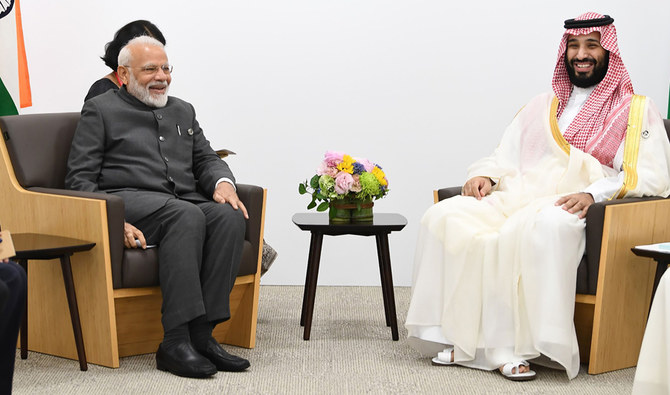
Saudi Crown Prince Mohammed bin Salman announces Hajj gift for India with 30,000 increase in quota

Saudi Crown Prince Mohammed bin Salman with Indian Prime Minister Narendra Modi during the G20 Summit in Osaka on Friday. (AFP/Indian Ministry of Foreign Affairs)
Updated 29 June 2019
Follow

Saudi Crown Prince Mohammed bin Salman announces Hajj gift for India with 30,000 increase in quota

  • The total figure rises to 200,000 per year
  • The meeting took place in Osaka where the yearly G20 summit is taking place

NEW DELHI: Saudi Arabia has increased India’s Hajj quota by 30,000, lifting the figure to 200,000 per year. The enhanced quota means India will send the second-highest number of pilgrims for Hajj after Indonesia. 

Saudi Crown Prince Mohammed bin Salman decided to raise the quota after a bilateral meeting with Indian Prime Minister Narendra Modi in the Japanese city of Osaka.

Vijay Gokhale, India’s foreign secretary, said that the “crown prince has promised PM Modi the quota will be increased.”

“This is important and this has been done,” he said

India’s Minority Affairs Minister Mukhtar Abbas Naqvi said the increase was a result of Modi’s “cordial and friendly” relations with the Saudi leadership.

“This is the third hike in three years. When the Modi government came to power in 2014, India’s Hajj quota was 136,000. That has now been increased to 200,000,” he said.

Dr. Ausaf Sayeed, India’s ambassador to Saudi Arabia, welcomed the crown prince’s decision.

“We are grateful to the Kingdom for increasing the Hajj quota. This will be the highest number of pilgrims to be handled by the Indian Hajj mission in its history,” he told Arab News. “The decision reflects the increasingly close and developing strategic relationship between the two countries, which has taken an upward trajectory in the recent years,” he said.

“We are geared up to receive the Indian Hajj pilgrims starting from July 4, 2019. The Saudi leadership involved in Hajj management, including Makkah Gov. Prince Khaled Al-Faisal and Hajj Minister Mohammed Salih Bentin, have promised to make Indian pilgrims’ stay in the Kingdom as comfortable as possible.”

Anwar Sadat, a New Delhi resident, also welcomed the increase in the quota. “I waited for three years before my turn came to perform Hajj. The increase of 30,000 is significant ... I feel that the quota should go up further.”


Between deadlines and devotion — how Saudi professionals balance work, worship during Ramadan

Updated 9 sec ago
Follow

Between deadlines and devotion — how Saudi professionals balance work, worship during Ramadan

ALKHOBAR: For working professionals, the month of Ramadan reshapes the Saudi workday — and the actual structure of the day itself.

Under Saudi labor regulations, working hours for employees are reduced during Ramadan to a maximum of six hours per day, or 36 hours per week. In practice, this often translates into office schedules beginning around 9 or 10 a.m. and ending mid-afternoon. The adjustment is designed to ease the strain of fasting, but deadlines and performance expectations remain unchanged.

“I plan my entire day around conserving energy,” said Lina Al-Faraj, a marketing manager in Riyadh. “I schedule heavy tasks at the start of my workday and leave lighter administrative work for later. If I don’t structure it, the day drains me.”

In offices across the country, meetings are pushed to the first half of the day. Critical decisions are addressed early, before energy levels dip in the afternoon. Tasks that might normally stretch across a full schedule are condensed into tighter windows.

Yet client demands, internal targets and project timelines do not pause for Ramadan.

“I’m less productive in the late afternoon, but more focused at night,” said Khaled Al-Tamimi, an operations supervisor in the Eastern Province. “Ramadan taught me to work smarter, not longer. You have to prioritize differently.”

Employees balance deadlines with devotion, protecting prayer time while maintaining performance expectations during fasting hours. (Pexels)

Sleep patterns shift alongside office hours. Many professionals divide rest into shorter segments, sleeping after taraweeh prayers and again before dawn. Others take brief midday naps when possible. The result is a recalibrated rhythm that blends work obligations with worship.

Employers vary in their approach. Some organizations offer additional flexibility, such as staggered start times or limited remote arrangements, while others maintain standard expectations despite reduced hours.

“After taraweeh is our peak,” said Aisha Al-Mansour, a barista in Jeddah. “The cafe fills up fast. I pray before my shift starts and try to stay focused through the rush. Ramadan doesn’t slow us down; it just changes when the pressure comes.”

Reduced hours can sharpen focus. With less time available, meetings are shorter and agendas clearer. Nonessential tasks are deferred. Communication becomes more direct.

Still, the experience differs by sector. Office-based roles may benefit from compressed schedules, but customer-facing and operational positions often face steady demand throughout the day.

In hospitality, retail and marketing, Ramadan can coincide with heightened commercial activity, particularly in the evening. Employees in these sectors sometimes extend their availability after sunset to meet client needs or manage peak periods.

“I sometimes log back in after taraweeh to finalize campaigns,” Al-Faraj said. “It’s quieter. I can focus. But it means the workday stretches.”

Digital tools ease some of the strain. Messaging platforms reduce the need for long in-person meetings, while project management apps allow tasks to be completed asynchronously. Video conferencing limits commuting time. These adjustments help professionals manage workload within shortened official hours.

Workplace culture also shifts. Managers are more mindful of scheduling around maghrib and taraweeh. Prayer spaces see higher attendance. Teams communicate more intentionally as energy fluctuates.

The balance between devotion and deadlines becomes visible in practical decisions: shorter meetings, revised launch dates and realistic daily targets.

Previous Arab News reporting on Ramadan workplace routines has highlighted similar patterns, with professionals describing compressed schedules and the need to build structured routines around fasting hours. The adjustments are seasonal, but they are consistent.

Ramadan reorganizes workplace pressure. Energy fluctuates. Time is condensed. Priorities become clearer.

For many professionals, the month reinforces discipline rather than diminishing output. Limited hours encourage sharper planning. Morning focus becomes more valuable. Distractions are reduced.

Al-Tamimi said the lessons are often carried beyond the holy month. “After Eid, I keep some of the habits,” he said. “I protect my mornings. I avoid unnecessary meetings. Ramadan reminds you that time is limited.”

Ramadan highlights both operational strain and adaptive resilience within Saudi workplaces. It shows how productivity can shift without collapsing, and how structure can compensate for reduced hours.

Between meetings and maghrib, spreadsheets and suhoor, professionals across the Kingdom negotiate a balance that is neither purely economic nor spiritual.

Deadlines remain. Worship deepens. Schedules adjust.

And for 30 days each year, the Saudi workday follows a different rhythm — one defined not only by business hours, but by belief.