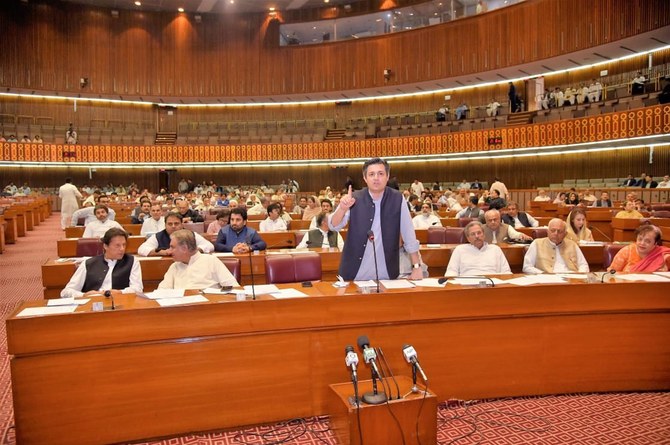
ISLAMABAD: Pakistan’s National Assembly on Friday accorded a formal approval to the federal budget for fiscal year 2019-20 with a total outlay of $54 billion amid protests by members of the opposition parties.
Prime Minister Imran Khan’s government managed to get the budget passed with a majority vote following an extensive debate that lasted for over two weeks. The government said the budget would focus on fiscal consolidation, revenue mobilization, austerity measures and protection of vulnerable segments of society.
The federal budget sailed through parliament, defeating the combined opposition’s bid to block its passage before the International Monetary Fund’s board members convene on July 3 to give formal approval to $6 billion loan to Pakistan.
The opposition parties’ move to block the presentation of the bill for final voting was rejected by the house with 175 votes by treasury members against 146 votes of the opposition members.
“Our government has retired record foreign loans worth of $9.5 billion during the current fiscal year which had never been done by any government in a single year,” Hammad Azhar, minister of state for revenue, said while responding to criticism by the opposition parties.
He said that his government had reduced civil expenditures up to five percent, adding that annual expenditure of the Prime Minister House had also been cut as part of the austerity drive of the government.
“We have reduced the current account deficit by 20 percent and trade deficit by $4 billion,” he said, clarifying that his government had imposed no new taxes on cooking oil.
The government incorporated some amendments in the finance bill proposed by members of the treasury benches while rejecting those by the opposition members, most of which pertained to changes in tax rates on food items and construction material, tax exemptions and abolition of interest on bonds.
The opposition members participated in the budget session wearing black armbands to record their protest against what they called the “IMF Obedience Act 2019.”
Earlier, while taking part in the budget debate, former prime minister and senior leader of Pakistan Muslim League-Nawaz (PML-N) Shahid Khaqan Abbasi criticized the government for what he called its inefficiency and inability to steer the country out of economic crisis.
“People of Pakistan and the opposition reject this budget,” he said, adding the recent sharp devaluation of rupee against the US dollar would add Rs4,000 billion in the circular debt alone.
Pakistan Peoples Party’s senior lawmaker Naveed Qamar questioned the government’s ability to meet the tax collection target of $36 billion. “There is no investment in the market and how can you meet the tax collection target,” he said, adding that the government had also failed to improve the capacity of the Federal Board of Revenue, the government body responsible for collecting taxes.
Prime Minister Imran Khan along with federal ministers and members of the allied parties remained present in the session that continued for several hours. Former president Asif Ali Zardari, leader of opposition Shehbaz Sharif and Bilawal Bhutto Zardari attended the session with full strength of the members of their respective parties.
The finance bill now awaits presidential assent to come into effect from July 1 for the next fiscal year.


![]()

After two weeks of debate, Pakistan parliament passes budget with majority vote
After two weeks of debate, Pakistan parliament passes budget with majority vote
- Government has targeted a sharp hike in tax revenues
- Opposition members have been participating in budget debate wearing black armbands
Latest updates


Recommended


© 2026 SAUDI RESEARCH & PUBLISHING COMPANY, All Rights Reserved And subject to Terms of Use Agreement.