

UN wants US, Russia to move Syria peace process

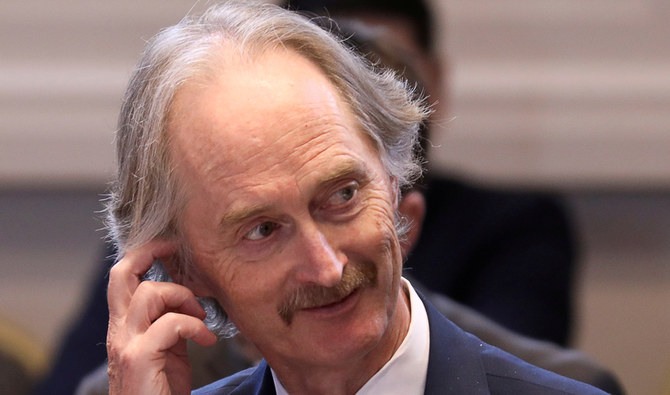
United Nations Special Envoy to Syria Geir Pedersen. (File/Reuters)
Updated 28 June 2019
Follow

UN wants US, Russia to move Syria peace process

  • UN envoy trying to arrange a body to reform Syria’s constitution

GENEVA: “A deeper understanding” between Russia and the US is needed to move the Syrian peace process forward, UN Syria envoy Geir Pedersen said in an interview published on Thursday.

Successive UN envoys have failed to stop Syria’s eight-year war, which has caused hundreds of thousands of deaths and led to an exodus of refugees.

Pedersen, the fourth man in the job, is trying to arrange a committee to oversee the reform of Syria’s constitution — a modest effort, compared with former UN Secretary-General Kofi Annan’s attempt to reach a peace agreement at an international conference in 2012.

“Obviously, a Constitutional Committee in itself will not change much,” Pedersen said in an interview published by the Geneva-based Center for Humanitarian Dialogue. “But if handled correctly, and if there is political will, it could be a door-opener for a broader political process.

HIGHLIGHTS

Successive UN envoys have failed to stop Syria’s eight-year war, which has caused hundreds of thousands of deaths and led to an exodus of refugees.

He told the key players that he needed “a different international setup,” Pedersen said, and wanted to convene a group of influential states alongside the Constitutional Committee meeting.

It would include the five permanent UN Security Council members and two groups of countries that have been politically active on Syria: The “Astana Group” comprising Iran and Turkey as well as Russia, and the “Small Group,” which includes Egypt, Germany, Jordan, Saudi Arabia, France, Britain and the US.

“This is indicative of the fact that we are in a new phase ... this has been going on for too long, and it should be possible to move forward. This would, of course, require a deeper understanding between Russia and the US on how to move forward,” he said. “We are also working on that.”

The UN envoy said he had pressed the Syrian regime and the opposition Syrian National Commission on the importance of tackling the issue of people who had been detained or abducted or were missing, and he had appealed to them for “bigger unilateral steps on this.”


Tunisian police arrest member of parliament who mocked president

Updated 05 February 2026
Follow

Tunisian police arrest member of parliament who mocked president

  • Ahmed Saidani mocked the president in a Facebook post, describing him as the “supreme commander of sewage and rainwater drainage”

TUNIS: Tunisian police arrested lawmaker Ahmed Saidani on Wednesday, two of his colleagues ​said, in what appeared to be part of an escalating crackdown on critics of President Kais Saied.
Saidani has recently become known for his fierce criticism of Saied. On Tuesday, he mocked the president in a Facebook post, describing him as the “supreme commander of sewage and rainwater drainage,” blasting what he said ‌was the absence ‌of any achievements by Saied.
Saidani ‌was ⁠elected ​as ‌a lawmaker at the end of 2022 in a parliamentary election with very low voter turnout, following Saied’s dissolution of the previous parliament and dismissal of the government in 2021.
Saied has since ruled by decree, moves the opposition has described as a coup.
Most opposition leaders, ⁠some journalists and critics of Saied, have been imprisoned since he ‌seized control of most powers in 2021.
Activists ‍and human rights groups ‍say Saied has cemented his one-man rule and ‍turned Tunisia into an “open-air prison” in an effort to suppress his opponents. Saied denies being a dictator, saying he is enforcing the law and seeking to “cleanse” the country.
Once a supporter ​of Saied’s policies against political opponents, Saidani has become a vocal critic in recent months, accusing ⁠the president of seeking to monopolize all decision-making while avoiding responsibility, leaving others to bear the blame for problems.
Last week, Saidani also mocked the president for “taking up the hobby of taking photos with the poor and destitute,” sarcastically adding that Saied not only has solutions for Tunisia but claims to have global approaches capable of saving humanity.
Under Tunisian law, lawmakers enjoy parliamentary immunity and cannot be arrested for carrying out their ‌duties, although detention is allowed if they are caught committing a crime.