

Saudi Arabia reaffirms commitment to world market oil supply after Korea visit

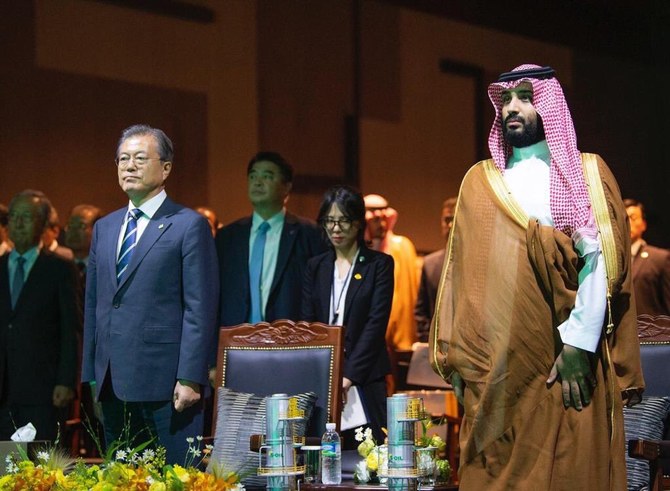
Crown Prince Mohammed bin Slaman's visit to Korea included deals between Saudi Aramco and Korean company S-Oil. (Saudi Foreign Ministry)
Updated 28 June 2019
Follow

Saudi Arabia reaffirms commitment to world market oil supply after Korea visit

  • Statement comes in a joint communique from Crown Prince Mohammed bin Salman's visit to South Korea
  • The countries signed an $8.3 billion economic cooperation pact that included a $6 billion deal between Saudi Aramco and the Korean company S-Oil

RIYADH: Saudi Arabia said it was committed to ensuring world markets are supplied with oil after Crown Prince Mohammed bin Salman visited South Korea.

The Kingdom also confirmed its commitment to compensating for shortages that may occur as a result of any supply disruptions from other sources.

In a joint communique issued by Saudi Arabia and South Korea on Thursday, the Kingdom said that as “the world’s largest reliable source of oil,” it would make sure that oil markets were well supplied.

South Korea, the world’s fifth-largest importer of crude oil, depends on the Middle East for the vast majority of its supplies.

Asian countries have been worried about oil supply after two tankers were attacked in the Gulf of Oman this month. The attacks on the Japanese owned Kokuka Courageous and Norwegian Front Altair were blamed on Iran.

Saudi Arabia’s Crown Prince Mohammed bin Salman visited South Korea on Wednesday in a bid to strengthen economic ties between the two countries.

“Saudi Arabia, a key ally of South Korea, is the biggest oil supplier to our government and the largest economic partner among the Middle Eastern countries,” South Korean presidential spokeswoman Koh Min-jung said.

South Korea halted its Iranian oil imports in May as its waivers from US sanctions on Tehran expired.

The communique detailed the agreements made and meetings held by the two countries during the visit. 

The countries signed an $8.3 billion economic cooperation pact that included a $6 billion deal between Saudi Aramco and the Korean company S-Oil to build an oil refinery and downstream petrochemical facilities in South Korea.


Saudi Arabia’s foreign reserves rise to a 6-year high of $475bn

Updated 22 February 2026
Follow

Saudi Arabia’s foreign reserves rise to a 6-year high of $475bn

RIYADH: Saudi Arabia’s foreign reserves climbed 3 percent month on month in January to SR1.78 trillion, up SR58.7 billion ($15.6 billion) from December and marking a six-year high.

On an annual basis, the Saudi Central Bank’s net foreign assets rose by 10 percent, equivalent to SR155.8 billion, according to data from the Saudi Central Bank, Argaam reported.

The reserve assets, a crucial indicator of economic stability and external financial strength, comprise several key components.

According to the central bank, also known as SAMA, the Kingdom’s reserves include foreign securities, foreign currency, and bank deposits, as well as its reserve position at the International Monetary Fund, Special Drawing Rights, and monetary gold.

The rise in reserves underscores the strength and liquidity of the Kingdom’s financial position and aligns with Saudi Arabia’s goal of strengthening its financial safety net as it advances economic diversification under Vision 2030.

The value of foreign currency reserves, which represent approximately 95 percent of the total holdings, increased by about 10 percent during January 2026 compared to the same month in 2025, reaching SR1.68 trillion.

The value of the reserve at the IMF increased by 9 percent to reach SR13.1 billion.

Meanwhile, SDRs rose by 5 percent during the period to reach SR80.5 billion.

The Kingdom’s gold reserves remained stable at SR1.62 billion, the same level it has maintained since January 2008.

Saudi Arabia’s foreign reserve assets saw a monthly rise of 5 percent in November, climbing to SR1.74 trillion, according to the Kingdom’s central bank.

Overall, the continued advancement in reserve assets highlights the strength of Saudi Arabia’s fiscal and monetary buffers. These resources support the national currency, help maintain financial system stability, and enhance the country’s ability to navigate global economic volatility.

The sustained accumulation of foreign reserves is a critical pillar of the Kingdom’s economic stability. It directly reinforces investor confidence in the riyal’s peg to the US dollar, a foundational monetary policy, by providing SAMA with ample resources to defend the currency if needed.

Furthermore, this financial buffer enhances the nation’s sovereign credit profile, lowers national borrowing costs, and provides essential fiscal space to navigate global economic volatility while continuing to fund its ambitious Vision 2030 transformation agenda.