

Death penalty sought for 3 accused of murdering hikers in Morocco

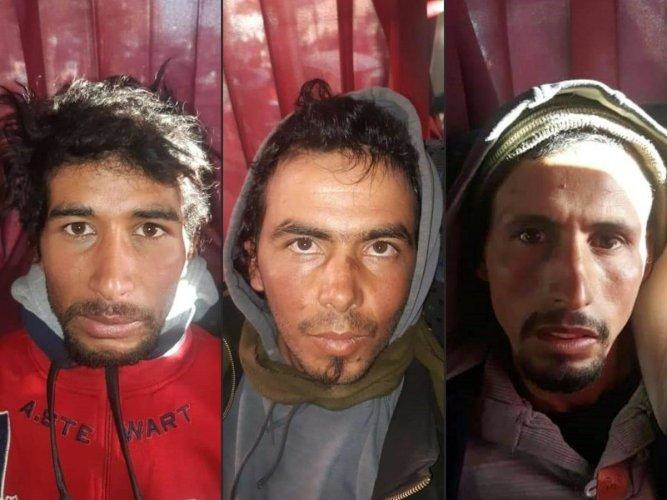
Rachid Afatti, left, Younes Ouaziyad, center, and Abdessamad Ejjoud, the three main suspects in the murder of two Scandinavian hikers. (AFP)
Updated 27 June 2019
Follow

Death penalty sought for 3 accused of murdering hikers in Morocco

  • The maximum sentence was sought for 25-year-old suspected ringleader Abdessamad Ejjoud and two radicalized Moroccans
  • The three admitted to killing Danish student Louisa Vesterager Jespersen, 24, and 28-year-old Norwegian Maren Ueland in the High Atlas mountains

SALÉ, Morocco: Moroccan prosecutors on Thursday called for the death penalty for the three main extremist suspects on trial for the “bloodthirsty” murder of two young Scandinavian hikers.
The maximum sentence was sought for 25-year-old suspected ringleader Abdessamad Ejjoud and two radicalized Moroccans, although the country has had a de facto freeze on executions since 1993.
The three admitted to killing Danish student Louisa Vesterager Jespersen, 24, and 28-year-old Norwegian Maren Ueland in the High Atlas mountains last December.
The prosecution called for jail terms of between 15 years and life for the 21 other defendants on trial before an anti-terror court in Sale, near Rabat.
The life sentence was sought for Abderrahim Khayali, a 33-year-old plumber, who had accompanied the three assailants but left the scene before the murders.
The prosecution called for 20 years in jail for Kevin Zoller Guervos, a Spanish-Swiss convert to Islam.
All but three of those on trial had said they were supporters of the Daesh group, according to the prosecution.
The three killers of the girls were “bloodthirsty monsters,” the prosecution said, pointing out that an autopsy report had found 23 injuries on Jespersen’s decapitated body and seven on that of Ueland.
Ejjoud, an underground imam, had confessed to beheading one of the girls and Younes Ouaziyad, a 27-year-old carpenter, the other, while Rachid Afatti, 33, had videoed the murders on his mobile.
Lawyers for the Danish victim’s family on Thursday accused authorities of having failed to monitor the activities of some of the suspects before the two women camped in an isolated mountain area had their throats slit.
The brutal killings could have been spared had authorities heeded information on the behavior of street vendor Ejjoud, they said.
The alleged ringleader who had been convicted for trying to join Daesh in Syria was released early from prison in 2015 and went on to meet former inmates and other individuals without checks by authorities, attorney Khaled El Fataoui said.
He alleged police had been informed of their activities but failed to act.
Lawyer Houssine Raji added the suspects met in Qur’anic schools run by cleric Mohamed Al-Maghraoui, which had been shut in 2010 under a court decision but ordered reopened in 2012 by the justice minister.
The lawyers demanded that Maghraoui and the then justice minister Mustapha Ramid be summoned for questioning, a request rejected by the court.
Investigators have said the “cell” was inspired by Daesh ideology, but Morocco’s anti-terror chief insisted the accused had no contact with the extremist group in conflict zones. 

Daesh has never claimed responsibility for the murders.


Junta leader Gen. Mamdi Doumbouya is declared winner of Guinea’s election, provisional results show

Updated 56 min 27 sec ago
Follow

Junta leader Gen. Mamdi Doumbouya is declared winner of Guinea’s election, provisional results show

  • Mamady Doumbouya took power in 2021 coup

CONAKRY, Guinea: Guinea coup leader ​Mamady Doumbouya has been elected president, according to provisional results announced on Tuesday, completing the return to civilian rule in the bauxite- and iron ore-rich West African nation.
The former special forces commander, thought to be in his early 40s, seized power in 2021, toppling then-President Alpha Conde, who had been in office since 2010. It was one in a series of nine coups that have reshaped politics in West and Central Africa since 2020.
The provisional results announced ‌on Tuesday showed Doumbouya ‌winning 86.72 percent of the December 28 vote, ‌an ⁠absolute majority ​that allows ‌him to avoid a runoff.
The Supreme Court has eight days to validate the results in the event of any challenge.
Doumbouya’s victory, which gives him a seven-year mandate, was widely expected. Conde and Cellou Dalein Diallo, Guinea’s longtime opposition leader, are in exile, which left Doumbouya to face a fragmented field of eight challengers.
Doumbouya reversed pledge not to run
The original post-coup charter in Guinea barred junta members from running ⁠in elections, but a constitution dropping those restrictions was passed in a September referendum.
Djenabou Toure, the ‌country’s top election official who announced the results on ‍Tuesday night, said turnout was 80,95 percent. However ‍voter participation appeared tepid in the capital Conakry, and opposition politicians rejected ‍a similarly high turnout figure for the September referendum.
Guinea holds the world’s largest bauxite reserves and the richest untapped iron ore deposit at Simandou, officially launched last month after years of delay.
Doumbouya has claimed credit for pushing the project forward and ensuring Guinea benefits ​from its output.
His government this year also revoked the license of Emirates Global Aluminium’s subsidiary Guinea Alumina Corporation following a refinery dispute, ⁠transferring the unit’s assets to a state-owned firm.
The turn toward resource nationalism — echoed in Mali, Burkina Faso and Niger — has boosted his popularity, as has his relative youth in a country where the median age is about 19.
Political space restricted, UN says
Political debate has been muted under Doumbouya. Civil society groups accuse his government of banning protests, curbing press freedom and restricting opposition activity.
The campaign period was “severely restricted, marked by intimidation of opposition actors, apparently politically motivated enforced disappearances, and constraints on media freedom,” UN rights chief Volker Turk said last week.
On Monday, opposition candidate Faya Lansana Millimono told a press conference the election was marred by “systematic fraudulent practices” and ‌that observers were prevented from monitoring the voting and counting processes.
The government did not respond to a request for comment.