Palestinian PM expects no political plan from US Bahrain workshop

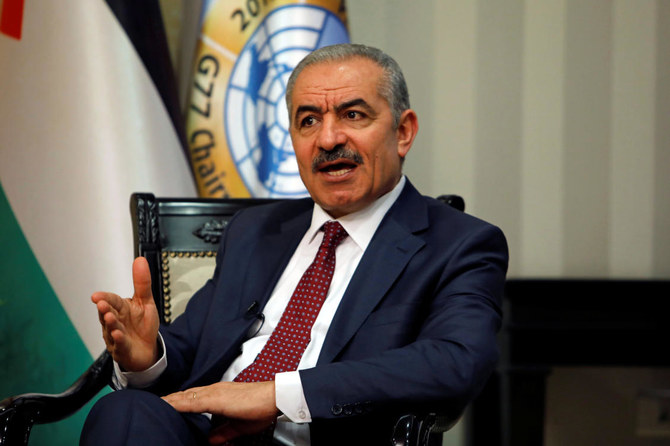
Palestinian Prime Minister Mohammad Shtayyeh said he felt Trump administration initiative “is not going to go anywhere.” (Reuters)
Updated 27 June 2019
Follow

Palestinian PM expects no political plan from US Bahrain workshop

  • Shtayyeh told says he felt the initiative 'will not really materialize and it’s not going to go anywhere'
  • Palestinian leaders boycotted the Bahrain conference and are refusing to engage with the White House

RAMALLAH: A day after the Trump administration wrapped up an international conference meant to lay the economic foundations for Israeli-Palestinian peace, the Palestinian premier said it was “divorced from reality” and unlikely to evolve into a political plan.
Washington billed the two-day workshop in Bahrain as the first stage of its broader blueprint to resolve the Middle East conflict. US Gulf Arab allies said the economic initiative had promise if a political settlement is reached.
But Palestinian Prime Minister Mohammad Shtayyeh told Reuters on Thursday he felt the initiative “will not really materialize and it’s not going to go anywhere.”
“Bahrain was just simply a terrible exercise. I think it’s an economic workshop that has been fully and totally divorced from reality,” he said in his office in the West Bank city of Ramallah. “(It was) no more than an intellectual exercise.”
The Bahrain “Peace to Prosperityt” workshop called for a $50 billion investment fund to stimulate the Palestinian and neighboring Arab state economies, more than half to be spent in the Palestinian territories over 10 years.
But Palestinian leaders boycotted the conference and are refusing to engage with the White House — accusing it of pro-Israel bias after US President Donald Trump recognized Jerusalem as Israel’s capital in 2017. The Palestinians demand East Jerusalem as the capital of a future state.
The political details of the long-delayed plan, which is spearheaded by Trump’s son-in-law Jared Kushner, remain a secret known only to a handful of people.
Kushner and Trump’s Mideast envoy Jason Greenblatt say the political elements will be unveiled later, possibly after a second snap Israeli election set for September.
But Palestinians fear the Trump team may abandon the “two-state solution,” which envisages the creation of an independent Palestinian state co-existing alongside Israel.
“We haven’t seen in the paper any reference to (Israeli) occupation, to settlements, to Palestine, to two states, to 1967 borders, to Jerusalem and so on,” Shtayyeh said. Of the Israelis, he said: “The debate in Israel today, it’s very unfortunate that it is not between those who want to end occupation and those who want to maintain occupation. The debate in Israel today is between those who want to maintain the status quo and those who want to annex certain parts of the West Bank.”
Israel captured the West Bank, East Jerusalem and the Gaza Strip in the 1967 Middle East war, territories where the Palestinians now seek statehood.
Days before an Israeli election in April, Prime Minister Benjamin Netanyahu pledged to annex Jewish settlements in the West Bank if he won.
Shtayyeh, a member of Palestinian President Mahmoud Abbas’s Fatah faction, was named in March to replace Rami Al-Hamdallah, who had spearheaded reconciliation efforts with Fatah’s principal internal rival, the Islamist Hamas, which rules Gaza.
Few doubt the economist Shtayyeh’s grasp of financial issues facing the Palestinian Authority (PA), which exercises limited self-rule in the West Bank. He formerly headed PECDAR, the Palestinian Economic Council for Development and Reconstruction.
But he inherited a government squeezed by steep US aid cuts, the crisis exacerbated by a political dispute with Israel over the withholding of some 5 percent of the approximately $190 million monthly tax revenues that Israel transfers to the Palestinian Authority.
The mounting financial pressures on the PA have sent its debt soaring to $3 billion, and led to a severe contraction in its estimated $13 billion GDP economy, according to the PA’s top central banker.
Shtayyeh said the fundamental economic problem was Israel’s continuing occupation of the West Bank, which meant Palestinians “don’t control our borders, we don’t control our entry points, our exit points, and we have no control of our land.”
The current financial crisis, he said, had been exacerbated by the tax dispute with Israel.
Israel said the sum it is withholding is to match stipends sent by the PA to families of Palestinian militants in Israeli jails, payments Israel says encourage attacks.
The PA has refused to accept any tax transfers until those funds are restored. The shortfall, Shtayyeh said, had contributed to the PA — the largest employer in the Palestinian Territories — having to cut its own civil servants salaries in half.
He warned that this situation could soon weaken the PA security forces that work closely with Israel’s military in the West Bank.
“Can we maintain this situation? I’m not sure about that. If the policeman has no petrol in his car, he will not be able to maintain law in order in the streets. That is where the problem is,” he said.


Hamas seeks role for its police in Gaza

Updated 7 sec ago
Follow

Hamas seeks role for its police in Gaza

  • Letter from Hamas assures its 40,000 civil servants and security forces that it is working to incorporate them into the new government
CAIRO: Hamas is seeking to incorporate its 10,000 police officers into a new US-backed Palestinian administration for Gaza, sources say, a demand likely to be opposed by Israel as the militant group debates whether to surrender its ​arms.
Islamist group Hamas retains control of just under half of Gaza following an October ceasefire deal brokered by US President Donald Trump.
The agreement ties further Israeli troop withdrawals to Hamas giving up its weapons.
The 20-point plan to end the war, now in its second phase, calls for the governance of Gaza to be handed to the National Committee for the Administration of Gaza, a Palestinian technocratic body with US oversight that is meant to exclude Hamas.

In a letter to staff on Sunday, seen by Reuters, Gaza’s Hamas-run government urged its more than 40,000 civil servants and security personnel to cooperate with the NCAG but assured them it was working to incorporate them into the new government.
That would include the roughly 10,000-strong Hamas-run police force, four sources familiar with the matter said, a demand that ‌has not been previously ‌reported. Many of them have been patrolling Gaza as Hamas reasserts its grip in areas ‌under its ⁠control.
It ​was not ‌immediately clear whether Israel, which has adamantly rejected any Hamas involvement in Gaza’s future, would agree to the civil and security workers’ inclusion in the NCAG.
Israeli Prime Minister Benjamin Netanyahu’s office did not respond to a request for comment.

Sticking points

Hamas’ plans for its police force and workers point to wide gaps between Hamas and Israel, backed by the US, as Trump pushes ahead with his plans. Last week, Trump hosted a signing ceremony to establish his “Board of Peace” that will serve as a transitional administration to set the framework and coordinate funding for the redevelopment of Gaza. The framework includes a provision barring “foreign terrorist organizations” from participating in governance.
Hamas spokesperson Hazem Qassem told Reuters the group was prepared to hand over governance to the ⁠15-member NCAG and its chair, Ali Shaath, with immediate effect.
“We (have) full confidence that it will operate on the basis of benefiting from qualified personnel and not wasting the rights of anyone who ‌worked during the previous period,” Qassem said, referring to the inclusion of the 40,000 ‍personnel.
The four sources said Hamas is open to the NCAG restructuring ‍ministries and sending some workers into retirement. Mass dismissals risked chaos, the sources said.
Hamas and NCAG Chair Shaath have not yet ‍met in person to discuss governance, a Hamas official said. Shaath’s office did not respond to a request for comment.
Another issue was whether Sami Nasman, the former Palestinian Authority general assigned to oversee security under the NCAG, would be able to operate effectively, a Palestinian official said.
Nasman, originally from Gaza, moved to the occupied West Bank after Hamas routed Palestinian Authority forces from the enclave in 2007 following a brief civil war. A Hamas court in Gaza later sentenced him ​in absentia, accusing him of instigating chaos. Nasman denies this.

Neutralizing arms

Trump’s administration wants to see heavy weapons decommissioned immediately, with “personal arms registered and decommissioned by sector as (the) NCAG police become capable of guaranteeing personal security,” according to a ⁠document shared by the White House last week. A US official said on Tuesday that Hamas fighters would be granted some sort of amnesty.
The militant group is still believed to possess rockets, which several diplomats estimated to number in the hundreds. It is also estimated to possess thousands of light weapons, including rifles.
Hamas recently agreed to discuss disarmament with other Palestinian factions and with mediators, sources said. However, two Hamas officials told Reuters that neither Washington nor the mediators had presented the group with any detailed or concrete disarmament proposal.
A Palestinian official close to the disarmament talks said the US had approached Hamas to explore potential disarmament mechanisms involving parties including Israel, Qatar, Egypt and Turkiye.
“Hamas has spoken about the possibility of neutralising arms, which could be achieved if there is a truce, and it is ready for a long-term ceasefire — five years or a little longer,” the official said.
“But Hamas strongly believes that a serious political negotiation process must begin on Palestinian statehood, whereby weapons and fighters would come under the authority of the State of Palestine,” the official said.
Hamas is not the only militant group in the enclave to possess arms. A source in a Gaza faction allied with Hamas ‌said other groups were discussing disarmament but worried about being left defenseless.
In remarks to parliament on Monday, Netanyahu said that the next phase of the Gaza deal “is not reconstruction.”
Rather, he said, “the next phase is demilitarization of the Strip and disarming Hamas.”