Islamabad: A meeting of opposition party leaders in Islamabad on Wednesday decided to unite to remove the chairman of the upper house of parliament through “constitutional means” as the beginning of a movement against the incumbent government of Prime Minister Imran Khan.
The Senate is the upper legislative house of the bicameral legislature of the country, with equal representation from all four provinces. In March last year, Sanjrani, a little-known opposition candidate, was elected chairman of the Senate with the support of the ruling Pakistan Tehreek-e-Insaf (PTI), the opposition Pakistan Peoples Party (PPP) and a block of independent Senators from Balochistan.
According to the party position in the 104-member house, opposition parties have the required strength to remove Sanjrani from his position by moving a no-confidence motion against him. Laws in Pakistan need ratification from both the Senate and the National Assembly and having a chairman of their choice would grant the opposition great leverage in politics.
In a day-long multiparty conference held here in Islamabad, members of opposition parties including the PPP, Pakistan Muslim League-Nawaz (PML-N), Jamiat Ulema-e-Islam-Fazal (JUI-F), Awami National Party (ANP) and others mulled ways to launch a movement against the PTI-led government.
“It is decided in the meeting that Chairman Senate will be removed through constitutional and legal means,” JUI-F chief Maulana Fazal-ur-Rehman told reporters after the conference, flanked by Leader of Opposition in the National Assembly Shehbaz Sharif and PPP chairman Bilawal Bhutto Zardari.
Rehman said a ‘Rehbar Committee’ had been constituted to “propose a unanimous nomination” for the new chairman of the Senate and said any such move would be done while upholding the supremacy of parliament, the constitution, rule of law and civilian rule.
Opposition parties also announced that they would launch a mass contact campaign against the government from July 25, the date of last year’s general elections.
“The meeting has demanded that institutions should not interfere in politics,” Rehman said in a veiled reference to the country’s security institutions, namely the army and its spy agencies, accused of supporting the PTI government in the pre and post election phase. The institutions vehemently deny the charge.
Rehman also demanded that the National Development Council (NDC), an economic body formed by the government this month with the army chief as a member, be dissolved.
“There is no need for it in the presence of the constitutional body, the National Economic Council,” he said.
“The need for struggle for the democratic rights of the people has been reiterated in the meeting,” Rehman said, demanding that the Election Commission of Pakistan (ECP) withdraw its notification that empowers the deployment of army troops inside polling stations during elections in Pakistan’s northwestern tribal districts on July 20.
Rehman said attendees of Wednesday’s meeting demanded an immediate end to the ongoing “revengeful accountability” going on in the country, in a veiled reference to cases against opposition politicians, and demanded a new law under which the accountability of all “who draw salaries from the national exchequer” be held.
The multiparty conference also unanimously rejected the government’s proposed ‘Debt Inquiry Commission’ and called it unconstitutional and an attack on parliament.


![]()

Opposition parties kick off anti-government drive by uniting to remove Senate chairman
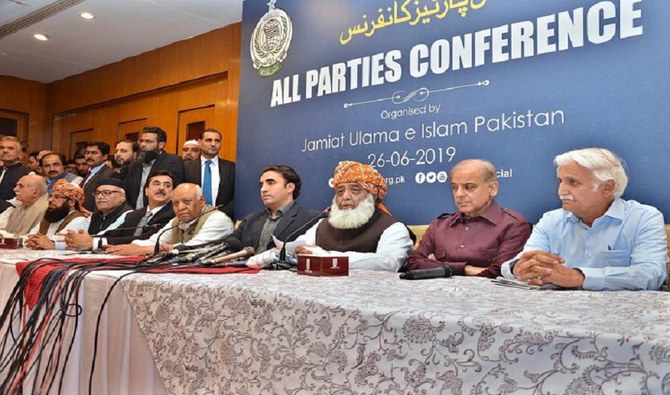
Opposition parties kick off anti-government drive by uniting to remove Senate chairman
- Announce mass contact campaign from July 25, the date of last year’s general elections
- Demand that new economic body formed by government with army chief as a member be dissolved
Latest updates


© 2026 SAUDI RESEARCH & PUBLISHING COMPANY, All Rights Reserved And subject to Terms of Use Agreement.