ISLAMABAD: The legal framework required to strengthen bilateral and economic ties between Abu Dhabi and Islamabad will be finalized during the next Joint Ministerial Commission meeting between the two countries, media reports said on Wednesday quoting UAE ambassador to Pakistan, Hamad Obaid Al-Zaabi.
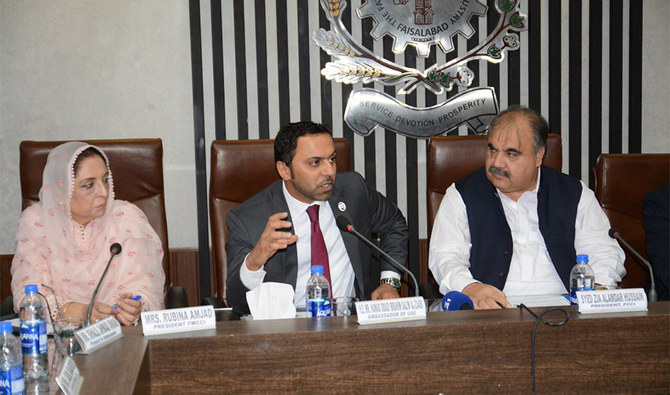
Alzaabi’s comments were part of an address to the Faisalabad Chamber of Commerce and Industry on Tuesday.
“… the UAE Ambassador to the Islamic Republic of Pakistan, meets Chairman and members of the Board of Directors of Textile Manufacturers Association in Faisalabad Punjab and discusses bilateral cooperation, joint work and enhancement of trade partnership,” the UAE Embassy tweeted on Tuesday.
“The United Arab Emirates is a pivotal economic partner of the #Faisalabad city in #Punjab province, which is considered an important industrial center and third largest city of #Pakistan and witnessing great economic, commercial and industrial activity,” excerpts from the tweet said.
Faisalabad is Pakistan’s third-largest metropolis, earning itself the moniker of being the country’s Manchester, for hosting the largest textile industries.
During his visit to Faisalabad, Alzaabi said that plans were in place to open UAE visa centers in Islamabad, Lahore and Karachi to facilitate Pakistani businessmen.
Pakistan and UAE enjoy close bilateral ties. Earlier this month, both countries agreed to set up a joint platform to expedite the resolution of grievances and legal disputes of overseas workers in the emirates.
According to statistics, more than 1.6 million Pakistani expatriates live in the UAE and work in different public and private departments. Additionally, more than $4 billion is remitted annually to Pakistan.


UAE on track to strengthen trade ties with Islamabad, envoy says
UAE on track to strengthen trade ties with Islamabad, envoy says

- Discusses measures during key meeting with businessmen in Faisalabad
- Plans in place to open visa centers across the emirates to facilitate businessmen from Pakistan

Rating firm S&P says it won’t rush Iran war downgrades, sees risks for countries like Pakistan
- Agency says it is monitoring indebted energy importers as higher oil prices strain finances
- Gulf economies seen better placed to weather shock, though Bahrain flagged as vulnerable
LONDON: S&P Global said it would not make any knee-jerk sovereign rating cuts following the outbreak of war in the Middle East, but warned on Thursday that soaring oil and gas prices were putting a number of already cash-strapped countries at risk.
The firm’s top analysts said in a webinar that the conflict, which has involved US and Israeli strikes against Iran and Iranian strikes against Israel, US bases and Gulf states, was now moving from a low- to moderate-risk scenario.
Most Gulf countries had enough fiscal buffers, however, to weather the crisis for a while, with more lowly rated Bahrain the only clear exception.
Qatar’s banking sector could also struggle if there were significant deposit outflows in reaction to the conflict, although there was no evidence of such strains at the moment, they said.
“We don’t want to jump the gun and just say things are bad,” S&P’s head global sovereign analyst, Roberto Sifon-Arevalo, said.
The longer the crisis was prolonged, though, “the more difficult it is going to be,” he added.
Sifon-Arevalo said Asia was the second-most exposed region, due to many of its countries being significant Gulf oil and gas importers.
India, Thailand and Indonesia have relatively lower reserves of oil, while the region also had already heavily indebted countries such as Pakistan, Bangladesh and Sri Lanka whose finances would be further hurt by rising energy prices.
“We are closely monitoring these (countries) to see how the credit stories evolve,” Sifon-Arevalo said.


