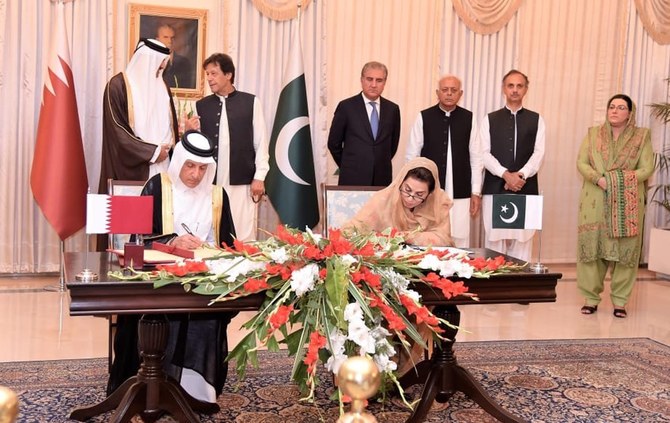
KARACHI: Pakistani stocks continued to extend losses on Tuesday, brokers said, despite an announcement a day earlier that Qatar would make $3 billion worth of new investments in Pakistan in the form of deposits and direct investments.
Following the latest investment pledge, the economic partnership between Qatar and Pakistan will reach $9 billion.
By midday Tuesday, Pakistani stocks were down 466 points, with weekly accumulated losses of 1119 points.
On Monday, too, the stock market declined by 653 points as “panic selling by investors over grim inflation and interest rate outlook and lack of positive triggers created a jittery atmosphere,” Muhammad Faizan Munshey, head of foreign institutional sales at Next Capital, said, adding that the news of the new Qatari investment had “failed to excite investors who preferred to exercise caution.”
The Oil and Gas Regulatory Authority has recommended major price hikes as part of prior-actions of an International Monetary Fund bailout agreed last month. The program, for a three-year, $6 billion rescue package, aims at shoring up Pakistan’s fragile public finances and strengthening a slowing economy.
Samiullah Tariq, Director Research at Arif Habib Limited, said investors were worried about the capabilities of the industrial sector and whether it would be able to withstand the impact of the gas price hike.
Analysts hope market sentiments will improve after the IMF executive board, scheduled to meet on July 3, gives its final approval to the loan program.
Ahead of a visit to Pakistan by the Emir of Qatar, Sheikh Tamim bin Hamad Al Thani, last weekend, media reported that $22 billion in investment deals would be signed between Islamabad and Doha. However, the Emir left after signing just three Memorandum of Understandings (MoUs) in the areas of trade and investment, tourism, and exchange of financial intelligence.
Pakistani Prime Minister Imran Khan’s government is seeking to stabilize its economy with loans from Gulf countries and international donors. Saudi Arabia earlier provided Pakistan with a $3 billion loan and a similar amount every year in oil supply on deferred payments. The United Arab Emirates also announced a $3 billion loan package.

Qatari $3billion investment pledge fails to lift Pakistani stocks
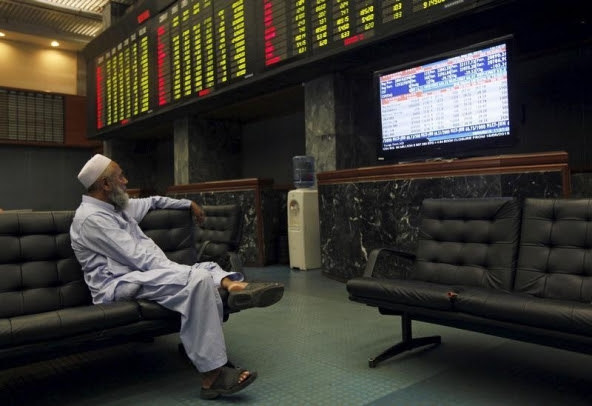
- By midday Tuesday, stocks were down 466 points
- News of Qatari funding did not excite investors, brokers said
Pakistan reports current account surplus in Jan. owing to improved trade, remittances
- Pakistan’s exports crossed the $3 billion mark in Jan. as the country received $3.5 billion in remittances
- Last month, IMF urged Pakistan to accelerate pace of structural reforms to strengthen economic growth
ISLAMABAD: Pakistan recorded a current account surplus of more than $120 million in January, the country’s finance adviser said on Tuesday, attributing it to improved trade balance and remittance inflows.
Pakistan’s exports rebounded in January 2026 after five months of weak performance, rising 3.73 percent year on year and surging 34.96 percent month on month, according to data released by the country’s statistics bureau.
Exports crossed the $3 billion mark for the first time in January to reach $3.061 billion, compared to $2.27 billion in Dec. 2025. The country received $3.5 billion in foreign remittances in Jan. 2026.
Khurram Schehzad, an adviser to the finance minister, said Pakistan reported a current account surplus of $121 million in Jan., compared to a current account deficit of $393 million in the same month last year.
“Improved trade balance in January 2026, strong remittance inflows, and sustained momentum in services exports (IT/Tech) continue to reinforce the country’s external account position,” he said on X.
Pakistan has undergone a difficult period of stabilization, marked by inflation, currency depreciation and financing gaps, and international rating agencies have acknowledged improvements after Islamabad began implementing reforms such as privatizing loss-making, state-owned enterprises (SOEs) and ending subsidies as part of a $7 billion International Monetary Fund (IMF) loan program.
Late last month, the IMF urged Pakistan to accelerate the pace of these structural reforms to strengthen economic growth.
Responding to questions from Arab News at a virtual media roundtable on emerging markets’ resilience, IMF’s director of the Middle East and Central Asia Jihad Azour said Islamabad’s implementation of the IMF requirements had been “strong” despite devastating floods that killed more than 1,000 people and devastated farmland, forcing the government to revise its 4.2 percent growth target to 3.9 percent.
“What is important going forward in order to strengthen growth and to maintain the level of macroeconomic stability is to accelerate the structural reforms,” he said at the meeting.
Azour underlined Pakistan’s plans to privatize some of the SOEs and improve financial management of important public entities, particularly power companies, as an important way for the country to boost its capacity to cater to the economy for additional exports.
“This comes in addition to the effort that the authorities have made in order to reform their tariffs, which will allow the private sector of Pakistan to become more competitive,” the IMF official said.


