

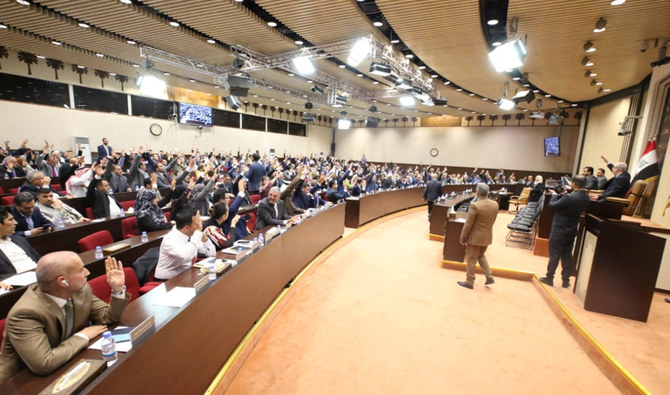

BAGHDAD: Iraq’s Parliament on Monday filled three key ministerial positions to end seven months of failed negotiations and political deadlock in the country.
The Parliament approved Najah Al-Shammari as defense minister, Yassin Al-Yassiri as interior minister and Farouq Amin Othman as justice minister. The three were sworn in on Monday.
The election of an education minister was postponed after its candidate was voted down.
In October, Iraq’s Parliament voted to confirm Prime Minister Adel Abdul Mahdi’s new government while leaving the four Cabinet posts unfilled, a move that underlined the country’s deep political divisions.
Parliamentary approval of the three ministers came on the eve of a deadline by Shiite cleric Moqtada Al-Sadr to the prime minister and leaders of political blocs to fill the vacant ministries.
Al-Sadr, one of the most influential clerics in the country, with millions of followers, a large armed faction and a parliamentary bloc, last week threatened to withdraw his support for the government if Abdul Mahdi failed to finalize his Cabinet within 10 days.
In response, Iraq’s leader rushed to provide a list of candidates to fill the vacant ministries.
Abdul Mahdi’s government resulted from an agreement between the parliamentary Reform coalition led by Al-Sadr and the pro-Iranian parliamentary Construction Coalition led by Hadi Al-Amiri, commander of the Badr Organization, one of the most powerful Shiite armed factions.
The two coalitions agreed to share ministries, support the government and vote for each other’s candidates, but a dispute erupted when Al-Amiri and his allies insisted on the nomination of Falih Al-Fayyadh, the current national security adviser, as interior minister. Al-Sadr and his allies within Reform rejected the nomination, saying Al-Fayadh was backed by Qassem Sulaimani, leader of Iran’s Revolutionary Guards.
The vote to fill the three ministerial vacancies is unlikely to end Iraq’s political turmoil, analysts warned.
“Now Abdul Mahdi can catch his breath until the next crisis,” Abdul Wahid Tuama, an independent analyst, told Arab News.
“Nothing will be changed after the election of these ministers. The performance of the government will not change and the problems facing the prime minister will not be resolved.
“The most important thing achieved today is that the pressure submitted by Al-Sadr on Abdul Mahdi and the heads of blocs will ease for a while.”


