SEOUL: North Korea raked in more than $120 million a year from a symbolic cross-border industrial zone that Pyongyang and Seoul are pushing to re-open as part of nuclear negotiations, a report said Monday.
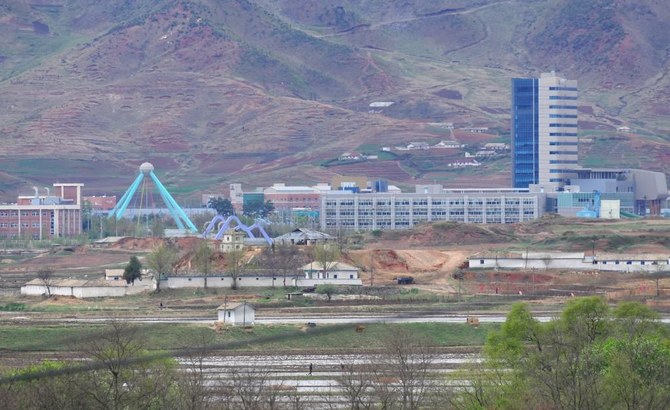
The Kaesong Industrial Complex — where around 55,000 North Korean workers churned out products ranging from watches to clothes for some 125 South Korean companies — was one of the most visible signs of reconciliation that followed the first inter-Korean summit in 2000.
But it was shuttered by the South’s then-conservative government in 2016 in response to a nuclear test and missile launches by the North, saying profits from Kaesong were funding Pyongyang’s provocations.
The South’s current President Moon Jae-in has dangled re-opening the complex as an incentive for Pyongyang to engage in denuclearization talks, but doing so is complicated by the web of international sanctions imposed on the North over its weapons programs.
At their Pyongyang summit in September, Moon and North Korean leader Kim Jong Un agreed to “normalize” operations at Kaesong when conditions were “ripe,” but negotiations between Pyongyang and Washington are now deadlocked and Northern media have pressed the South to implement joint economic projects.
The International Crisis Group called on Monday for the complex to be reopened with “a modest deal involving sanctions relief.”
Doing so would create “much needed momentum for stalled peace talks and serve as a reminder to both North and South Korea of the benefits of building a sustainable peace on the peninsula,” it added in a statement.
The factory zone gave the North foreign investment in its infrastructure, employment for its people and “much-needed revenue in hard currency,” it said in a report, while the South Korean businesses involved enjoyed cheap but high-quality labor — wages in China were 2.9 times higher in 2014.
In 2015, the year before it closed, South Korean firms paid the North around $123 million for their workers, ICG calculated.
The North taxed the sums at 30 percent and paid the workers 70 percent of the remainder in essential foodstuffs and coupons for state-run shops, the report said, citing the firms in Kaesong and the South’s unification ministry.
The rest was paid “in local currency at an artificially low official exchange rate,” it added.
Currently the North’s official exchange rate is around 80 times lower than the market rate. If a similar ratio applied to the Kaesong workers, they will have received in cash only around one quarter of one percent of the value paid to the North for their services, AFP calculates.
Profits from Kaesong were equivalent to only about 10 percent of what the North made from coal exports to China, ICG said, but “were nevertheless important... to a regime that needed all the cash it could get.”
“In this sense, reopening Kaesong would unquestionably be a concession to the North,” it added.


![]()

North Korea made $120 million a year from joint factory park: report
North Korea made $120 million a year from joint factory park: report
- The Kaesong Industrial Complex was one of the most visible signs of reconciliation that followed the first inter-Korean summit in 2000
- Around 55,000 North Korean workers churn out products ranging from watches to clothes for some 125 South Korean companies

Latest updates


Recommended



© 2026 SAUDI RESEARCH & PUBLISHING COMPANY, All Rights Reserved And subject to Terms of Use Agreement.