

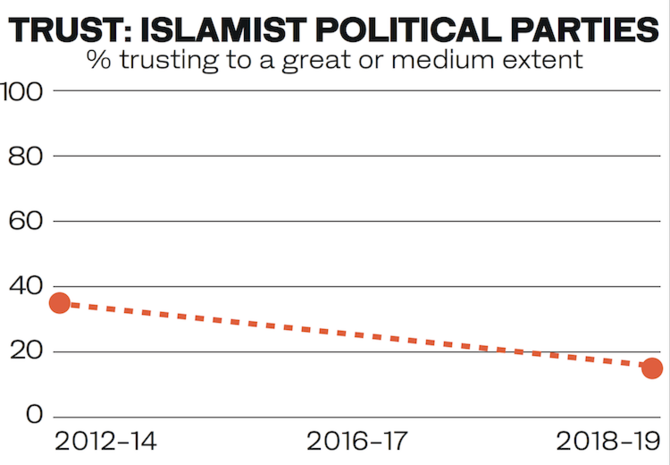

LONDON: Trust in Islamist movements across the Middle East and North Africa (MENA) has declined dramatically since the Arab Spring uprisings, an extensive survey for BBC Arabic has found.
Branches of the Muslim Brotherhood, Hamas and Iran-backed Hezbollah have all suffered a decline in how they are perceived.
Many of the groups, particularly in Egypt and Tunisia, emerged from the chaos of the protests that started in 2011, emboldened and empowered.
But the study reveals further evidence of the extent to which support for Islamist groups has been in demise over the last eight years.
“This pattern continues a general trend of decline in trust for Islamists in MENA, which has been taking place across the region since the Arab uprisings,” the Big BBC News Arabic Survey 2018/2019 said.
“Despite the initial success of Islamist movements in Egypt and Tunisia, there is increasing evidence that Islamism has been in decline over the last eight years.”
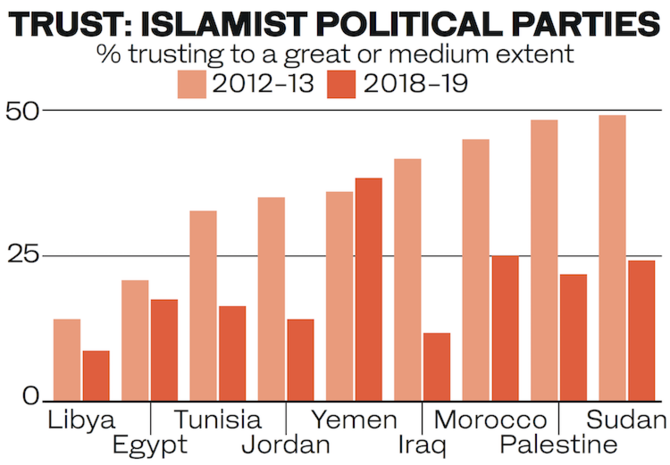
In Jordan and Morocco, trust in the Brotherhood has dropped by about 20 percent since 2012-2013.
In Sudan, where pro-Brotherhood countries such as Turkey and Qatar tried to gain influence, the figure is even higher at 25 percent.
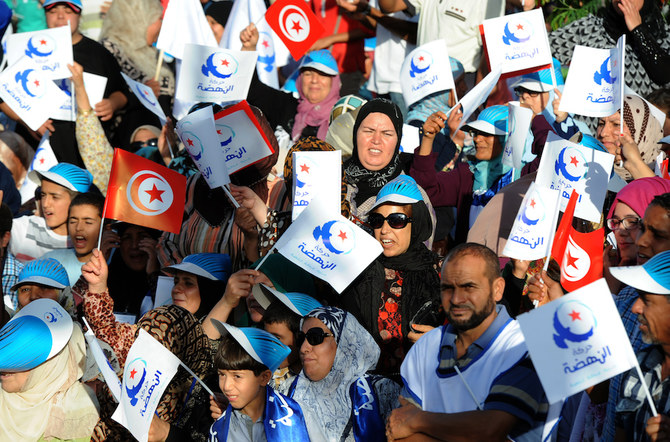
The survey also documented a decline for Ennahda, the Brotherhood-inspired party that is part of the ruling coalition in Tunisia, where the Arab Spring started.
Despite emerging as a strong political force in the aftermath of the uprising, trust in the movement has dropped by 24 percent.
The party was linked to two political assassinations in 2013, and has been rocked by accusations last year that it ran a secret organization to infiltrate the military and other state institutions.
Elections this year will provide a test of how much the drop in trust will affect the party at the ballot box.
In Palestine, trust in Hamas, which rules the Gaza Strip, has dropped from 45 percent to 24 percent as living conditions in the territory have plummeted under a crippling Israeli blockade.
Hamas, which receives large donations from Qatar, was founded in 1987 as an offshoot of the Brotherhood.

In Egypt, where the Brotherhood’s Mohammed Mursi was elected president in June 2012 before vast protests brought an end to his short and divisive rule, trust decreased by around 4 percent.
The figure was similar in Libya, where fighting continues to rage seven years after Muammar Qaddafi’s reign was brought to an end, sparking a conflict between an Islamist-backed administration in the west and a rival Parliament in the east.
The study was based on data from the Arab Barometer research center based at Princeton University.
Researchers interviewed more than 25,000 people in 11 Arab countries: Morocco, Algeria, Tunisia, Libya, Egypt, Palestine, Yemen, Jordan, Iraq, Sudan and Lebanon.
The Brotherhood was founded in Egypt in 1928 by Hassan Al-Banna, and branches were established in countries across the region.
The group was banned in Egypt in 2013 after the country’s current President Abdel Fattah El-Sisi led the overthrow of Mursi, who died last week after collapsing in a Cairo courtroom.
Since the 2011 uprisings, many Arab countries, including Saudi Arabia and the UAE, have increasingly seen the Brotherhood as a major threat.
It has been designated a terrorist organization by Saudi Arabia, Egypt, the UAE and Russia. In April, the White House said the Trump administration is working to designate the Brotherhood a foreign terrorist organization.
Saudi Arabia, the UAE, Bahrain and Egypt cut transport, trade and diplomatic ties with Qatar in 2017, accusing the country of hosting and funding terror groups, including the Brotherhood.
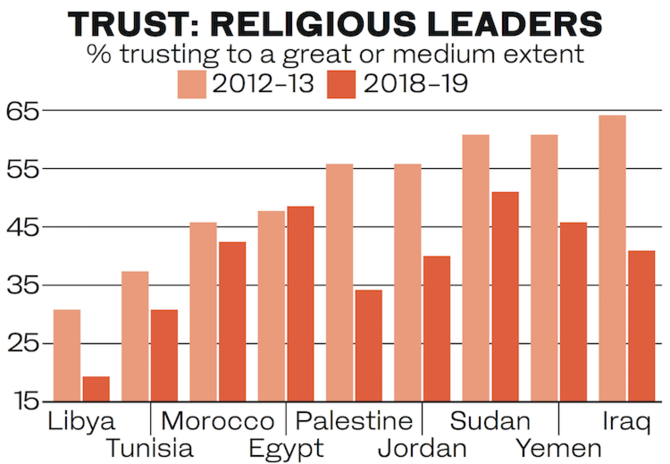
The BBC survey also highlighted a general decline in trust in religious leaders from 2012-2014 to 2018-2019.

The largest decrease was in Morocco — 20 percent since 2016. In Libya, where Khalifa Haftar’s eastern forces are fighting to take the capital Tripoli, there has been a drop of 12 percent since 2014.
Trust in religious leaders in Palestine has also declined significantly — by 22 percent since 2012.
The situation is similar in Jordan, where there has been a decrease of 16 percent over the same period.
Lebanon is the only country in the survey where trust in religious leaders has increased. In fact, it has doubled since 2016 — this could be due to the country’s sectarian political makeup.
The survey also asked people about the biggest threat to their country. Around a third of participants in Iraq and Yemen perceived Iran as the biggest threat.
In Yemen, Iran backs the Houthi militia against the internationally recognized government. In Iraq, Iran funds a range of armed groups and is accused of interfering in its internal affairs.
Israel is considered to be the largest threat in Palestine, Lebanon, Egypt, Jordan, Sudan and Libya.
The survey suggests that support for Turkish President Recep Tayyip Erdogan’s foreign policies far exceeds those of his US and Russian counterparts.
In seven of the 11 countries surveyed, half or more approved of Erdogan’s policies, despite his support for Islamist parties. This included high levels of support in Sudan, Jordan and Palestine.
But support is far lower in Libya (21 percent), Lebanon (30 percent) and Iraq (38 percent). This may be linked to Turkey’s involvement in the Syrian conflict.
Support for Erdogan is much lower in Egypt, where only 15 percent of people favor his policies. This could be due to ongoing tensions between El-Sisi and Erdogan.
Russian President Vladimir Putin’s foreign policies do not have much support, but are more popular than those of US President Donald Trump.
Support for Putin ranges from 43 percent in Libya, 38 percent in Iraq and 37 percent in Lebanon, to just 13 percent in Jordan and 11 percent in Yemen.
Support for him is stronger in countries with significant Shiite populations. This probably reflects Russia’s support of the Assad regime in Syria, which is backed by Iran.
Trump’s foreign policies are deeply unpopular in all the countries surveyed, with 20 percent or less saying his policies have been good or very good.
His policies are most popular in Sudan (20 percent) and Iraq (16 percent), and least popular in Yemen (5 percent), Palestine (6 percent) and Jordan (7 percent).


