TBILISI: The head of Georgia’s parliament quit Friday after more than 240 people were injured in a police crackdown on mass protests, which erupted over a controversial address to lawmakers by a Russian MP.
Opposition leaders have vowed to hold demonstrations until parliament is dissolved and snap elections are held.
Rallies broke out in the capital Tbilisi on Thursday after a Russian lawmaker addressed parliament from the speaker’s seat — a deeply controversial move in a country at loggerheads with Moscow.
Police fired rubber bullets and tear gas at crowds, leaving at least 160 demonstrators and 80 officers injured according to the health ministry.
The use of force in the pro-Western ex-Soviet country has sparked an international outcry, while the Kremlin condemned the protests as “Russophobic provocation.”
The presence of Russian MP Sergei Gavrilov in parliament brought a backlash in Georgia, which in 2008 fought and lost a brief but bloody war with Moscow over the breakaway regions of Abkhazia and South Ossetia.
With parliamentary polls set for next year, opposition groups are also seeking to capitalize on discontent with the ruling Georgian Dream party and its oligarch leader Bidzina Ivanishvili over the failure to kick-start a stagnant economy.
“Ivanishvili’s regime must cede power,” former president Mikheil Saakashvili said in a video address to supporters Friday.
The United Opposition alliance has demanded snap parliamentary polls and the resignation of the interior minister.
“Peaceful mass protest will continue until these demands are met,” its leader Grigol Vashadze told AFP, adding that a fresh rally would start at 7 p.m. (GMT 1500) on Friday.
About 10,000 protesters gathered outside parliament on Thursday afternoon after Gavrilov addressed a forum of lawmakers from predominantly Orthodox countries.
Police pushed back demonstrators when they attempted to enter the parliament courtyard, but the rally remained largely peaceful until midnight when officers launched a violent crackdown.
After ambulances evacuated dozens of injured protesters, hundreds of baton-wielding riot police intervened again, beating and arresting dozens of protesters.
Georgian and foreign journalists were among those injured, according to reports. The health ministry said 102 people were being treated in hospital Friday for their injuries.
Human Rights Watch criticized the use of tear gas and rubber bullets “against thousands of non-violent protesters.”
Police failed to “abide by human rights for the use of force,” the group said.
Georgian President Salome Zurabishvili described Gavrilov’s Russian-language speech as “a crime... an offense against the country’s dignity.”
“But this can’t justify anti-state actions, calls to storm parliament and overthrow the government,” she said in a statement Thursday as she cut short a trip to fellow ex-Soviet republic Belarus.
Prime Minister Bakhtadze said “destructive opposition leaders” who “staged mass violence” would face justice.
Oligarch Ivanishvili — widely believed to be calling the shots in the country — said he “fully shares the sincere outrage of Georgians” over the invitation to the Russian representative.
Mass protests are relatively common in Georgia, where tens of thousands rallied last year over alleged irregularities in a presidential election.
A 2003 “Rose Revolution” pushed out the country’s Soviet-era leadership and brought in reformer Saakashvili, who served until 2013 and now lives in self-imposed exile as a Ukrainian citizen.
Relations between Georgia and its Soviet-era master Russia have long been fractured over Tbilisi’s bid to join the European Union and NATO.
The confrontation culminated in a five-day war in August 2008.
The Russian army swept into Georgia — bombing targets and occupying large swathes of territory — after Tbilisi launched a military operation against South Ossetian separatist forces who had been shelling Georgian villages.
After the war, which claimed the lives of hundreds of soldiers and civilians from both sides, Moscow recognized South Ossetia and another separatist region, Abkhazia, as independent states where it then stationed permanent military bases.
Tbilisi and its Western allies have denounced the move as an “illegal military occupation.”

Georgia parliament head quits after 240 injured in crackdown
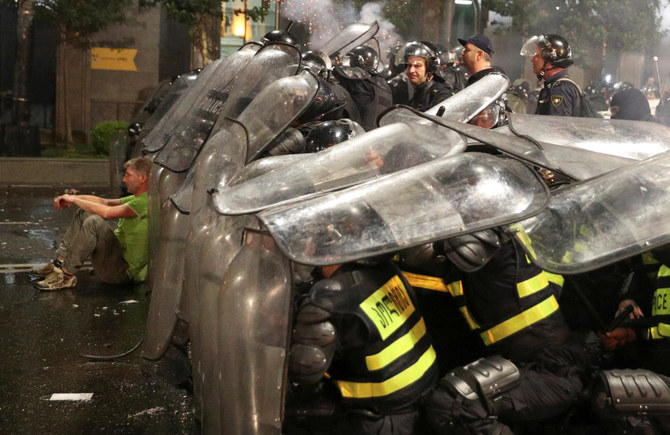
- Rallies broke out in the capital Tbilisi on Thursday after a Russian lawmaker addressed parliament from the speaker’s seat
- Police fired rubber bullets and tear gas at crowds, leaving at least 160 demonstrators and 80 officers injured
Filmmakers defend Berlin festival chief in Gaza row
- Actors and filmmakers rushed to defend the head of the Berlin film festival Thursday following a media report that her job was on the line over a director’s anti-Israel speech at the event
BERLIN: Actors and filmmakers rushed to defend the head of the Berlin film festival Thursday following a media report that her job was on the line over a director’s anti-Israel speech at the event.
Syrian-Palestinian filmmaker Abdallah Al-Khatib kicked off a controversy during Saturday’s closing ceremony by accusing Germany of being complicit in genocide in Gaza through its support for Israel.
German tabloid Bild had reported that Tricia Tuttle was due to be dismissed at an emergency meeting on Thursday, citing sources close to state-owned KBB, the company that runs the festival.
Culture minister Wolfram Weimer’s office confirmed the meeting had taken place but made no mention of Tuttle being sacked, stating that discussions had been “constructive and open” and would “continue in the coming days.”
A group of cinema luminaries including Tilda Swinton, Todd Haynes, Sean Baker and Tom Tykwer signed an open letter defending the Berlinale as a forum for free expression.
“As filmmakers in Germany and beyond, we are following the debates surrounding the Berlinale and the discussion about the dismissal of Tricia Tuttle with great concern,” they wrote. “We defend the Berlinale for what it is: a place of exchange.”
Angry rows over the Israel-Palestinian conflict have repeatedly rocked the Berlinale, held every February as Europe’s first major film festival of the year.
Environment Minister Carsten Schneider walked out of Saturday’s closing ceremony, labelling Khatib’s remarks “unacceptable.”
Germany, as it has sought to atone for the horrors of the Holocaust, has been a steadfast supporter of Israel, and criticism of Israel’s conduct in Gaza has been more muted than in many other countries.
Conservative lawmaker Ellen Demuth was among those who condemned the “antisemitic incident” at the awards ceremony and urged “a fresh start at the top of the film festival.”
The Berlinale Team in an Instagram post meanwhile defended Tuttle, praising her “clarity, integrity and artistic vision.”
The writers’ association PEN Berlin said Khatib’s comments were protected by freedom of expression and that if Tuttle were to be sacked over them, it would cause “immense damage” to the festival.
“Such wanton destruction of the German cultural scene, such self-inflicted insularity, must not be allowed to happen,” it said.
The backdrop of the Middle East conflict led to a tense 76th edition of the festival from the start.
More than 80 film professionals criticized the Berlinale’s “silence” on the Gaza war in an open letter, accusing the festival of censoring artists “who reject the genocide” they believe Israel has committed in Gaza.
Award-winning Indian writer Arundhati Roy withdrew from the festival after the jury president, German director Wim Wenders, said cinema should “stay out of politics” when asked about Gaza.
Syrian-Palestinian filmmaker Abdallah Al-Khatib kicked off a controversy during Saturday’s closing ceremony by accusing Germany of being complicit in genocide in Gaza through its support for Israel.
German tabloid Bild had reported that Tricia Tuttle was due to be dismissed at an emergency meeting on Thursday, citing sources close to state-owned KBB, the company that runs the festival.
Culture minister Wolfram Weimer’s office confirmed the meeting had taken place but made no mention of Tuttle being sacked, stating that discussions had been “constructive and open” and would “continue in the coming days.”
A group of cinema luminaries including Tilda Swinton, Todd Haynes, Sean Baker and Tom Tykwer signed an open letter defending the Berlinale as a forum for free expression.
“As filmmakers in Germany and beyond, we are following the debates surrounding the Berlinale and the discussion about the dismissal of Tricia Tuttle with great concern,” they wrote. “We defend the Berlinale for what it is: a place of exchange.”
Angry rows over the Israel-Palestinian conflict have repeatedly rocked the Berlinale, held every February as Europe’s first major film festival of the year.
Environment Minister Carsten Schneider walked out of Saturday’s closing ceremony, labelling Khatib’s remarks “unacceptable.”
Germany, as it has sought to atone for the horrors of the Holocaust, has been a steadfast supporter of Israel, and criticism of Israel’s conduct in Gaza has been more muted than in many other countries.
Conservative lawmaker Ellen Demuth was among those who condemned the “antisemitic incident” at the awards ceremony and urged “a fresh start at the top of the film festival.”
The Berlinale Team in an Instagram post meanwhile defended Tuttle, praising her “clarity, integrity and artistic vision.”
The writers’ association PEN Berlin said Khatib’s comments were protected by freedom of expression and that if Tuttle were to be sacked over them, it would cause “immense damage” to the festival.
“Such wanton destruction of the German cultural scene, such self-inflicted insularity, must not be allowed to happen,” it said.
The backdrop of the Middle East conflict led to a tense 76th edition of the festival from the start.
More than 80 film professionals criticized the Berlinale’s “silence” on the Gaza war in an open letter, accusing the festival of censoring artists “who reject the genocide” they believe Israel has committed in Gaza.
Award-winning Indian writer Arundhati Roy withdrew from the festival after the jury president, German director Wim Wenders, said cinema should “stay out of politics” when asked about Gaza.
© 2026 SAUDI RESEARCH & PUBLISHING COMPANY, All Rights Reserved And subject to Terms of Use Agreement.


