

KARACHI: Investigators have held a local pediatrician guilty for a surge in patients infected with HIV, the virus that causes AIDS, in Pakistan’s southern Sindh province, police said this week, as health officials blamed widespread malpractice and negligence for an outbreak that has affected over 800 people in just one area.
Officials say more than 821 people, many of them children, tested positive for the HIV virus after a mass screening of 28,850 people was recently performed in Ratodero, a sub-division of Larkana, with a population of around 300,000. The source of the outbreak, according to Pakistani and World Health Organization officials, is the use of unsanitary equipment and rampant malpractice, often at the hands of quack doctors.
At the heart of the crisis is one pediatrician, Dr. Muzaffar Ghangharo, who used contaminated syringes while treating his patients in Ratodero, police officials said on Thursday. Dr. Muzaffar Ghanghro was arrested on April 30 and has been charged with unintentional murder.
Police officer Sartaj Jagirani said 123 infected children, whose family members had recorded their statements with police, had been treated by Ghangharo.
“The joint investigation teams (JIT) has held Dr. Muzaffar Ghangharo responsible for spreading the virus by using contaminated syringes while vaccinating his patients,” Jagirani, who is stationed at Ratodero, told Arab News. “The doctor is guilty.”
Many local doctors and health officials, however, said not all of the 812 people who tested positive in Ratodero were treated by the accused doctor, and the problem was much bigger than one individual.
In rural Sindh — long bridled by harsh poverty and illiteracy — access to information about HIV and other diseases has kept the large swathes of the population in the dark about how the virus is transmitted. Healthcare facilities in the province are meagre and negligence by inadequately-qualified doctors is common.
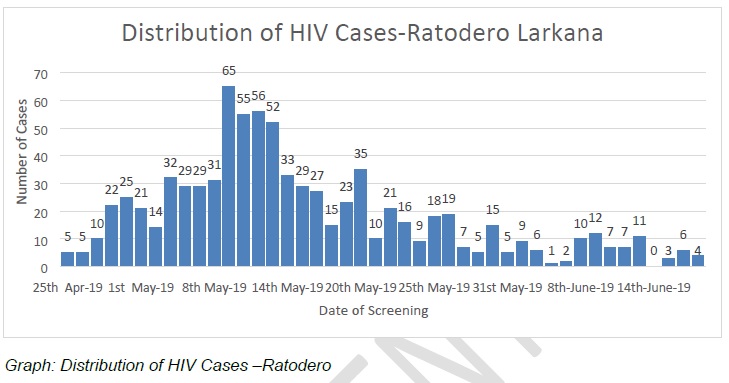
(Source: Sindh AIDs Control Program)
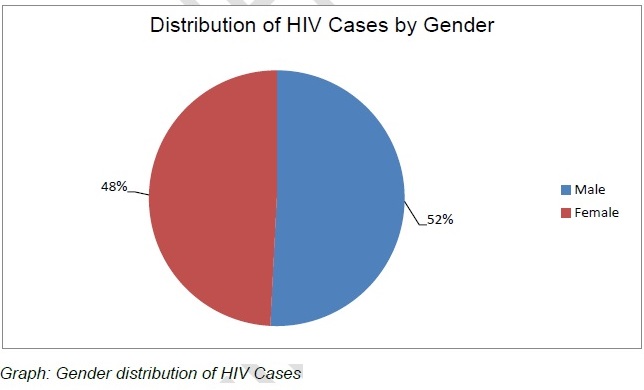
(Source: Sindh AIDs Control Program)
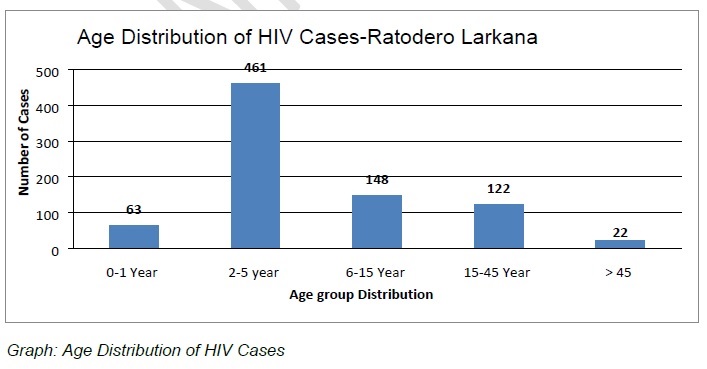
(Source: Sindh AIDs Control Program)
“If a mass screening is carried out across the province, we are likely to discover that the situation in Ratodero is just the tip of the iceberg,” said Dr. Ghulam Shabbir Imran Arbani, the medical practitioner who first reported HIV cases to the media in April this year. “Since medical malpractice persists across the province, there should be a mass screening program to save people from dying.”
Dr. Ramesh Kumar, the medical superintendent of Taluka Hospital Ratodero, said the accused Ghangharo was probably one among several sources of the growing epidemic.
“There are children with HIV infection from other towns who went to other doctors for treatment,” he told Arab News. “If a mass screening is conducted in other parts of Sindh, the results will not be different.”
In April, Arbani informed police that 18 children in Ratodero had tested positive for the HIV virus, which is incurable, but if left untreated can lead to acquired immunodeficiency syndrome (AIDS) within a period of six months to ten years. AIDS is fatal.
The increase in the number of new HIV cases reported in Pakistan stands in sharp contrast to a global decline. According to the National AIDS Control Program, the country’s Sindh province has 60,000 estimated cases of HIV and about 9,500 cases of AIDS.
Dr. Safdar Kamal Pasha at the World Health Organization said a mass screening was usually performed in “key HIV populations,” responding to a question of whether a province-wide screening would take place.
“Unsafe injection practices and poor infection control are among the most important drivers of the outbreak,” Pasha told Arab News.
He also added this was not the first outbreak in Sindh. After two minor outbreaks in the last decade, a third outbreak occurred in 2016 when a chronic kidney disease patient at Chandka hospital tested positive.
“Later 46 patients who used to come for blood transfusion tested positive for the virus as well,” Pasha said, speaking about the 2016 outbreak.
In rural Sindh, as across Pakistan, widespread stigma attached to HIV and AIDS and its spread has unleashed widespread rumors and superstitions.
Last month a man strangled his wife to death after she tested positive for HIV in Sindh province with her husband accusing her of having an extramarital affair.
Arbani said the woman’s murder was not the only case where a victim of the disease had been punished. He recalled the case where a father was unwilling to test his 16-month baby for the disease, saying the test was only meant “for adults with bad moral character.”
He added that during an awareness campaign at the Waris Dino Mashi village, he found a woman tied to a tree like an animal. “The family told us she was HIV positive and would spread the deadly virus if she was not tied properly,” he said.
“A 3-year-old baby who was HIV positive was brought to my clinic on Wednesday,” Arbani continued. “Her mother told me that her son was mistreated by all the children in the neighborhood who did not play with him since they thought he was going to bring harm to them.”