

Erdogan in lose-lose situation after Istanbul vote

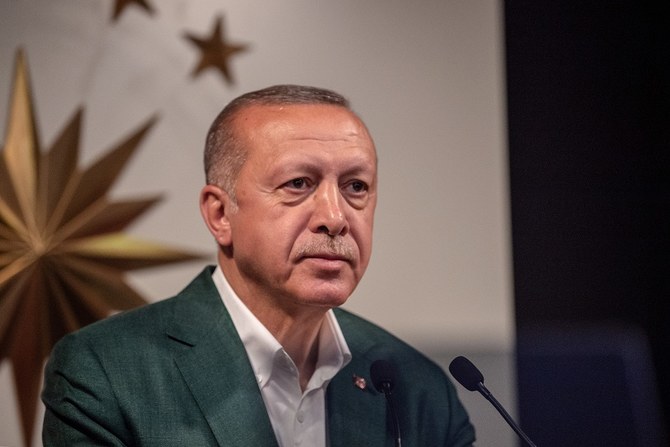
Turkish President Tayyip Erdogan delivers a speech on the stage of the conference room at Huber Mansion in Istanbul, on March 31, 2019, following local elections. (File/AFP)
Short Url
Updated 24 May 2023
Follow

Erdogan in lose-lose situation after Istanbul vote

  • Local elections around Turkey on March 31 showed Erdogan's ruling party remained the most popular overall, but it suffered a shock defeats in Istanbul and Ankara
  • Main opposition candidate Ekrem Imamoglu’s success was short-lived in Istanbul after Turkey’s top election body accepted claims of fraud by the AKP and called a re-run for June 23

Voters in Istanbul will take part in a re-run of the mayoral election on Sunday after a vote in March was annulled over alleged irregularities.

Local elections around Turkey on March 31 showed the ruling party of President Recep Tayyip Erdogan remained the most popular overall, but it suffered a shock defeat in Istanbul, as well as losing the capital Ankara.

It was the first time in 25 years that neither Istanbul nor Ankara were under the control of the Justice and Development Party (AKP) or its predecessors.

However, the main opposition candidate Ekrem Imamoglu’s success was short-lived in Istanbul after Turkey’s top election body accepted claims of fraud by the AKP and called a re-run for June 23.

It did not annul the votes for the city council that were cast at the same time, and where the majority of seats went to Erdogan’s party.

Why is there another Istanbul election?

The AKP’s Binali Yildirim, an Erdogan loyalist and former premier, lost by around 13,000 votes to Imamoglu of the Republican People’s Party (CHP) in March.

After two weeks of multiple recounts, the AKP applied in April to the Supreme Electoral Council (YSK) to annul the vote, claiming there was widespread corruption and theft at the ballot box.

There were also claims some of the ballot box committee chairmen and members were not civil servants as required by Turkish law.

Critics of the ruling party claim the AKP pressured election authorities into calling the re-run in Istanbul because it is Turkey’s economic powerhouse, home to 15 million people, and vital to the AKP’s political machine.

“The municipality spends billions of US dollars on public tenders and services, which puts the AKP in direct contact with voters. In short, it’s the gasoline on which the AKP machine runs,” said Berk Esen, assistant professor of international relations at Ankara’s Bilkent University.

But Abdullah Guler, an AKP lawmaker in Istanbul, dismissed the allegations.

“If the AKP looked at the situation like this, it would have done the same (in other big cities like Ankara and Antalya),” he told AFP. “Why didn’t we? Because there was open corruption in Istanbul.”

Why is Erdogan campaigning less?

Before the March vote, Erdogan’s face and voice was everywhere. He held 102 rallies in 50 days in 59 provinces across the country despite not being on the ballot paper.

At first, it appeared he would continue this approach for the Istanbul re-run, with the Hurriyet daily reporting he would hold 39 rallies in the city’s 39 districts.

But that has not happened. On Wednesday, Hurriyet said Erdogan would make speeches in just four districts.

Guler said this was normal for a single-city election.

“Generally we would have a big rally in Istanbul before an election to send messages to the whole of Turkey. But there is only an election in Istanbul, not all of Turkey.”

But others, like Esen, believe Erdogan is avoiding a major presence “so that he would not be the face of defeat, which seems very likely according to the opinion polls.”

“He did not want to campaign heavily because he is a polarising figure and they tried a reconciliatory strategy,” Esen said, in the hopes of having a broader appeal.

But now, Esen added, “Erdogan is the last tool left at their disposal.”

What risk does Erdogan face?

The vote still remains highly significant for Erdogan -- to keep alive his reputation as an unbeatable political force as well as to ensure divisions in the party are kept under wraps.

Ayse Ayata, a professor at Ankara’s Middle East Technical University, said if Imamoglu won, it would be “major chaos” for the AKP with members realising the party can lose.

But a victory for the AKP would be greeted with suspicion by Erdogan’s critics at home and abroad, where the order to replay the election has already drawn criticism.

“The whole democratic world will lose further faith in the process and in Turkey,” said Ayata.

A growing distrust in the West would then increase concern for investors over the trajectory of Turkey, whose economy was hit by tensions with the US last summer. The Turkish lira lost nearly 30 percent in value against the US dollar in 2018.

“It’s a lose-lose situation,” Esen said. “If he wins, he’ll only slow down the haemorrhage of votes for the time being. But if he loses a second time, it’s going to be a mortal blow to his regime and party.”

Guler, the AKP lawmaker, denied there was any risk to Erdogan or the party.

“The AK Party continues to have the support of the public,” he said, pointing to its control of 760 of Turkey’s 1,389 local authorities.


US hotels seek World Cup boost after tourism dip under Trump

Updated 58 min ago
Follow

US hotels seek World Cup boost after tourism dip under Trump

  • At the US hotels that Meade Atkeson manages, a drop in tourism weighs heavily on business — but hoteliers like him hope that World Cup enthusiasm will soon eclipse wariness over President

WASHINGTON: At the US hotels that Meade Atkeson manages, a drop in tourism weighs heavily on business — but hoteliers like him hope that World Cup enthusiasm will soon eclipse wariness over President Donald Trump’s policies.
The US hospitality sector has been reeling from a tourism slump in the world’s biggest economy, which became the only major destination to see a drop in foreign visitors last year.
“Just financially, it’s difficult when international travel is down,” Atkeson told AFP, noting that such visitors tend to stay longer and spend more.
Foreign travelers account for nearly a quarter of business at the three hotels under Sonesta group that he manages — two in Washington and a third in Miami Beach.
Yet, in the first eleven months of 2025, US official data showed that inbound travel dropped by 5.4 percent.
Canadians were noticeably absent, with travel plunging by 21.7 percent from 2024, translating to about four million fewer people. The decline was nearly seven percent for French visitors.
Industry professionals see this as a consequence of Trump’s policies, even if they may not openly say so.
Visitors have chafed at the Republican president’s sweeping tariffs on foreign goods, broadsides against other countries, tightening immigration rules and portrayal of certain Democrat-led cities as ridden with crime.
Canadians “were asked to be the 51st state, right?” Atkeson said.
“If you talk to Canadians, many of them have chosen not to travel out of conscience” or on principle, he added.
Brazilian tourists meanwhile “can go anywhere they want,” he said. “And so they may have gone to Europe, they may have gone to the islands.”
‘Fear’
Thousands of kilometers away, the major resort city of Las Vegas in Nevada — boasting 150,000 hotel rooms — has also had a bad year.
Elsa Rodan, a chambermaid at the Bellagio resort and casino, says her establishment is “blessed” compared with others.
But even so, it has had to lower prices to attract guests, added Rodan, a representative of the Unite Here union who spoke at a Washington press conference.
Unite Here President Gwen Mills urges for a renewed effort to lobby the Trump administration over policies and rhetoric that she believes are jeopardizing the sector employing more than two million people.
According to her, hoteliers are not pushing the government enough.
Employers express “fear, the fear of picking your head up,” she said.
Hopefully ‘better’
Fewer visitors and overnight stays, alongside a drop in revenue, have triggered a $6.7 billion shortfall for Nevada hotels in 2025, according to the American Hotel and Lodging Association (AHLA).
But the organization hopes that 2026 will be a turning point — it is counting on the World Cup, from June 11 to July 19, to attract visitors.
Eleven US cities will be hosting matches.
“It’s being equated to having nearly 80 Super Bowls in just over a month,” AHLA spokesman Ralph Posner told AFP.
“The economic lift won’t be limited to host cities,” he added. “Destinations across the country are hoping to benefit as international visitors extend their trips and travel between markets.”
Las Vegas, for example, hopes to draw fans who might stop there before or after a game in Los Angeles or Kansas City.
Organizers say that besides the seven million spectators in stadiums, the World Cup is set to attract 20-30 million tourists.
The whole event, they believe, can generate $30 billion for the US economy.
“I hope that things will look better,” Atkeson said.
His Miami hotel is under renovations and cannot host much World Cup-related activity.
But his Washington establishments are highlighting their proximity to Philadelphia, where several matches will be held.
Another complication is war in the Middle East following US-Israeli strikes on Iran, which could snarl travel.
“It’s a little too soon to tell how we’re going to do with that, but we’ll see,” he said.