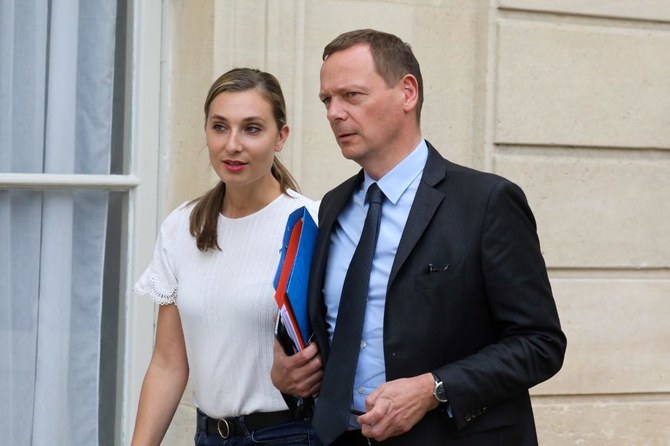
PARIS: President Emmanuel Macron sent his top diplomatic adviser to Iran this week as part of European efforts to defuse tensions between Tehran and Washington, the French presidency said Thursday.
The adviser, Emmanuel Bonne, held “high-level meetings” Wednesday in Tehran, “with the aim of contributing to the de-escalation of tensions in the region,” Macron’s office said.
The presidency refused to say whom Bonne met, adding only that he left Tehran on Wednesday evening.
The strains between Washington and Tehran increased Thursday with Iran’s announcement that it had shot down a US “spy drone” that violated Iranian airspace near the Strait of Hormuz.
The United States has yet to respond.
The incident marks the latest escalation in tensions following last week’s attacks on two oil tankers in the Strait of Hormuz, which the United States blamed on Iran.
Tehran has denied any involvement.
Tensions between the longtime foes, who have had no relations since the hostage crisis that followed the 1979 Islamic revolution, have increased sharply since US President Donald Trump last year abandoned a landmark 2015 nuclear agreement with Iran and re-imposed sanctions.
Macron, who is traveling to a G20 summit in the Japanese city of Osaka on June 28-29, will “have contact with the main players” in the standoff, his office said.
Before that he will pay an official visit to Japan on June 26-27, during which he will hold talks with Prime Minister Shinzo Abe, who recently traveled to Iran to try mediate in the crisis.
Abe met with Iran’s supreme leader, Ayatollah Ali Khamenei, who categorically refused to hold talks with Trump.
The EU is under pressure from Tehran to try salvage the 2015 deal, with Iran threatening to breach its nuclear enrichment limits.
On Tuesday, Macron urged Tehran to be “patient and responsible.”


![]()

France’s Macron sends senior diplomat to Iran to defuse US tensions
France’s Macron sends senior diplomat to Iran to defuse US tensions
- Emmanuel Bonne held ‘high-level meetings’ Wednesday in Tehran
- The French presidency refused to say whom the top diplomatic adviser met


Latest updates


© 2026 SAUDI RESEARCH & PUBLISHING COMPANY, All Rights Reserved And subject to Terms of Use Agreement.