

Iran linked to rocket attack on US oil targets in southern Iraq

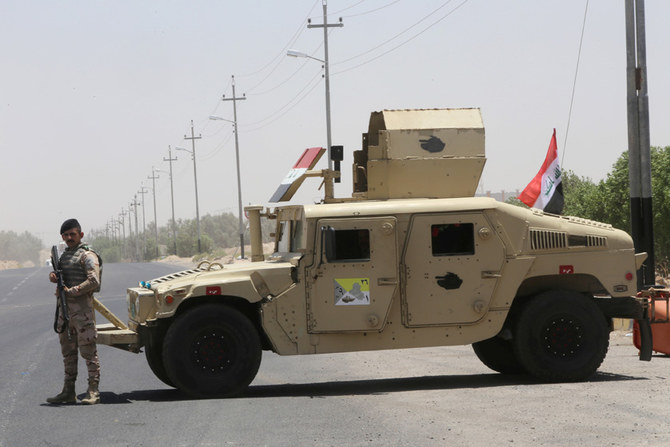
An Iraqi soldier stands next to a military vehicle at the entry of Zubair oilfield after a rocket struck the site of residential and operations headquarters of several oil companies at Burjesia area, in Basra, Iraq, on June 19, 2019. (REUTERS/Essam Al-Sudani)
Updated 20 June 2019
Follow

Iran linked to rocket attack on US oil targets in southern Iraq

  • Fourth oil-related terrorist assault since Tehran’s threat to halt exports from Gulf
  • Three people were injured in Wednesday’s incident

BAGHDAD, Iraq:  Iran was accused of sowing further chaos on Wednesday when a rocket hit a site near Basra in southern Iraq used by US and other oil companies.

The attack came hours after three rockets landed in the Rumailah oil field in Basra, near a camp used by the US oil services company Baker Hughes.

It was the fourth oil-related terrorist attack since Tehran threatened to halt exports from the Arabian Gulf in response to US sanctions aimed at reducing Iran’s oil sales to zero.

Three people were injured in Wednesday’s incident, when a short-range Katyusha rocket hit a drilling site in the Burjesiya area near Basra, an operational area for oil companies including Royal Dutch Shell, Eni of Italy and the US giant ExxonMobil.

The finger of blame was immediately pointed at Iran-backed armed groups in the area, particularly Kata’ib Hezbollah. “They are equipped with this type of rocket, which is ubiquitous among the Iranian-supported militias,” security analyst Dr. Theodore Karasik told Arab News.

TIMELINE OF TERROR

● July 21, 2018 Iran’s supreme leader Ayatollah Ali Khamenei says if Iran’s oil sales are impeded by sanctions, ‘no other country in the region will export oil either.’

● April 21, 2019 US says it will end sanctions exemptions allowing some countries to buy Iranian oil, with the aim of reducing its exports to zero.

● May 12 Four tankers — two Saudi, one Emirati and one Norwegian — are sabotaged with explosive mines off the coast of Fujairah in the UAE. ● May 14 Drone attacks on two oil pumping stations temporarily shut down pipeline from eastern Saudi Arabia to Yanbu port on the Red Sea.

● June 13 Two tankers, one Japanese and one Norwegian, are attacked in the Gulf of Oman, leaving one ablaze and both adrift.

● June 19 Rocket attack targets foreign oil installations near Basra in southern Iraq, where Iran-backed militias are active.

“The Islamic Republican Guard Corps has created a supply network for local militias that helped to build up a weapons stock around Basra. It is easily fed by new supplies from Iran because of the porous nature of the border between the two, both on land and at sea,” said Karasik, senior adviser at Gulf State Analytics in Washington, DC.

An Iraqi security source also blamed Iran-backed militias. “The team that launched the rocket is made up of more than one group and were well trained in missile launching,” he said.

The rocket was fired from farmland about 4 km away and landed 100 meters from part of the site used as a residence and operations center by Exxon. Company staff were flown to Dubai.

Abbas Maher, mayor of the nearby town of Zubair, said he believed Iran-backed groups had specifically targeted Exxon to “send a message” to the US.

“We cannot separate this from regional developments, meaning the US-Iranian conflict,” he said. “These incidents have political objectives.”

Meanwhile US investigators presented more evidence that Iran was behind last week’s tanker attacks in the Gulf of Oman.

“The limpet mine used in the attack … bears a striking resemblance to Iranian mines already publicly displayed in Iranian military parades,” said US Navy Commander Sean Kido.


UK foreign minister urges UN Security Council to confront ‘bitter truth’ of ‘catastrophically failing Sudan’

Updated 5 sec ago
Follow

UK foreign minister urges UN Security Council to confront ‘bitter truth’ of ‘catastrophically failing Sudan’

  • Yvette Cooper recounts harrowing stories of atrocities during the country’s civil war, including ‘point-blank executions of civilians’ and sexual violence against women and girls
  • The diplomatic momentum that secured the Gaza ceasefire must now be harnessed to secure peace in Sudan and ensure those guilty of atrocities are held to account, she says

NEW YORK CITY: Britain’s foreign secretary, Yvette Cooper, on Thursday called on the UN Security Council to confront “the bitter truth” that the world has been “catastrophically failing the people of Sudan.”
The UK is chairing the Security Council this month, and Cooper is serving as its president. Setting out the scale of the crisis in Sudan, which has been locked in civil war since April 2023, she cited a report by a fact-finding mission on atrocities in El-Fasher, commissioned by the UK, that was published on Thursday.
She highlighted its accounts of “indiscriminate shootings, point-blank executions of civilians in homes, streets, open areas or while attempting to flee the city.”
In one incident, Cooper said: “A pregnant woman was asked how far she was in her pregnancy. When she responded ‘seven months,’ he fired seven bullets into her abdomen, killing her.”
Hospitals, medical personnel and the wounded “were not spared,” she added, and survivors reported being raped in front of relatives, including children.
The report concluded that the atrocities “bear the hallmarks of genocide,” Cooper said. “El-Fasher should have been a turning point. Instead, the violence now is continuing.”
More than three months after the fall of the city, she said, reports of violations of international humanitarian law and human rights abuses persist. Aid agencies face barriers to access, while schools, hospitals, markets and humanitarian convoys, including those belonging to the World Food Programme, have come under attack.
Since the start of the month alone, she said, there have been reports of strikes on aid operations by both of the warring military factions, the Sudanese Armed Forces and the Rapid Support Forces.
Cooper described what she had witnessed firsthand during a recent visit to the border between Chad and Sudan, and warned that behind the statistics lie shattered lives.
“At the Chad-Sudan border, in a camp of over 140,000 people who have fled Sudan’s conflict, 85 percent of them are women and children,” she said.
A Sudanese community worker told her she believed “half, more than half, the women in the camp had been subjected to sexual violence,” Cooper revealed.
She recounted the case of “three sisters arriving at one of the Sudanese emergency response rooms, who had all been raped. The oldest sister was 13. The youngest was eight.
“There is a war being waged on the bodies of women and girls. The world must hear the voices of the women of Sudan and not the military men who are perpetuating this conflict; voices that ensure that this council confronts the bitter truth, because the world has been catastrophically failing the people of Sudan.”
She described the conflict as “the worst humanitarian crisis of the 21st Century,” with 33 million people in need of assistance, 14 million forced from their homes, and famine “stalking millions of malnourished children.”
It is also a regional security crisis and a migration crisis, Cooper added, as she warned of destabilization across the Horn of Africa and the Sahel, opportunities for extremist groups to exploit the instability, and the risk of increased migration affecting Europe.
Cooper commended US-led efforts to convene regional powers, including Egypt, the UAE and Saudi Arabia, to discuss peace plans, as well as support from the African Union and the EU.
“We will need pressure from every UN member state,” she said. “I urge all of those with influence on both the RSF and the SAF not to fuel further conflict, but instead to exert maximum pressure on them to halt the bloodshed.”
She warned that “the reason that the military men still convince themselves there is a military solution is because they can still obtain ever-more lethal weapons.”
Arms restrictions “need to be enforced and extended,” Cooper said, adding: “Now is the time to choke off the arms flows and exert tangible pressure for peace.”
She also called for greater accountability, saying it was time for more sanctions against the perpetrators. The UK has already sanctioned senior RSF commanders linked to atrocities in El-Fasher, she said, and joined the US and France in proposing that they be designated by the Security Council.
Recalling the diplomatic momentum behind efforts to secure a ceasefire in Gaza last year, Cooper said: “We need that same energy and determination to bring peace for Sudan so we can
secure an immediate ceasefire, humanitarian truce, and so that those responsible for atrocities are held to account.
“Let this be the time that the world comes together to end the cycle of bloodshed and to pursue a path to peace.”