

Saudi Arabian Airlines to boost A320neo family fleet

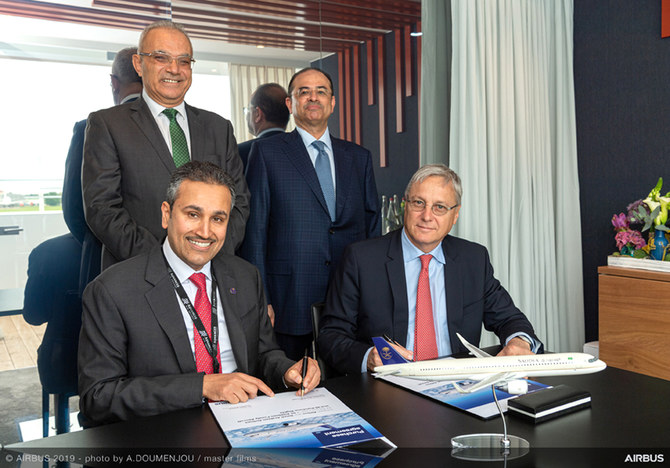
The agreement was announced at the Paris Air Show in a ceremony attended by Chairman of Saudi Arabian Airlines Corporation Dr. Ghassan Al-Shibl and signed by Saleh bin Nasser Al-Jasser, director-general of Saudia, and Christian Scherer, Airbus chief commercial officer.
Updated 18 June 2019
Follow

Saudi Arabian Airlines to boost A320neo family fleet

Saudi Arabian Airlines (Saudia) has reached an agreement to expand its existing A320neo family order from 35 to as many as 100 neo aircraft including 35 options. The additional firm order takes Saudia’s order of A320neo family aircraft to 65, of which 15 are A321XLRs and 20 are A321neos.

The agreement was announced at the Paris Air Show in a ceremony attended by Chairman of Saudi Arabian Airlines Corporation Dr. Ghassan Al-Shibl and signed by Saleh bin Nasser Al-Jasser, director-general of Saudia, and Christian Scherer, Airbus chief commercial officer.

Passenger demand in the Kingdom is experiencing exponential growth on domestic, regional, as well as international routes. The additional aircraft will be deployed to support the national flag carrier’s plan to boost capacity. Saudia currently flies to more than 95 routes across four continents. 

Al-Jasser said: “Year-on-year growth has been in the double digits, both in domestic travel as well as the growing international transit traffic, as a result of the airline’s expanding route map and additional frequencies offered on existing routes. In addition to the narrow-body order, evaluations are currently underway for wide-body requirements, expected to be concluded within the next few months.”

Saudia operates a fleet of more than 150 narrow and wide-body aircraft, including 100 Airbus A320 family and A330s. The airline operates one of the most modern fleets in the world — at an average aircraft age of less than five years. This latest purchase is in line with the group’s SV2020 Transformation Program, which includes the establishment and growth of a dual-brand strategy of operating airlines catering to the different customer segments in the Kingdom, region and beyond.

Since the launch of Saudia’s transformation plan in 2015, the airline has introduced a number of new products and services onboard, added new aircraft to the fleet, and expanded technological features on its mobile app and website.

The A320neo and its derivative aircraft family members are the world’s best-selling single aisle aircraft with over 6,100 orders from over 100 customers since its launch in 2010. The A320neo also offers significant environmental benefits with nearly 50 percent reduction in noise footprint compared to its previous generation aircraft.


New energy vehicles drive next phase of mobility in Saudi Arabia

Updated 06 February 2026
Follow

New energy vehicles drive next phase of mobility in Saudi Arabia

Saudi Arabia stands at a defining moment in its mobility transformation. Under Vision 2030, the Kingdom is accelerating its transition toward cleaner, smarter and more connected transport systems.
New energy vehicles are at the center of this shift, offering a pathway to a more sustainable automotive ecosystem. Yet while consumer interest is rising rapidly, converting intent into everyday adoption will depend on how effectively the wider mobility system evolves alongside electric vehicles.
Recent nationwide research by Al-Futtaim highlights the strength of this momentum. More than 70 percent of Saudi residents surveyed are already familiar with NEVs, while nearly eight in 10 say they would consider purchasing one as their next vehicle. Most notably, 80 percent expect to buy an electric vehicle within the next three years, signaling that the transition is moving from aspiration to reality.
Despite this optimism, important barriers remain. Range anxiety continues to be the most frequently cited concern, alongside high purchase prices and long charging times. Practical considerations dominate purchasing decisions, with affordability and access to charging infrastructure outweighing environmental motivations. These findings underline a pressing reality: consumers will embrace NEVs at scale only when electric mobility feels as convenient, reliable and accessible as conventional driving.
For industry leaders, this represents both an opportunity and a responsibility. Jerome Saigot, managing director of Al-Futtaim BYD KSA, said: “Saudi Arabia is building the foundations for a future-ready mobility system under Vision 2030. The opportunity now is to connect the dots, bringing together vehicles, charging infrastructure, consumer education and service capability to unlock confident, large-scale adoption of new energy vehicles.”
Charging networks therefore play a central role in supporting adoption, but they are not the only requirement. NEV uptake is closely linked to how cities are planned, how people commute and how transport systems connect.
Emerging mobility models also point to a more connected future. High levels of openness to mobility-as-a-service, autonomous vehicles and shared transport indicate that Saudi consumers are receptive to innovation. However, these technologies will succeed only if they are embedded within systems that link vehicles, infrastructure, data and urban design.
Successful electric mobility ecosystems need to be built around coordinated rather than isolated initiatives. Electric vehicles perform best when supported by reliable charging, smart traffic management, efficient public transport and well-designed urban environments. In this context, NEVs benefit directly from parallel investment in rail, bus networks, digital platforms and active mobility infrastructure.
Encouragingly, public confidence in Saudi Arabia’s long-term mobility vision remains strong. More than 85 percent of respondents surveyed by Al-Futtaim believe the Kingdom is on track to lead in future mobility. Consumers also clearly identify priorities for continued progress, including expanding charging infrastructure, improving mass transportation and strengthening regulatory frameworks.
For policymakers, investors and industry players, the message is clear. The next phase of mobility transformation must focus on alignment: aligning infrastructure with consumer expectations, aligning innovation with everyday needs, and aligning public and private investment around shared outcomes.
Saudi Arabia’s mobility transition is no longer a distant ambition. It is unfolding now, shaped by confident consumers, ambitious institutions and accelerating technological change. By building connected systems that place people at their center, the Kingdom can ensure that electric mobility becomes a lasting part of its sustainable future.
To explore these insights and recommendations in more detail, download The Future of Mobility in Saudi Arabia.