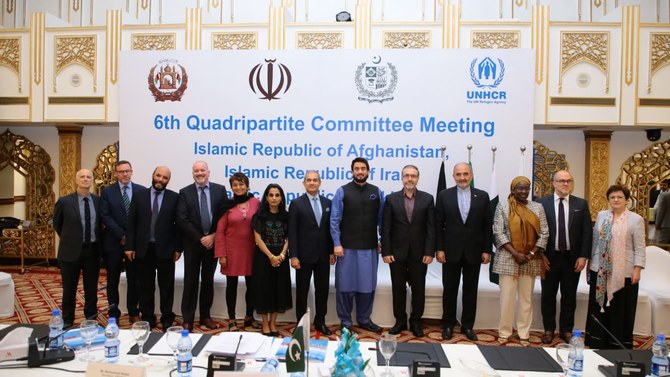
ISLAMABAD: In talks held in Islamabad on Monday, representatives from Pakistan, Afghanistan, Iran and the United Nations High Commissioner for Refugees (UNHCR) called on the international community to further the cause of Afghan refugees and provide means to end future displacement.
The sixth edition of the Quadripartite Steering Committee meeting, held every year, saw the participation of Sayed Hussain Alemi Balkhi, Afghanistan’s Minister of Refugees and Repatriation (MoRR) and Shehryar Afridi, Pakistan’s Minister of States and Frontier Regions.
The Iranian side was represented by Hossein Zolfaghari, Deputy Minister of Interior for Security and Disciplinary Affairs, while Indrika Ratwatte, Director of the Regional Bureau for Asia and the Pacific, was speaking on behalf of the UNHCR.
The purpose of the meeting was to discuss the progress and challenges of the Solutions Strategy for Afghan Refugees (SSAR) which aims to support host countries by providing voluntary repatriation and sustainable reintegration.
“All parties reaffirmed their commitment to the SSAR and agreed to extend it until 2021...for identifying and implementing solutions for Afghan refugees,” the UNHCR said in a statement released on Monday.
All parties reiterated their support for joint advocacy and resource mobilization to support the strategy. “The participants urged development actors and other partners to provide adequate, tangible assistance for the SSAR,” the statement read.
The groups also called for joint efforts to create a conducive environment for a gradual, phased and voluntary return and sustainable reintegration of refugees in Afghanistan, in addition to aiding host communities, such as Iran and Pakistan, for the purpose.
Afridi, for his part, appealed to the international community to allocate more funds for the Refugee Affected and Hosting Areas (RAHA) program. He also urged for concerted efforts for development inside Afghanistan which could lure refugees to return home.
Recognizing Pakistan’s contribution in hosting Afghan refugees for the past 40 years, Balkhi said that due to a large number of migrants in Pakistan and Iran – and due to insecurity in Afghanistan – the SSAR has not been able to reach its goals.
“The need for SSAR continues to exist and I, therefore, call on the extension of the SSAR time frame,” he said.


![]()

Four-party meet in Islamabad seeks world’s attention for Afghan refugees
Four-party meet in Islamabad seeks world’s attention for Afghan refugees
- Representatives call for joint advocacy and resource mobilization
- Push for an extension of timeframe to realize goals set by group
Latest updates


© 2026 SAUDI RESEARCH & PUBLISHING COMPANY, All Rights Reserved And subject to Terms of Use Agreement.