

Austrian allure: Vienna’s vintage delights

1 / 4
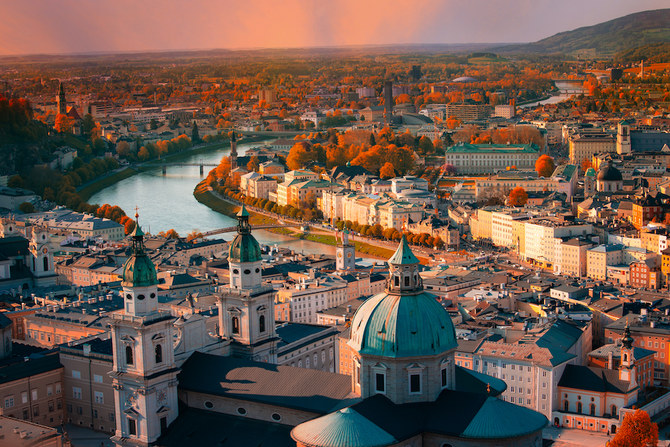
Vienna, on the banks of the Danube. (Shutterstock)
2 / 4
The Hofburg palace complex in Vienna. (Shutterstock)
3 / 4
Vienna's Naschmarkt. (Shutterstock)
4 / 4
The Sachertorte, a type of chocolate cake invented for Prince Wenzel von Metternich by the Sacher Hotel’s founder, Franz Sacher, in 1832. (Shutterstock)
Updated 18 June 2019
Follow

Austrian allure: Vienna’s vintage delights

  • The Austrian capital remains one of Europe’s great cities
  • Vienna is one of the world’s great art capitals, and a city obsessed with music

DUBLIN: There are few places more regal than Vienna. The former capital of the Austro-Hungarian empire is one of Europe’s great cities, filled with imperial palaces, baroque architecture and countless artistic and cultural highlights. It’s also increasingly being seen as a haven for design and food — and gradually shedding its rather staid reputation: while Austria’s star may have fallen since the heady days when it ruled a large part of the world, Vienna’s star is very much in ascendance.

First, the palaces. You can thank the Habsburg Monarchy for the Hofburg palace complex, a stunning collection of imperial architecture in the center of the city. Highlights include the Spanish Riding School, where stallions perform intricate equine dances; the Burgkapelle, where the Vienna Boy’s Choir sings at Sunday Mass; and the fascinating Kaiserappartments, where the city’s royalty lived and played.

Other palaces worth visiting are the Schloss Schonbrunn, the Habsburg’s 1,441-room summer residence, and the Schloss Belvedere, a huge complex of baroque buildings, which is a UNESCO World Heritage Site and includes a museum featuring a plethora of Austrian art.

And if you’re looking for an artistic fix, you are in the right place — Vienna is one of the world’s great art capitals. Head to the Albertina first, which is a converted 19th-century palace filled with old masters and some of the world’s best 20th-century artists. There’s work by everyone from Monet to Picasso to Rothko and it’s worth spending a few hours here to take it all in. A few minutes away is mumok, Vienna’s contemporary art museum. It has a huge collection of more than 10,000 works, featuring the likes of Jasper Johns, Roy Lichenstein and Pablo Picasso. It focuses on modern art, something reflected in the building’s stark design.

By this stage, you are going to need a pit stop, and a few minutes’ walk from mumok is the Hotel Sacher — the most storied hotel in the city. It’s hosted Queen Elizabeth II, John F. Kennedy and a host of other world leaders and A-listers. It is deservedly famous for its Sachertorte, a type of chocolate cake invented for Prince Wenzel von Metternich by the hotel’s founder, Franz Sacher, in 1832.

Given that its former residents include the likes of Mozart, Beethoven, Schubert and Strauss, it’s no surprise that Vienna is a city obsessed with music. There are countless venues across the city where you can hear classical music, including Musikverein, where the Vienna Philharmonic Orchestra perform; the stunningly designed gold-and-crystal Staatsoper (State Opera House); and the wonderful Konzerthaus. For a tour of the city’s musical heritage, pay a visit to Haus der Musik, which features a range of interactive exhibits and traces the musical journey from the prehistoric age to the present day. It’s located in the Palace of Archduke Charles, where the founder of the Vienna Philharmonic once lived.

Vienna may not traditionally be known for its food (aside from the ubiquitous schnitzel), but recent years have seen it rise up the foodie ranks. A good place to start is Naschmarkt, a popular market dotted with small stalls and restaurants. There’s everything from noodles and falafel to, of course, wurstel.

For something more upmarket, head to Gastwirtschaft Wratschko, a favorite of the late Anthony Bourdain. Housed in a low-lit, wood-paneled restaurant that oozes atmosphere, it features a huge range of traditional Austrian cuisine. We recommend trying the steak with green peppercorn sauce, although if you want to go veggie, opt for the cabbage, tomato and cheese lasagna.

Once you are fed and watered, head to the Riesenrad, a huge Ferris wheel built in 1897 that’s over 65 meters high, and takes 20 minutes to complete its rotation. You may recognize it from its many cinematic appearances, including the 1987 James Bond movie “The Living Daylights.”

For something more down to earth, sign up for one of the many river cruises that head up and down the Danube. Most of the cruises offer similar itineraries, although costs can vary wildly, so do your research. The Danube is Europe’s second-longest river and flows nearly 3,000km through 10 countries, and there are plenty of boats that will bring you across Eastern Europe via the river. Although Vienna’s charms are such you’ll likely be reluctant to leave.


Showtime: The best television of 2025 

Updated 26 December 2025
Follow

Showtime: The best television of 2025 

  • From belly laughs to gut punches, here are the must-watch shows of the year 

‘Adolescence’ 

This harrowing drama consisted of four episodes, all shot in a single take. It told the story of 13-year-old Jamie Miller (the debut role for Owen Cooper, who deservedly won an Emmy for his faultless performance), who is accused of murdering a schoolmate, and the aftermath of that accusation for his family. “Adolescence” was the perfect blend of style and substance; you could marvel at the “balletic production processes that must have been involved,” as our reviewer noted, even while squirming in your seat at the painfully raw performances of the excellent ensemble cast. “It may be one of the most upsetting shows released this year,” our review concluded, “but it is also a remarkable work of art.” 

‘Severance’ S2 

Apple’s absorbing sci-fi comedy-drama expanded its universe in season two, as Mark S (Adam Scott) and his team of data refiners dealt with the fallout from their successful, if brief, escape from their ‘severed’ floor — where work and out-of-work memories and personalities are controlled and delineated by a chip embedded in their brains — at Lumon, during which they tried to alert the outside world to the cruelties of their working conditions. “Creator Dan Erickson and director Ben Stiller waste no time in rediscovering the subtle blend of tangible oddness and sinister dystopian creepiness that made the first season such an uncomfortable joy,” our reviewer wrote.  

‘Stranger Things’ S5 Vol. 1 

At the time of writing, we don’t know whether volume two of the final season of this epic Eighties-set sci-fi horror drama — out Dec. 26 — will be able to maintain the quality of this first volume, but all signs are good. As our reviewer wrote of volume one: “The Duffer Brothers lay down a compelling claim to be the current best-in-class when it comes to making thrilling mainstream TV. Is there anyone better at consistently building tension, releasing it a little through comedy, action, or both, then applying the pressure once again? The four episodes fly by.” There was edge-of-the-seat action and high-stakes jeopardy aplenty, but tempered by the moments of emotional interaction that have been crucial to the show’s success. 

‘Mo’ S2 

In Mo Amer’s semi-autobiographical comedy drama, he plays Mo Najjar, a Kuwait-born Palestinian refugee living in Houston, Texas, with his mother Yusra (the superb Farah Bsieso), and his older brother Sameer (Omar Elba), who’ve been waiting more than two decades to have their asylum case heard. In season two, our reviewer said, Amer continued to explore “incredibly complex and divisive topics — family, religion, imbalance of power, exile, mental health, parenthood, multiculturalism and much more — with an artful lightness of touch, without ever taking them lightly.”  

‘Andor’ S2 

The best of the multitude of TV spinoffs from “Star Wars,” “Andor” was only two seasons long, and the majority of viewers would already have known what was coming (spoiler: the events of “Rogue One” were coming). But its story of a population rising up against the erosion of their rights was both convincing and timely. “With ‘Andor,’ (creator Tony) Gilroy and (star Diego) Luna have truly set the gold standard for what future ‘Star Wars’ can be,” our reviewer wrote. “Not just a space opera, but real stories of transformation and beauty.” 

‘The Studio’ 

With “The Studio,” Seth Rogen and his co-creators manage both to skewer Hollywood and remind us why it’s still (sometimes) great (because it can still produce shows like ‘The Studio’). The star-studded comedy about a newly appointed Hollywood studio head, Matt Remick (Grogan), who believes himself to be a supporter of great art, but quickly discovers that he’ll have to park his principles and chase the money, was as sharp a satire as you could wish to see, confronting the inherent silliness of showbusiness but remaining entertaining throughout. 

‘Slow Horses’ S5 

The fifth season of this excellent, darkly humorous espionage drama wasn’t its strongest, but even so, it trumped most of the competition. British super-spy Jackson Lamb and his crew of misfit agents at Slough House were once again embroiled in high-level conspiracies when their resident tech nerd Roddy gets a glamorous new girlfriend who everyone — or, at least, everyone except for Roddy — can see is well out of his league. That led us into a plot covering Islamic extremism, the British far-right, and much more, all held together by Gary Oldman’s scene-stealing turn as Lamb. 

‘Last One Laughing’ 

Putting a group of 10 comedians in a room for six hours and telling them not to laugh isn’t the greatest premise on paper, but this UK adaptation of the Japanese show “Documental,” featuring a stellar lineup of some of Britain’s funniest people — and host Jimmy Carr — was an absolute joy. From Joe Wilkinson being eliminated by Lou Sanders’ whispered “Naughty tortie” to eventual winner Bob Mortimer’s whimsical flights of fancy, there was so much to love about this endearingly silly show. And credit to the casting directors — the mix of comics was central to its success.