

HOUSTON, Texas: US President Richard Nixon gave moon rocks collected by Apollo 11 and Apollo 17 astronauts to 135 countries around the world and the 50 US states as a token of American goodwill.
While some hold pride of place in museums and scientific institutions, many others are unaccounted for — they have either gone missing, were stolen or even destroyed over the decades.
The list below recounts the stories of some of the missing moon rocks and others that were lost and later found.
It is compiled from research done by Joseph Gutheinz Jr, a retired NASA special agent known as the “Moon Rock Hunter,” his students, and collectSPACE, a website which specializes in space history.
• Both the Apollo 11 and Apollo 17 moon rocks presented to perpetually war-wracked Afghanistan have vanished.
• One of the moon rocks destined for Cyprus was never delivered due to the July 1974 Turkish invasion of the island and the assassination of the US ambassador the following month.
It was given to NASA years later by the son of a US diplomat but has not been handed over to Cyprus.
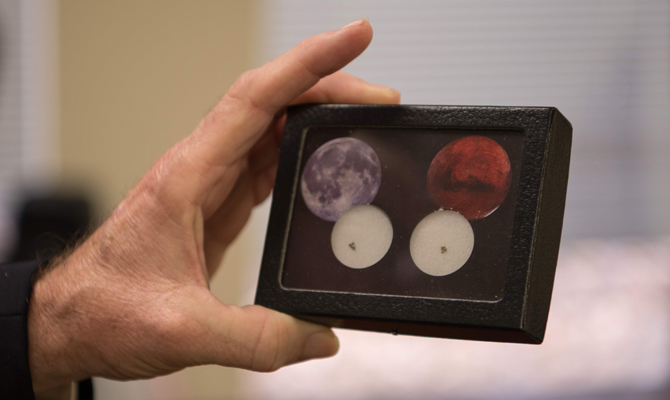
Joseph Gutheinz, an attorney known as the "Moon Rock Hunter," displays meteorite fragments in his office on May 22, 2019 in Friendswood, Texas. (AFP / Loren Elliot)
• Honduras’s Apollo 17 moon rock was recovered by Gutheinz and Bob Cregger, a US Postal Service agent, in a 1998 undercover sting operation baptized “Operation Lunar Eclipse.”
It had been sold to a Florida businessman, Alan Rosen, for $50,000 by a Honduran army colonel. Rosen tried to sell the rock to Gutheinz for $5 million. It was seized and eventually returned to Honduras.
• Ireland’s Apollo 11 moon rock was on display in Dublin’s Dunsink Observatory, which was destroyed in a 1977 fire. Debris from the observatory — including the moon rock — ended up in the Finglas landfill.
• The Apollo 11 and Apollo 17 moon rocks given to then Libyan leader Col. Muammar Qaddafi have vanished.
• Malta’s Apollo 17 moon rock was stolen from a museum in May 2004. It has not been found.
• Nicaragua’s Apollo 17 moon rock was allegedly sold to someone in the Middle East for $5-10 million. Its Apollo 11 moon rock ended up with a Las Vegas casino owner, who displayed it for a time in his Moon Rock Cafe. Bob Stupak’s estate turned it over to NASA when he died. It has since been returned to Nicaragua.
• Romania’s Apollo 11 moon rock is on display in a museum in Bucharest. Romania’s Apollo 17 moon rock is believed to have been sold by the estate of former dictator Nicolae Ceausescu, who was executed along with his wife, Elena, on Christmas Day 1989.
Spain’s Apollo 17 moon rock is on display in Madrid’s Naval Museum after being donated by the family of Admiral Luis Carrero Blanco, who was assassinated by the Basque separatist group ETA in 1973.
Spain’s Apollo 11 moon rock is missing and is believed to be in the hands of the family of former dictator Francisco Franco.
cl/sst