

Sudan's former president Bashir to be referred to trial soon

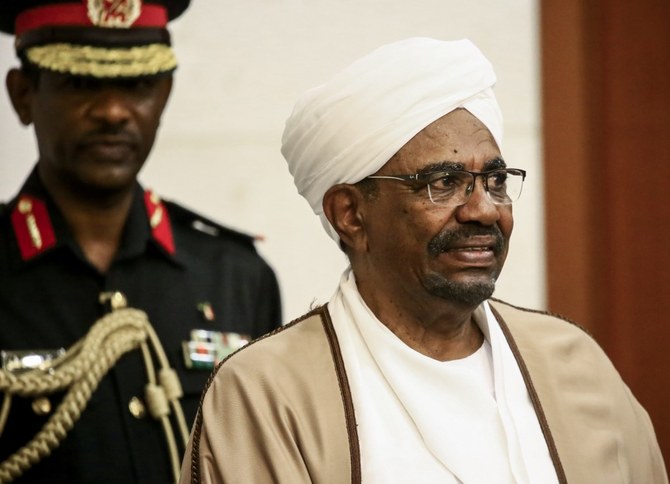
Ousted president Omar Al-Bashir will be referred for trial soon after a period for objections expires. (File/ AFP)
Updated 15 June 2019
Follow

Sudan's former president Bashir to be referred to trial soon

  • The decree demands that the joint UN-African Union peacekeeping force in Darfur hand over its premises as part of its withdrawal

KHARTOUM: Sudan's chief prosecutor said on Saturday that ousted president Omar Al-Bashir will be referred for trial soon after a period for objections expires.
Alwaleed Sayed Ahmed Mahmoud also told a news conference in Khartoum that criminal cases related to corruption have been opened against 41 other former officials.
He said he had attended a meeting with military heads to discuss judicial supervision of a plan to clear what he called "criminals" from an area adjacent to a protest camp in the centre of the capital.
But the idea of dispersing the protesters was not discussed, he said.

On Friday, a Sudanese diplomat said Sudan’s transitional military council had suspended the implementation of a decree demanding that the joint UN-African Union peacekeeping force in Darfur hand over its premises as part of its withdrawal next year. 
Omer Ahmed Mohamed Ahmed told the UN Security Council that the transitional military council also decided Thursday to withdraw all armed forces and other security forces from sites the government has already received from the peacekeeping force known as UNAMID.
The United Nations has opposed the transitional military council’s decree, saying under an agreement with the Sudanese government its facilities when handed over are to be used solely for civilian purposes.
Last July, the Security Council voted to dramatically cut the UNAMID force in the vast western Darfur region in response to reduced fighting and improved security conditions. The target for ending the mission is June 30, 2020, and Ahmed urged the council to keep to that timetable.
“We reject any attempt to postpone or suspend the exit of UNAMID given that there are no conditions, no justification or reasons for its presence,” Ahmed said.
Russia and China backed Sudan and urged the Security Council to stick to the timetable.
But Britain, Germany, South Africa, the United States and others raised questions about the impact on Darfur of the transitional military council’s crackdown on protesters last week that killed over 100 people and wounded hundreds more.
Earlier this week, the Security Council strongly condemned the violence and urged Sudanese authorities to immediately end the use of violence, respect human rights, and ensure justice and accountability.
A monthslong popular uprising against Sudanese President Omar Al-Bashir’s 30-year rule led to his fall from power in April, but there has been a standoff since then between the protesters and the transitional military council that succeeded him.
Britain’s Deputy UN ambassador Jonathan Allen told the council that his government and Germany are proposing “a technical rollover” to extend the UNAMID mandate, which expires June 30.
This “would provide time for progress on the broader political situation,” he said, and give time to resolve the issue of the handover of UNAMID sites.
South Africa’s UN Ambassador Jerry Matjila said “there is an urgent need for an assessment of the drawdown” of the UNAMID force, given the political situation following Al-Bashir’s ouster.
UNAMID must also ensure that its assets are handed over to civilian authorities — not the military, he stressed.


Syrian army and Kurdish forces exchange strikes east of Aleppo

Updated 5 sec ago
Follow

Syrian army and Kurdish forces exchange strikes east of Aleppo

  • This marks a potential escalation after recent clashes in the city of Aleppo
  • No casualties have been reported
ALEPPO: Syrian government forces and the Kurdish-led Syrian Democratic Forces exchanged fire Tuesday in a tense area of eastern Aleppo province, marking a possible escalation after days of clashes in the northern city.
No casualties were immediately reported, as an impasse continues in negotiations between the central government and the SDF over merging its thousands of fighters into the national army.
The Syrian army earlier declared an area east of Aleppo as a “closed military zone.” Eastern Aleppo province has been a tense frontline dividing areas under the Syrian government and large swaths of northeastern Syria under the SDF.
In a statement, the SDF said government forces have started shelling Deir Hafer district. The group later said government troops launched exploding drones, artillery and rockets to a village south of Deir Hafer.
Syrian state television later said the SDF targeted the village of Homeima on the other side of the Deir Hafer frontline with exploding drones.
Several days of deadly clashes in Aleppo last week displaced tens of thousands of people. They ended over the weekend with the evacuation of Kurdish fighters from the contested neighborhood of Sheikh Maqsoud. Aleppo Governor Azzam Ghareeb said Damascus now has full control of Sheikh Maqsoud and Achrafieh, where clashes took place.
Syrian officials have accused the SDF of building up its forces near the towns of Maskana and Deir Hafer, about 60 kilometers (37 miles) east of Aleppo city. SANA, the state news agency, reported that the army had declared the area a closed military zone because of “continued mobilization” by the SDF, and accused the group of using the area as a launchpad for drone attacks in Aleppo city.
The army statement said the armed groups should withdraw east of the Euphrates River.
A drone hit the Aleppo governorate building on Saturday shortly after two Cabinet ministers and a local official held a news conference on the developments in the city.
The SDF have denied mobilizing in the area or being behind the attack.
The leadership in Damascus, under interim President Ahmad Al-Sharaa, signed a deal in March with the SDF, which controls much of the northeast, for it to merge with the Syrian army by the end of 2025. There have been disagreements on how it would happen.
Some of the factions that make up the new Syrian army, which was formed after the fall of former President Bashar Assad in a rebel offensive in December 2024, were previously Turkiye-backed insurgent groups that have a long history of clashing with Kurdish forces.
The SDF for years has been the main US partner in Syria in fighting against the Daesh group, but Turkiye considers the SDF a terrorist organization because of its association with the Kurdistan Workers’ Party, or PKK, which has waged a long-running insurgency in Turkiye. A peace process is now underway.
Despite the long-running US support for the SDF, the Trump administration has also developed close ties with Al-Sharaa’s government and has pushed the Kurds to implement the March deal.
The recent developments have left the SDF and the autonomous administration that runs northeastern Syria frustrated with Washington and accusing Damascus of not implementing its end of the deal.
“The American government needs to clarify its position of the Syrian government which is committing massacres,” the administration’s foreign relations official, Elham Ahmad, told journalists Tuesday. She accused government forces of committing “horrific violations” and alleged that forces affiliated with IS and foreign fighters took part in the clashes.
Shams TV, a broadcaster based in Irbil — the seat of northern Iraq’s semi-autonomous Kurdish region — had been set to air an interview with Al-Sharaa on Monday but later announced it had been postponed for “technical” reasons, without giving a new date for broadcast.