

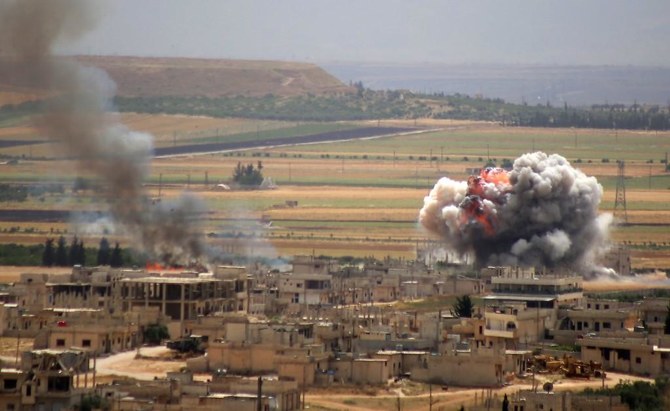

ANKARA: The dynamics in Syria’s latest opposition stronghold quietly shifted on Wednesday night with Russian news agencies claiming that Turkey and Russia had struck a cease-fire deal in Idlib between Syrian regime forces and opposition fighters.
However, contrary to the cease-fire claims, intensive shelling reportedly continued afterward targeting civilian zones in southern Idlib and the northern Hama countrysides. Turkey’s tenth observation post in the enclave was also attacked from the Syrian regime-held territory of Al-Shariah, wounding Turkish soldiers and damaging facilities.
The Turkish Foreign Ministry denied the cease-fire and announced that it would retaliate if regime attacks continue. The counterattacks by Syrian fighters against pro-Assad forces continued on Thursday.
Experts underline that such declarations of a cease-fire are only to provide room for maneuvering by Russia and Turkey to negotiate the dynamics on the ground in the light of their regional interests.
Hundreds of civilians have been killed and hundreds of thousands displaced since the Russian-led military offensive in northwestern Syria, which has become the scene of a serious military escalation between Assad regime forces and the fighters.
Joe Macaron, a fellow at the Arab Center in Washington, DC, thinks this is not the first or last time a fragile Russian-Turkish cease-fire announced in Idlib has already been violated.
FASTFACT
The Turkish Foreign Ministry denied the cease-fire and announced that it would retaliate if regime attacks continue. The counter-attacks by Syrian fighters against pro-Assad forces continued on Thursday.
“The two sides have irreconcilable interests in Idlib, however they chose neither to fight if off nor to strike a deal since both scenarios have a detrimental impact on their bilateral relations,” he told Arab News.
Moscow backs the Syrian regime, while Ankara gives its support to some opposition groups in the region.
For Macaron, the only way out of the Idlib quagmire is either the shortcut of an unwarranted military solution or the long-term arduous path of conflict resolution.
Some experts see the latest developments in Idlib from the prism of the current dynamics in relations between Moscow and Ankara, especially regarding the Russian air defense S-400 system and its approaching delivery within two months. Russian reports about the cease-fire in Idlib came hours after Turkish President Recep Tayyip Erdogan announced that Turkey has already bought S-400s, challenging the US threat of sanctions over the purchase.
“Idlib and the S-400 delivery have become increasingly intertwined and caught up in the US-Russian tensions and Turkey’s attempt to play both sides,” Macaron said.
“Erdogan is approaching a critical moment next month where he might have to choose between coming under significant US pressure if he officially receives the S-400s and dealing with a Russian offensive in Idlib if the S-400 deal does not go through,” he said.
Erdogan would also be put under domestic pressure ahead of the June 23 Istanbul vote if any escalation in Idlib triggered massive refugee flows to Turkey, considering the deep anti-Syrian sentiments among Turkish society.
Dr. Kerim Has, a Moscow-based analyst on Russia-Turkey relations, thinks that the latest cease-fire in Idlib cannot be realized.
“Following the “anonymous attack” in Idlib against Turkey’s tenth observation point, Ankara blamed the Syrian regime forces, whereas the Russian Ministry of Defense pointed out the militant groups and disclosed Turkey’s request for Moscow’s assistance to counter the attack,” Has told Arab News.
“The Turkish side denied Russian claims, and both statements still have quite contradictory details if compared with each other,” he said.
According to Has, the recent incompatible views of Turkey and Russia in Idlib have two main aspects.
“First, the Sochi deal of September 2018 on Idlib was born as an absolutely ‘dead deal,’ and Ankara now has to face the realities on the ground. Moscow’s pressure intensifies as the last chance for Turkey to eliminate the terrorist groups in the region who fled away,” he said.
Has noted that a 15-20 km demilitarized zone could not be created, and the M4 and M5 highways are still close to Assad regime’s use.
“Cease-fire violations both by the regime and Hayat Tahrir Al-Sham, or HTS, and other militant groups never stopped, drone attacks against Russian bases keep on going. HTS now almost totally dominates the Idlib province compared to partly controlling it when the Sochi deal was reached,” he said.
Experts also note that the deepening crisis in Turkish-US relations following the S-400 decision and F-35 deadlock plays into the hands of Moscow, especially in Idlib where “horse-trading” is heating up.
New Russian weapons were monitored heading for Syria through the Turkish straits a few days ago — likely a prelude to a bigger offensive in the region.
“Most possibly, we are going to watch not a comprehensive offensive soon, but a ‘slow motion’ advancement of regime forces in Idlib at least until the first US sanctions on Turkey over S-400’s procurement,” Has said.
“It seems that the cease-fire is part of Russia’s ‘strategy game.’ So, unfortunately new ‘friendly fires’ are likely to happen again if Turkey cannot quit this awkward dilemma,” he said.


