

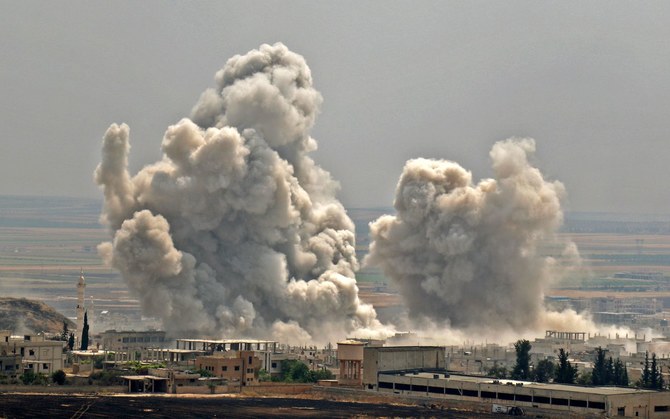
Russia carries out air strikes against militants in Syria’s Idlib

The Russian Ministry of Defence said on Thursday that its planes had carried out four air strikes against militants in Syria's Idlib region. (File/AFP)
Updated 13 June 2019
Follow

Russia carries out air strikes against militants in Syria’s Idlib

  • The Syrian army and its allies shelled rebel-held areas of northwest Syria on Thursday and attacked a Turkish observation post
  • Russia is Damascus’s main ally in the civil war between Syrian President Bashar Assad and rebels seeking to oust him, using its warplanes to bombard opposition areas

MOSCOW: The Russian Ministry of Defence said on Thursday that its planes had carried out four air strikes against militants in Syria's Idlib region, the RIA news agency reported.
The Russian military said that the Turkish army had asked for its help to protect Turkish troops by striking "terrorists in Idlib".

Earlier, the Syrian army and its allies shelled rebel-held areas of northwest Syria on Thursday and attacked a Turkish observation post, Ankara and a monitoring group said, despite Russia saying it and Turkey had brokered a new cease-fire.

However, Turkish Foreign Minister Mevlut Cavusoglu on Thursday said a ceasefire had not been fully secured in Syria's northwestern Idlib province, despite the announcement by Moscow.
"We are working hard with Russia to stop these attacks. It is not possible to say a complete ceasefire has been secured," Cavusoglu told a press conference with his French counterpart Jean-Yves Le Drian.
Turkey’s Defense Ministry said Syrian government forces carried out what it assessed to be a deliberate attack, firing 35 mortar shells at one of its observation posts in the de-escalation zone in Idlib, wounding three Turkish soldiers and damaging equipment and facilities.
Ankara has made representations to Moscow about the incident, the defense ministry said. It did not say when exactly the attack happened.
The Syrian Observatory for Human Rights, a war monitor, said air strikes on rebel-held areas paused overnight, but resumed on Thursday morning. They targeted the area around Khan Sheikhoun, an opposition-held town in southern Idlib province, it said, adding that the insurgents had also fired artillery at government forces.
On Wednesday, the Russian military said that Moscow and Ankara had agreed a full cease-fire in the northwest, centered on Idlib, but it did not say how long the truce would last.
The Syrian government launched its offensive against northwest Syria, the last major stronghold of the rebellion against it, in late April.
Russia is Damascus’s main ally in the civil war between Syrian President Bashar Assad and rebels seeking to oust him, using its warplanes to bombard opposition areas. Turkey backs some insurgent groups.
Moscow and Ankara had agreed a partial truce last September that called for an end to bombardment of the area and for Ankara to pull heavy weapons and militant groups from frontline areas.
The fighting has caused hundreds of thousands of people, many of whom had already been displaced, to flee further north and seek shelter along the Turkish border.
Turkey has pushed Russia to rein in the government’s offensive while Russia has said Turkey must curb the militant groups that dominate in Idlib.


Trump claims Iran working on missiles that could hit US

Updated 42 min 42 sec ago
Follow

Trump claims Iran working on missiles that could hit US

  • Trump says his preference is diplomacy, but would never allow Tehran to have a nuclear weapon

WASHINGTON: US President Donald Trump on Tuesday claimed Iran is seeking to develop missiles that can strike the United States and accused Tehran of working to rebuild a nuclear program that was targeted by American strikes last year.

The United States and Iran are engaged in high-stakes negotiations over Iran’s atomic program and other issues including missiles, with Trump saying he prefers diplomacy but is willing to use force if talks fail.

“They’ve already developed missiles that can threaten Europe and our bases overseas, and they’re working to build missiles that will soon reach the United States of America,” Trump said during his State of the Union address.

In 2025, the US Defense Intelligence Agency said Iran could potentially develop a militarily viable intercontinental ballistic missile by 2035 “should Tehran decide to pursue the capability,” but did not say if it had made such a decision.

Tehran currently possesses short- and medium-range ballistic missiles with ranges that top out at about 1,850 miles (3,000 kilometers), according to the US Congressional Research Service.

The continental United States is more than 6,000 miles from Iran’s western tip.

Washington and Tehran have concluded two rounds of talks aimed at reaching a deal on Iran’s nuclear program to replace the agreement that Trump tore up during his first term in office.

 ‘Preference’ is diplomacy

The United States has repeatedly called for zero uranium enrichment by Iran but has also sought to address its ballistic missile program and support for armed groups in the region — demands Iran has rejected.

Iran has also repeatedly rejected that it is pursuing nuclear weapons.

Trump ordered strikes on three Iranian nuclear sites last year, claiming afterward that Tehran’s atomic program was obliterated.

On Tuesday, he said Iran wants “to start all over again,” and that it is “at this moment again pursuing their sinister nuclear ambitions.”

Trump has sent a massive US military force to the Middle East, deploying two aircraft carriers as well as more than a dozen other ships, a large number of warplanes and other assets to the region.

He has repeatedly threatened to strike Iran if negotiations fail to reach a new agreement. Talks with Tehran are currently set to continue on Thursday.

“My preference is to solve this problem through diplomacy but one thing is certain: I will never allow the world’s number one sponsor of terror, which they are by far, to have a nuclear weapon,” Trump said.

The US president’s speech primarily focused on domestic issues, making no mention at all of China — Washington’s primary military and economic rival — and only briefly referring to Russia.

Trump said he was working to end the bloody conflict between Russia and Ukraine, and repeated his inaccurate claim that he had brought eight other wars to an end since returning to office in January 2025.

He also hailed NATO’s decision to spend five percent of gross domestic product on defense — a move made under heavy pressure from Trump and his administration.