Kosovo Albanians welcome Clinton, Albright 20 years after NATO intervention

1 / 3
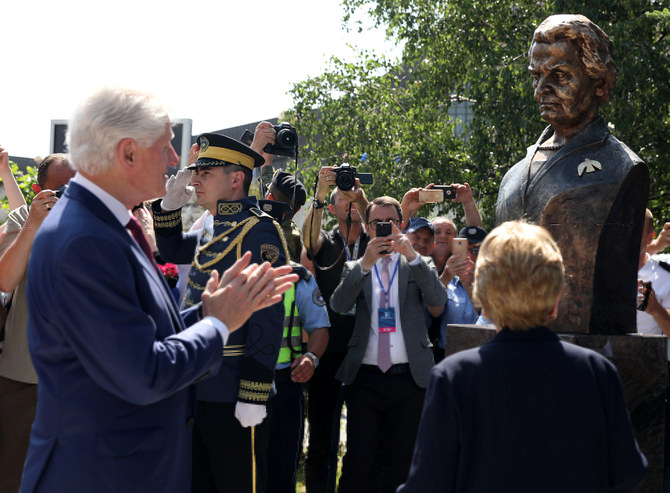
Former US President Bill Clinton applauds during the inauguration of the monument of Madeleine Albright at the 20th anniversary of the Deployment of NATO Troops in Kosovo, in Pristina. (Reuters)
2 / 3
Former US President Bill Clinton, Madeleine Albright, and President of Kosovo Hashim Thaci, walk during the 20th anniversary of the Deployment of NATO Troops in Kosovo, in Pristina. (Reuters)
3 / 3
Former US President Bill Clinton, Madeleine Albright, and President of Kosovo Hashim Thaci, walk during the 20th anniversary of the Deployment of NATO Troops in Kosovo, in Pristina. (Reuters)
Updated 12 June 2019
Follow

Kosovo Albanians welcome Clinton, Albright 20 years after NATO intervention

  • Clinton, 72, and Albright, 82, were greeted like rock stars in the Kosovo capital Pristina where a statue of Albright was unveiled in the city center for the occasion
  • Majority-Albanian Kosovo declared independence from Serbia in 2008, nine years after NATO air strikes ended Belgrade’s repressive grip on the territory

PRISTINA: Thousands of Kosovo Albanians turned out on Wednesday to welcome back former US president Bill Clinton and his ex-top diplomat Madeleine Albright 20 years after they helped engineer the NATO air war that ousted Serbian forces.
Clinton, 72, and Albright, 82, were greeted like rock stars in the Kosovo capital Pristina where a statue of Albright was unveiled in the city center for the occasion, joining one of Clinton erected earlier on a boulevard named after him.
Majority-Albanian Kosovo declared independence from Serbia in 2008, nine years after NATO air strikes ended Belgrade’s repressive grip on the territory following a brutal counter-insurgency campaign by Serbian security forces.
“I love this country and it will always be one of the greatest honors of my life to have stood with you against ethnic cleansing (by Serbian forces) and for freedom,” Clinton told thousands gathered in sweltering heat in downtown Pristina.
Marking the 20th anniversary of NATO peacekeeping troops entering Kosovo after Serbian forces left, Kosovo President Hashim Thaci awarded Clinton and Albright medals of freedom “for the liberty he brought to us and the peace to entire region.”
Clinton and Albright were the most outspoken proponents of NATO intervention to halt killings of Kosovar civilians by Serbian forces as part of Belgrade’s 1998-99 crackdown on a Kosovo Albanian guerrilla uprising.
“I was watching the NATO planes from the window of my apartment in Pristina during the war and I was praying to God and the USA; I had no other hope,” said Gani Kelmendi, 78, as he waited in the crowd for Clinton to appear.
“I remember the moment when in my village the Serb army was getting out and French soldiers were coming in. I could not believe my eyes,” said Fetah Berisha, 67, who considers Clinton Kosovo’s “savior.”
But the end of fighting brought about by NATO’s intervention has not brought true peace to the southern Balkan region.
Belgrade has still not recognized independent Kosovo more than a decade after more than 110 other countries did and, backed by its main ally Russia, is blocking Pristina’s bid for membership of the United Nations.
Tensions rose anew six months ago when Kosovo introduced a 100 percent tax on goods imported from Serbia and warned it would keep them until Belgrade recognized its independence.
The European Union has warned Kosovo and Serbia that they will not advance toward wished-for membership unless they reach an agreement to normalize relations.


Pakistan combing for perpetrators after deadly separatist attacks

Updated 9 sec ago
Follow

Pakistan combing for perpetrators after deadly separatist attacks

  • Around a dozen sites where the attacks took place — including the provincial capital Quetta — remained sealed off
  • The Baloch Liberation Army, the province’s most active militant separatist group, claimed responsibility for the attacks
QUETTA, Pakistan: Pakistan forces were hunting on Sunday for the separatists behind a string of coordinated attacks in restive Balochistan province, with the government vowing to retaliate after more than 120 people were killed.
Around a dozen sites where the attacks took place — including the provincial capital Quetta — remained sealed off, with troops combing the area a day after militants stormed banks, jails and military installations, killing at least 18 civilians and 15 security personnel, according to the military’s count.
At least 92 militants were also killed, the military added, while an official said that a deputy district commissioner had been abducted.
Mobile Internet service across the province has been jammed for more than 24 hours, while road traffic is disrupted and train services suspended.
After being rocked by explosions, typically bustling Quetta lay quiet on Sunday, with major roads and businesses deserted, and people staying indoors out of fear.
Shattered metal fragments and mangled vehicles litter some roads.
“Anyone who leaves home has no certainty of returning safe and sound. There is constant fear over whether they will come back unharmed,” Hamdullah, a 39-year-old shopkeeper who goes by one name, said in Quetta.
The Pakistan military said it was conducting “sanitization operations” in the areas that had been targeted in Saturday’s attacks.
“The instigators, perpetrators, facilitators and abettors of these heinous and cowardly act... will be brought to justice,” it said in a statement Saturday night.
The Baloch Liberation Army (BLA), the province’s most active militant separatist group, claimed responsibility for the attacks in a statement sent to AFP.
The group said it had targeted military installations as well as police and civil administration officials in gun attacks and suicide bombings.
Saturday’s attacks came a day after the military said it killed 41 insurgents in two separate operations in the province.
Pakistan has been battling a Baloch separatist insurgency for decades, with frequent armed attacks on security forces, foreign nationals and non-local Pakistanis in the mineral-rich province bordering Afghanistan and Iran.
Pakistan’s poorest province despite an abundance of untapped natural resources, Balochistan lags behind the rest of the country in almost every index, including education, employment and economic development.
Baloch separatists have intensified attacks on Pakistanis from other provinces working in the region in recent years, as well as foreign energy firms that they believe are exploiting its riches.
The separatists attacked a train with 450 passengers on board last year, sparking a two-day siege during which dozens of people were killed.