

PM Khan thanks Saudi Arabia, China and UAE for financial assistance

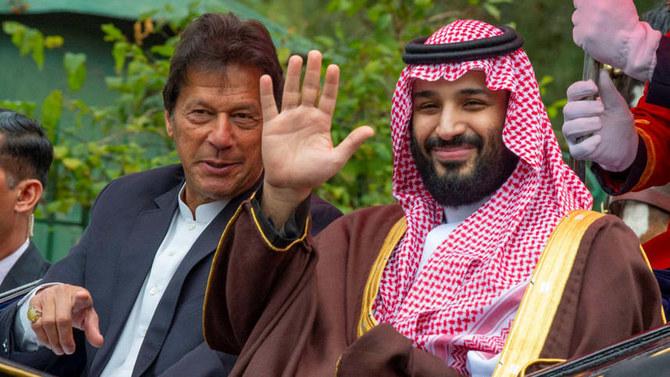
Pakistan’s Prime Minister Imran Khan and Saudi Crown Prince Mohammed Bin Salman riding in a carriage during a welcome ceremony in Islamabad on February 18, 2019. (AFP)
Updated 13 June 2019
Follow

PM Khan thanks Saudi Arabia, China and UAE for financial assistance

  • In televised post-budget speech, PM says three friendly countries helped Pakistan in times of economic difficulty
  • KSA has given Pakistan $3 billion in foreign currency support, $3 billion deferred oil payments facility

ISLAMABAD: Prime Minister Imran Khan on Tuesday hailed financial assistance that Pakistan has received from Saudi Arabia, United Arab Emirates (UAE) and China to prop up its stumbling economy and plug its depleted reserves.

In a speech televised late on Tuesday night following the presentation of the budget proposal for the fiscal year to June 2020, Khan said the three friendly countries had stood by Pakistan in times of economic difficulty.

Revenue Minister Hammad Azhar also underlined the importance of the financial aid received from Saudi Arabia, UAE and China while presenting the budget proposal in the National Assembly on Tuesday.

“We borrowed a total of $9.2 billion from China, Kingdom of Saudi Arabia, and the United Arab Emirates,” Azhar said.

Last year, Saudi Arabia gave Pakistan $3 billion in foreign currency support along with a $3 billion facility for deferred payments for oil imports. The prime minister’s adviser on finance, Abdul Hafeez Shaikh, confirmed last month that Saudi Arabia would activate the deferred oil payment facility from July 1, 2019 under which Islamabad will receive $3.2 billion per year for three years.  

Islamabad also received $3 billion in economic assistance from the UAE in December 2018 while all-weather friend China lent $2.2 billion in March this year. Beijing is also investing close to $60 billion in Pakistan under the China Pakistan Economic Corridor (CPEC) of infrastructure and energy projects.


Pakistan says responding to Afghan ‘offensive operations’ after border fire as tensions escalate

Updated 56 min 19 sec ago
Follow

Pakistan says responding to Afghan ‘offensive operations’ after border fire as tensions escalate

  • Afghan Taliban spokesperson says “large-scale offensive operations” launched against Pakistani military bases
  • Pakistan says Afghan forces opened “unprovoked” fire across multiple sectors along shared border

ISLAMABAD: Afghanistan’s Taliban authorities said on Thursday they had launched “large-scale offensive operations” against Pakistani military bases and installations, prompting Pakistan to say its forces were responding to what it described as unprovoked fire along the shared border.

The escalation follows Islamabad’s weekend airstrikes targeting what it said were Tehreek-e-Taliban Pakistan (TTP) and Daesh militant camps inside Afghanistan in response to a wave of recent bombings and attacks in Pakistan. Islamabad said the strikes killed over 100 militants, while Kabul said dozens of civilians were killed and condemned the attacks as a violation of its sovereignty.

In a post on social media platform X, Afghan government spokesperson Zabihullah Mujahid said Afghanistan had launched “large-scale offensive operations” in response to repeated violations by the Pakistani military.


Pakistan’s Ministry of Information said Afghan forces had initiated hostilities along multiple points of the frontier.

“Afghan Taliban regime unprovoked action along the Pakistan–Afghanistan border given an immediate, and effective response,” the ministry said in a statement.

The statement said Pakistani forces were targeting Taliban positions in the Chitral, Khyber, Mohmand, Kurram and Bajaur sectors, claiming heavy Afghan casualties and the destruction of multiple posts and equipment. It added that Pakistan would take all necessary measures to safeguard its territorial integrity and the security of its citizens.


Separately, security officials said Pakistani forces had carried out counterattacks in several border sectors.

“Pakistan’s security forces are giving a befitting reply to the unprovoked Afghan aggression with full force,” a security official said, declining to be named. 

“The Pakistani security forces’ counter-attack destroyed Taliban’s hideouts and the Khawarij fled,” they added, referring to TTP militants. 

The claims from both sides could not be independently verified.

Cross-border violence has intensified in recent weeks, with Pakistan blaming a surge in suicide bombings and militant attacks on militants it says are based in Afghanistan. Kabul denies providing safe havens to anti-Pakistan militant groups.

The clashes mark the third major escalation between the neighbors in less than a year. Similar Pakistani strikes last year triggered weeklong clashes before Qatar, Türkiye and other regional actors mediated a ceasefire in October.

The 2,600-kilometer (1,600-mile) frontier, a key trade and transit corridor linking Pakistan to landlocked Afghanistan and onward to Central Asia, has faced repeated closures amid tensions, disrupting commerce and humanitarian movement. Trade between the two nations has remained closed since October 2025.