

In Karachi, a growing love affair with a beloved Arab dish

1 / 2
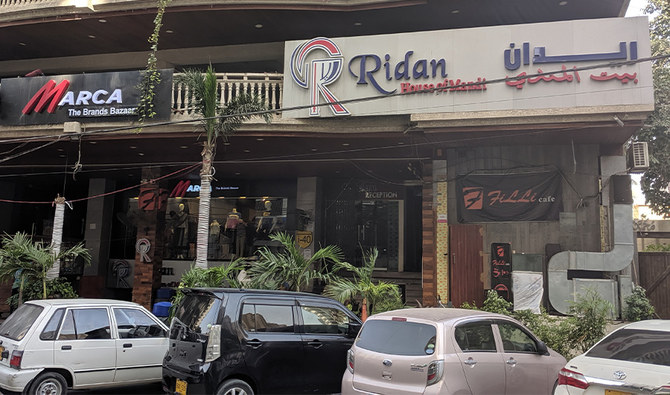
Ridan Mandi, a restaurant offering Arabic cuisines, is offering Arabic taste to local food lovers as well as Arab students, diplomats and businessmen since October 2016, owner Umair Idrees told Arab News on June, 8, 2019 ( AN Photo)
2 / 2
A plate of succulent meat mandi at Bait al Mandi in Karachi; June 8, 2019. (AN Photo)
Updated 12 June 2019
Follow

In Karachi, a growing love affair with a beloved Arab dish

  • People in the Pakistani port city have developed a taste for mandi, a medley of slow-stewed meat and fluffy rice
  • Dubai’s Bait al Mandi opens franchise in Karachi, adding to the list of restaurants where the classic Yemeni dish is available

KARACHI: After nearly two decades of service in the United Arab Emirates, Bait al Mandi restaurant opened a franchise in the Pakistani port city of Karachi on Friday, as eager customers lined up to try traditional Arab cuisine, particularly mandi, a medley dish of rice and meat and a signature blend of spices.
Mandi originated in Yemen and is extremely popular in many areas of the Arabian Peninsula. In Karachi, the dish is not entirely new. The popular Hanifia restaurant added mandi to its menu in 2007, and a speciality mandi restaurant called Ridan Mandilaunched in 2016. Many other restaurants that serve Pakistani food have also started offering mandi, albeit customized to Pakistani tastes, due to a growing demand for the dish.
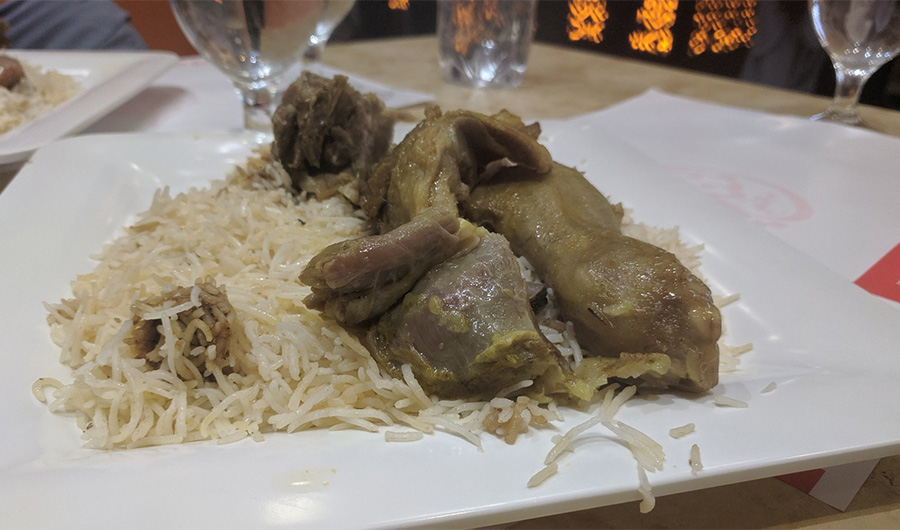


A plate of meat mandi, a traditional Arabic dish of rice and meat mixed with a signature blend of spices, costs Rs1,330 plus tax, at Bait al Mandi in Karachi; June 8, 2019. (AN Photo)

Celebrity chef Naheed Ansari said Arab cuisine was fast making inroads in Pakistan, and mandi was becoming particularly popular given its similarities to the Pakistani pulao and biryani meat and rice dishes.
“I like mandi and Arabic cuisine but to attract more Pakistani customers, Arab restaurants will need to add a few green or red chilies,” she told Arab News, referring to a Pakistani preference for spicy food. “Arab cuisine will also need to fit into local tastes, the way we have done with Chinese cuisine in Pakistan, created a fusion.”
Customers at Dubai’s Bait al Mandi restaurant said the dish wasn’t as spicy as they were used to eating but they still found it appetizing.
“The food wasn’t spicy as is common here in Karachi but it was mouth-watering,” said Tamjid Aijazi as he walked out of Bait al Mandi with his family on Friday night. “We ordered chicken mandi as we are used to doing regularly when we visit Dubai. It was great.”
Adnan al Omare, the Jordanian general manager of Bait al Mandi, said the restaurant had aimed to keep its recipe simple and original, resisting the temptation to add spices or other local flavours.



A large number of people queue up at Bait al Mandi, a franchise of a Dubai and Omani brand of Arabic cousins, in Karachi on June 8, 2019 (AN Photo)

“It’s the same dish as we have in Dubai and Oman,” Omare said, adding that all the chefs were Arabs. “They are trained and have twenty years of experience of cooking Arabic cuisines.”
Others like Hanifia and Ridan Mandi have preferred to alter the classic Yemeni dish to suit local tastes.
Umair Idrees, the owner of Ridan Mandi, said his chefs had trained for four months in Jeddah, Saudia Arabia, before he started serving Arabic food in Karachi.
“We have added a little spice to our original recipe,” he told Arab News, so that it would be appetizing both for Pakistanis and the large number of Arab customers working and studying in Karachi.
Behroze Sabzwari, a Pakistani film actor who was a guest at Bait al Mandi’s launch event on Friday evening, said Pakistan had a deep emotional attachment with Saudi Arabia and the rest of the Arab world and it was a welcome sign that the countries were embracing each other’s food also.
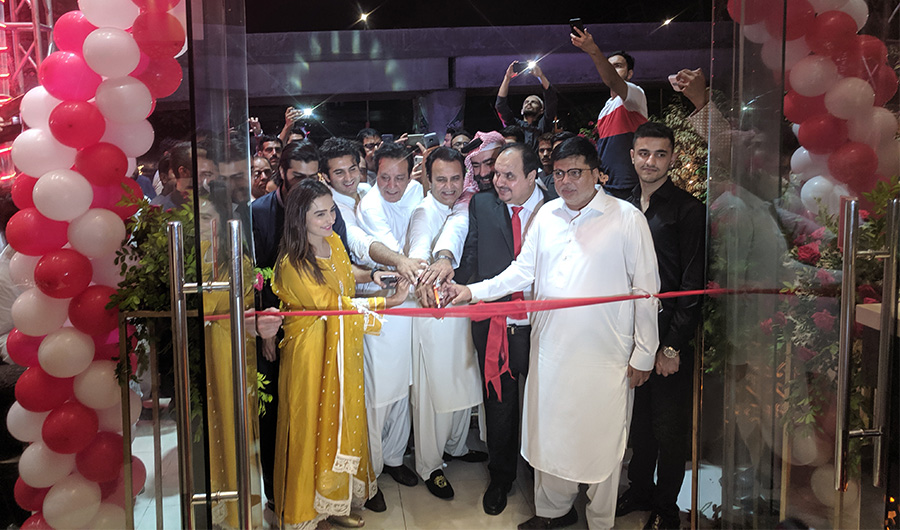


TV and film actors Behroz Subzwari (C), Javed Sheikh, Restaurant General Manager Adnan Al Omare, and actors Behroz Subzwari and Momal Sheikhs (L) inaugurate Bait al Mandi restaurant in Karachi on June, 7, 2019 ( AN Photo)

“Besides our religion which is the core, there are cultural commonalities and food is a new addition,” he said, adding that he ate mandi when he visited Makkah and Madinah, or the UAE, but had to wait each time to go back to these countries to have the beloved dish.
“Now I don’t need to wait anymore,” Sabzwari said. “I finally have mandi in my own hometown.”


Pakistan vaccinates over 43 million children as last polio drive of 2025 enters 6th day

Updated 8 sec ago
Follow

Pakistan vaccinates over 43 million children as last polio drive of 2025 enters 6th day

  • Campaign running simultaneously in Pakistan and Afghanistan, last two polio-endemic countries
  • Health authorities urge parents and communities to fully cooperate with anti-polio vaccinators

ISLAMABAD: Pakistan has vaccinated more than 43.8 million children in five days of its last nationwide polio campaign of 2025, health authorities said on Saturday, as the drive entered its sixth day amid renewed efforts to curb the virus.

The campaign, running from Dec. 15 to 21, targets children under the age of five and is being conducted simultaneously in Pakistan and Afghanistan, according to Pakistan’s National Emergency Operations Center (NEOC) which oversees eradication efforts.

Pakistan and neighboring Afghanistan are the only two countries where wild poliovirus transmission has never been interrupted, keeping global eradication efforts at risk. The virus, which can cause irreversible paralysis, has no cure and can only be prevented through repeated oral vaccination.

“The last nationwide polio campaign of 2025 continues in full swing on the sixth day,” the NEOC said in a statement. “Over 43.8 million children have been vaccinated in five days so far.”

Provincial data released by the National EOC showed that around 22.7 million children had been vaccinated in Punjab province, more than 10.2 million in Sindh, approximately 6.9 million in Khyber Pakhtunkhwa and about 2.5 million in Balochistan. In Islamabad, over 450,000 children received polio drops, while more than 274,000 were vaccinated in Gilgit-Baltistan and over 714,000 in Azad Jammu and Kashmir.

“The polio campaign is being conducted simultaneously in Pakistan and Afghanistan,” the NEOC said. “More than 400,000 polio workers are going door to door across the country to administer vaccines.”

Pakistan has logged 30 polio cases so far in 2025, underscoring the fragility of progress against the virus. The country recorded 74 cases in 2024, a sharp rise from six cases in 2023, reflecting setbacks caused by vaccine hesitancy, misinformation and access challenges in high-risk areas.

Health officials say insecurity remains a major obstacle. Polio workers and their security escorts have repeatedly been targeted in militant attacks, particularly in parts of northwestern Khyber Pakhtunkhwa and southwestern Balochistan, complicating efforts to reach every child. Natural disasters, including flooding, have further disrupted vaccination campaigns in recent years.

“Parents and communities are urged to fully cooperate with polio workers,” the NEOC said, stressing that every child under the age of five must be given polio drops.

Pakistan has dramatically reduced polio prevalence since the 1990s, when annual cases exceeded 20,000. Health authorities, however, warn that without sustained access to children in underserved and conflict-affected areas, eradication will remain out of reach.