

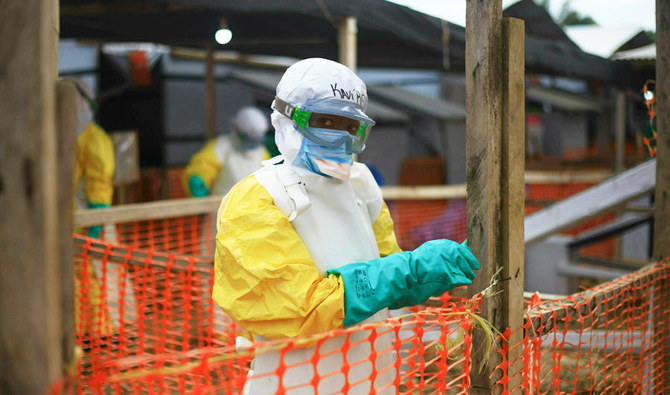

KAMPALA: A five-year-old boy is being treated for Ebola in Uganda, the first case since a deadly outbreak in neighboring Democratic Republic of Congo 10 months ago, Health Minister Ruth Aceng said Tuesday.
Uganda has been on high alert since the outbreak across a porous border in the eastern DRC, where more than 2,000 cases of the highly contagious virus have been recorded, two-thirds of which have been fatal.
“An Ebola case has been confirmed positive,” Aceng told AFP.
She said the patient was a boy who had traveled with his family from the western Ugandan town of Kasese to the Democratic Republic of Congo for a funeral, and fell sick upon his return.
“The boy has been taken into isolation unit as have other family members for monitoring. He is receiving treatment,” she said.
The World Health Organization confirmed the highly contagious virus had spread to Uganda, in its second-worst outbreak ever.
“The Ministry of Health and WHO have dispatched a Rapid Response Team to Kasese to identify other people who may be at risk, and ensure they are monitored and provided with care if they also become ill,” the WHO said in a statement.
According to the WHO, Uganda vaccinated nearly 4,700 health workers in 165 facilities with an experimental drug designed to protect them against the virus.
Uganda has experienced several outbreaks in the past, most recently in 2012, while in 2000 more than 200 people died in an outbreak in the north of the country.
The DRC has struggled to contain the outbreak which was first recorded in North Kivu province on August 1 and then spread to neighboring Ituri and has left over 1,300 dead.
Efforts to tackle the crisis have been hampered both by militia attacks on treatment centers and by the hostility of some local people to the medical teams.
Five workers have been killed, according to an AFP tally, and important preventative work, such as vaccination programs and burials of Ebola victims, has been delayed.
The outbreak is the 10th in Democratic Republic of Congo since the disease was identified in 1976.
It is the worst on record after an epidemic that struck Liberia, Guinea and Sierra Leone between 2014-2016, leaving more than 11,300 people dead.
“It is clear the current response to tackle Ebola isn’t working. No matter how effective treatment is, if people don’t trust or understand it, they will not use it,” Oxfam’s director for the DRC, Corinne N’Daw, said last week.
“Our teams are still meeting people on a daily basis who don’t believe Ebola is real... many cases are going unnoticed because people with symptoms have been avoiding treatment.”
Ebola is transmitted to people from wild animals and spreads among humans though close contact with the blood, body fluids, secretions or organs of an infected person.
Chimpanzees, gorillas, monkeys, forest antelope and porcupines can also become infected, and humans who kill and eat these animals can catch the virus through them.
Symptoms include high fever, intense muscle and joint pain, headaches and a sore throat which are often followed by vomiting and diarrhea, skin eruptions, kidney and liver failure, internal and external bleeding.
At present there is no licensed drug to prevent or treat Ebola although a range of experimental drugs are in development and thousands have been vaccinated in the DRC and some neighboring countries.
The average fatality rate from Ebola is around 50 percent, varying from 25 to 90 percent, according to the WHO.


