

Uganda confirms Ebola case as virus spreads from DRCongo

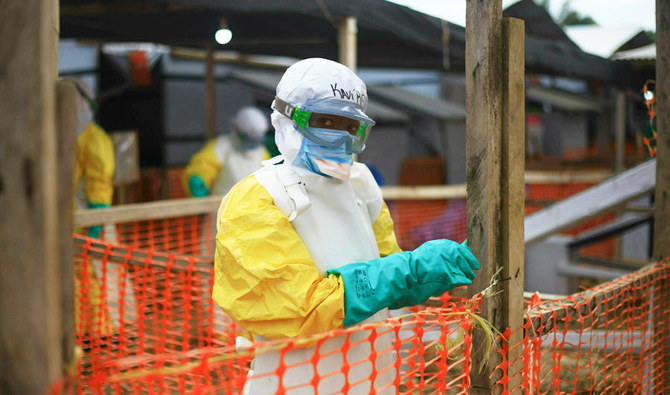
This Tuesday, April, 16, 2019 file photo taken in Congo shows an Ebola health worker at a treatment center in Beni, Eastern Congo. (AP)
Updated 12 June 2019
Follow

Uganda confirms Ebola case as virus spreads from DRCongo

  • Symptoms include high fever, intense muscle and joint pain, headaches and a sore throat which are often followed by vomiting and diarrhea, skin eruptions, kidney and liver failure

KAMPALA: A five-year-old boy is being treated for Ebola in Uganda, the first case since a deadly outbreak in neighboring Democratic Republic of Congo 10 months ago, Health Minister Ruth Aceng said Tuesday.
Uganda has been on high alert since the outbreak across a porous border in the eastern DRC, where more than 2,000 cases of the highly contagious virus have been recorded, two-thirds of which have been fatal.
“An Ebola case has been confirmed positive,” Aceng told AFP.
She said the patient was a boy who had traveled with his family from the western Ugandan town of Kasese to the Democratic Republic of Congo for a funeral, and fell sick upon his return.
“The boy has been taken into isolation unit as have other family members for monitoring. He is receiving treatment,” she said.
The World Health Organization confirmed the highly contagious virus had spread to Uganda, in its second-worst outbreak ever.
“The Ministry of Health and WHO have dispatched a Rapid Response Team to Kasese to identify other people who may be at risk, and ensure they are monitored and provided with care if they also become ill,” the WHO said in a statement.
According to the WHO, Uganda vaccinated nearly 4,700 health workers in 165 facilities with an experimental drug designed to protect them against the virus.
Uganda has experienced several outbreaks in the past, most recently in 2012, while in 2000 more than 200 people died in an outbreak in the north of the country.

The DRC has struggled to contain the outbreak which was first recorded in North Kivu province on August 1 and then spread to neighboring Ituri and has left over 1,300 dead.
Efforts to tackle the crisis have been hampered both by militia attacks on treatment centers and by the hostility of some local people to the medical teams.
Five workers have been killed, according to an AFP tally, and important preventative work, such as vaccination programs and burials of Ebola victims, has been delayed.
The outbreak is the 10th in Democratic Republic of Congo since the disease was identified in 1976.
It is the worst on record after an epidemic that struck Liberia, Guinea and Sierra Leone between 2014-2016, leaving more than 11,300 people dead.
“It is clear the current response to tackle Ebola isn’t working. No matter how effective treatment is, if people don’t trust or understand it, they will not use it,” Oxfam’s director for the DRC, Corinne N’Daw, said last week.
“Our teams are still meeting people on a daily basis who don’t believe Ebola is real... many cases are going unnoticed because people with symptoms have been avoiding treatment.”
Ebola is transmitted to people from wild animals and spreads among humans though close contact with the blood, body fluids, secretions or organs of an infected person.
Chimpanzees, gorillas, monkeys, forest antelope and porcupines can also become infected, and humans who kill and eat these animals can catch the virus through them.
Symptoms include high fever, intense muscle and joint pain, headaches and a sore throat which are often followed by vomiting and diarrhea, skin eruptions, kidney and liver failure, internal and external bleeding.
At present there is no licensed drug to prevent or treat Ebola although a range of experimental drugs are in development and thousands have been vaccinated in the DRC and some neighboring countries.
The average fatality rate from Ebola is around 50 percent, varying from 25 to 90 percent, according to the WHO.


Peru Congress to debate impeachment of interim president

Updated 6 sec ago
Follow

Peru Congress to debate impeachment of interim president

LIMA: Peru’s Congress is set to consider Tuesday whether to impeach interim president Jose Jeri, the country’s seventh head of state in 10 years, accused of the irregular hiring of several women in his government.
A motion to oust Jeri, 39, received the backing of dozens of lawmakers on claims of influence peddling, the latest of a series of impeachment bids against him.
The session, set for 10:00 am local time (1500 GMT), is expected to last several hours.
Jeri, in office since October, took over from unpopular leader Dina Boluarte who was ousted by lawmakers amid protests against corruption and a wave of violence linked to organized crime.
Prosecutors said Friday they were opening an investigation into “whether the head of state exercised undue influence” in the government appointments of nine women on his watch.
On Sunday, Jeri told Peruvian TV: “I have not committed any crime.”
Jeri, a onetime leader of Congress himself, was appointed to serve out the remainder of Boluarte’s term, which runs until July, when a new president will take over following elections on April 12.
He is constitutionally barred from seeking election in April.
The alleged improper appointments were revealed by investigative TV program Cuarto Poder, which said five women were given jobs in the president’s office and the environment ministry after visiting with Jeri.
Prosecutors spoke of a total of nine women.
Jeri is also under investigation for alleged “illegal sponsorship of interests” following a secret meeting with a Chinese businessman with commercial ties with the government.

- Institutional crisis -

The speed with which the censure process is being handled has been attributed by some political observers as linked to the upcoming presidential election, which has over 30 candidates tossing their hat into the ring, a record.
The candidate from the right-wing Popular Renewal party, Rafael Lopez Aliaga, who currently leads in polls, has been among the most vocal for Jeri’s ouster.
If successfully impeached, Jeri would cease to exercise his functions and be replaced by the head of parliament as interim president.
But first a new parliamentary president would have to be elected, as the incumbent is acting in an interim capacity.
“It will be difficult to find a replacement with political legitimacy in the current Congress, with evidence of mediocrity and strong suspicion of widespread corruption,” political analyst Augusto Alvarez told AFP.
Peru is experiencing a prolonged political crisis, which has seen it burn through six presidents since 2016, several of them impeached or under investigation for wrongdoing.
It is also gripped by a wave of extortion that has claimed dozens of lives, particularly of bus drivers — some shot at the wheel if their companies refuse to pay protection money.
In two years, the number of extortion cases reported in Peru jumped more than tenfold — from 2,396 to over 25,000 in 2025.