ISLAMABAD: Senior Pakistani and Afghan diplomats met in Islamabad on Monday to explore ways for cooperation that marks the revival of bilateral dialogue after a gap of nearly seven months, officials said.
Afghanistan had stopped meetings in November with Pakistan under the Afghanistan-Pakistan Action Plan for Peace and Solidarity (APAAPS), an all inclusive mechanism between the two countries, which has five sub-groups, under which the two countries are in contact regarding various issues.
The APAPPS review meetings should be held quarterly but Kabul was seemingly upset at what they claimed Pakistan’s failure to hold a
conference of Pakistani and Afghan religious scholars to condemn violence in Afghanistan.
However, Pakistan accuses Kabul of non-cooperation in hold the conference alleging the Afghan leaders of not respond to Pakistan’s proposals for the conference.
Kabul wants Pakistani scholars to issue a decree similar to Islamabad’s “Paigham-e-Pakistan” that had declared suicide attacks in Pakistan anti-Islamic.
The Foreign Office said that Pakistani and Afghan officials agreed on “joint efforts for trust building and mutual cooperation for regional
peace.”
Foreign Secretary Sohail Mahmood led the Pakistani side while the Afghan delegation was headed by Afghan Deputy Foreign Minister Idrees Zaman.
“The two sides exchanged views on cooperation in politics, diplomacy, defense, intelligence and Afghan refugees and agreed to strengthen it further and reviewed the progress made in the matters decided between the two countries,” a Foreign Office statement said.
The Afghan delegation also met Foreign Minister Shah Mahmood Qureshi, who assured Pakistan’s support for peace in Afghanistan and the region, according to the Foreign Office.
“Both sides also agreed to promote high level contacts of the leadership of both countries,” the statement said.
The APAPPS was established in May 2018 to provide a comprehensive and structured framework for institutional bilateral engagement between Pakistan and Afghanistan in diverse areas of cooperation.
The mechanism works through five Working Groups namely: Politico-Diplomatic; Military-to-Military Coordination; Intelligence
Cooperation; Economic and Refugees.
Pakistan’s former ambassador Asif Khan Durrani said that Prime Minister Imran Khan had taken the initiative to issue a policy statement on Afghanistan nearly a week before President Ghani’s phone call in which he had emphasized the importance of intra-Afghan dialogue and also condemned the Taliban’s spring offensive.
“Imran Khan’s statement was a message to the Taliban to sit on negotiations with the Afghan government,” Durrani told Arab News.
“Pakistan and Ghani believe that peace could return to Afghanistan through an inclusive process and no one could be excluded,” he said.
Senior journalist Ihsanullah Tipu Mehsud said President Ghani has adopted a new approach and policy of rapprochement with Pakistan
which is also a key to the success of the peace process.
“I think Pakistan, Afghan government and the Americans should realize that lack of unity and a unified approach could sabotage the on-going talks between the US and the Taliban,” said Mehsud.


![]()
![]()

Thaw in relations: Pakistan, Afghanistan revive bilateral dialogue after 7 months

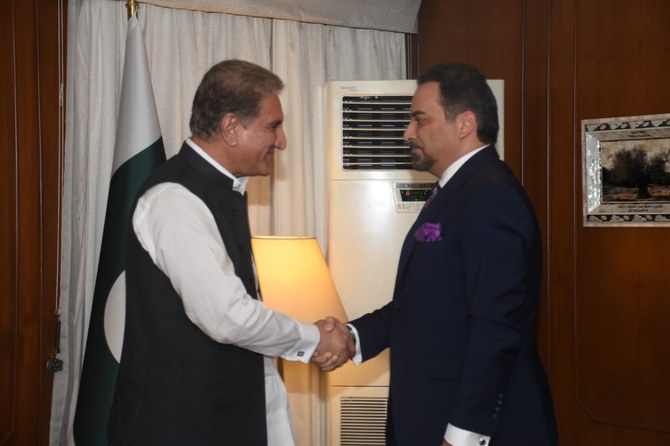
Thaw in relations: Pakistan, Afghanistan revive bilateral dialogue after 7 months
- Kabul had stopped the bilateral peace action plan talks in November last year
- The two sides agreed on joint efforts for trust building and mutual cooperation for regional peace, FO says
Latest updates




© 2026 SAUDI RESEARCH & PUBLISHING COMPANY, All Rights Reserved And subject to Terms of Use Agreement.