

Thiem ends Djokovic’s Slam run at French Open, faces Nadal in final

Austria's Dominic Thiem returns the ball to Serbia's Novak Djokovic during their men's singles semi-final match on day fourteen of The Roland Garros 2019 French Open tennis tournament in Paris on June 8, 2019. (AFP / Christophe Archambault)
Updated 08 June 2019
Follow

Thiem ends Djokovic’s Slam run at French Open, faces Nadal in final

  • Thiem, an Austrian ranked No. 4, who now gets a chance to win his first Grand Slam trophy on the red clay of Roland Garros
  • In the women’s final, Ash Barty of Australia beat Marketa Vondrousova of the Czech Republic for her first major title

PARIS: Novak Djokovic’s 26-match Grand Slam winning streak ended in the French Open semifinals because he made some odd strategic choices, because the wild weather bothered him, because the chair umpire got under his skin.
Mostly, though, because Dominic Thiem managed to outperform Djokovic at his own brand of defense-to-offense, speed-and-power baseline game.
Thiem put an end to the No. 1-ranked Djokovic’s bid for a fourth consecutive major championship Saturday with a dramatic 6-2, 3-6, 7-5, 5-7, 7-5 victory in a wind-whipped and rain-interrupted match that spanned more than four hours over two days.
“I don’t want to point out some reasons or find excuses for this loss,” said Djokovic, who had won nine of his past 10 five-setters and was 29-9 overall in such matches. “I mean, he took it, he won it, and well done to him.”
It wasn’t easy. Shouldn’t be against Djokovic, who kept digging holes for himself and climbing out.
Thiem wasted two match points with quick unforced errors when serving for the victory at 5-3 in the fifth, but he made his third chance count, smacking a forehand winner to break Djokovic in the last game.
“An epic match. I mean, so many ups and downs. And rain, going back to the locker, on court again. Somehow I had the feeling that I had the lead in the whole match, and then at the end, it got so tough,” Thiem said. “Both of us, we could win, and I luckily got the better in the end.”
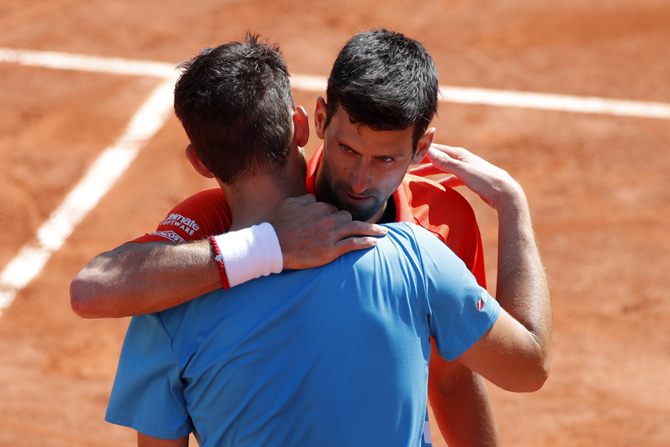


Austria's Dominic Thiem and Serbia's Novak Djokovic great each other after their semifinal match at the French Open in Paris on June 8, 2019. (REUTERS/Charles Platiau)

Djokovic was stopped two victories short of collecting his fourth consecutive major championship, a run that began on the grass at Wimbledon last July, then continued on the hard courts of the US Open and Australian Open.
Instead, it is Thiem, an Austrian ranked No. 4, who now gets a chance to win his first Grand Slam trophy on the red clay of Roland Garros.
Thiem will face 11-time French Open champion Rafael Nadal on Sunday in a rematch of last year’s final. Nadal won that one, part of an 8-4 lead for the Spaniard in their head-to-head series.
“All the time, if someone reaches the finals here, it’s against Rafa,” Thiem said with a laugh.
It will be the fourth straight day that Thiem is in action because of postponements, whereas Nadal will be well-rested, having played his quarterfinal Tuesday and his semifinal Friday, when he beat Roger Federer 6-3, 6-4, 6-2. Beating Thiem again would allow Nadal to raise his Grand Slam total to 18 titles, moving him with two of Federer’s record for a man.

Ashleigh Barty wins first major title

In the women’s final, which started 1½ hours late Saturday because it followed Thiem-Djokovic at Court Philippe Chatrier, No. 8 seed Ashleigh Barty of Australia won her first major title by beating unseeded 19-year-old Marketa Vondrousova of the Czech Republic 6-1, 6-3.
On Friday, Thiem had just broken Djokovic to go up a break at 3-1 in the third set when their match was suspended because of a shower. They resumed 18½ hours later, in dry, breezy conditions. The wind that was so fierce Friday — spreading loose, rust-colored clay dust from the court surface all over the place, making for something that seemed like a sandstorm — was much more manageable Saturday. It rippled players’ shirts but did not cause havoc with serve tosses and shots the way it had the evening prior.
“One of the worst conditions I have ever been part of,” Djokovic said about Friday. “That’s all I can tell you.”
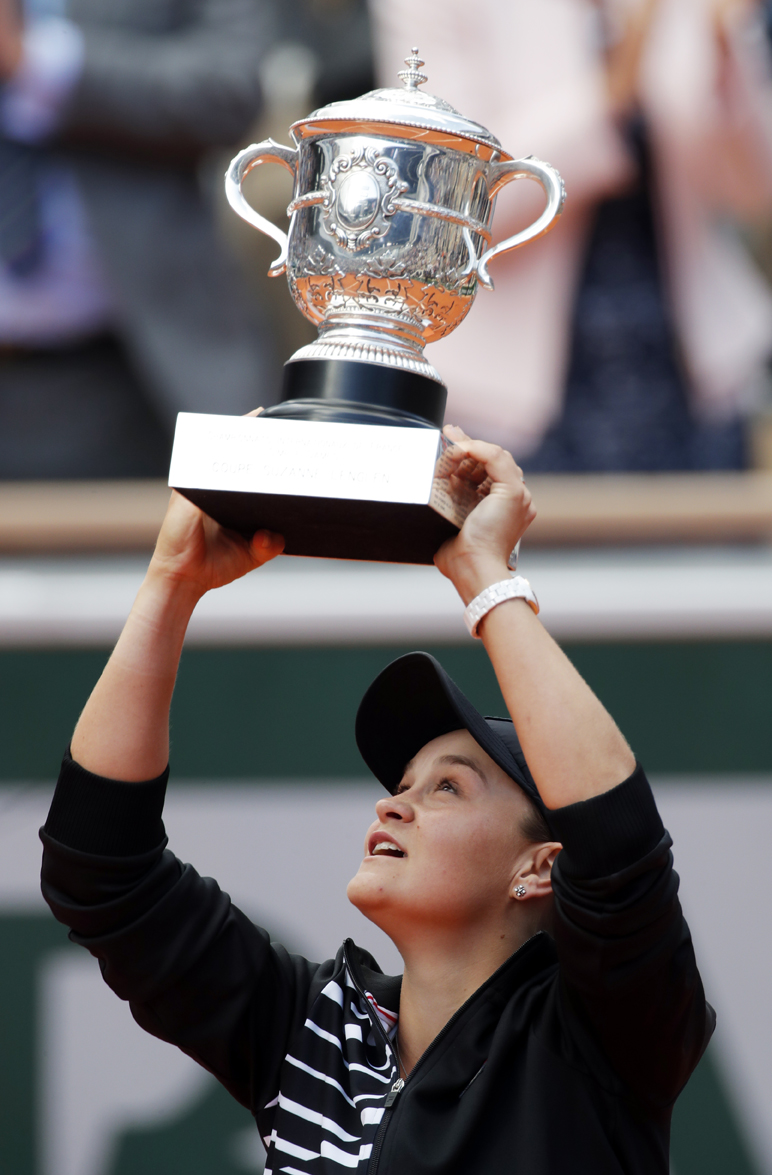


Australia's Ashleigh Barty celebrates with the trophy after winning the French Open final for women against Marketa Vondrousova of the Czech Republic. (REUTERS/Charles Platiau)

Repeatedly, they engaged in long and entertaining points that lasted 10 shots, 20 shots or more. They used anticipation and enviable court coverage to track down each other’s shots. They walloped the ball from all angles.
The very longest of these exchanges tended to go Djokovic’s way: He won 37 of 61 points (61 of nine or more strokes.
For whatever reason, Djokovic often felt compelled to try to shorten points often, hardly his usual strategy. So that led to this key statistic: He won only 35 of 71 points when he went to the net. Thiem, meanwhile, took 18 of 20 on his more judicious forays forward.
Serving at 15-all while down 6-5 in the third set, Djokovic was agitated by a warning from chair umpire Jaume Campistol for letting the serve clock expire. Djokovic wouldn’t let it go, complaining so much he was called for unsportsmanlike conduct.
The lack of focus drifted into his play, too, including a serve-and-volley attempt that handed that set to Thiem.
After forcing a fifth, Djokovic faltered again, getting broken to trail 3-1 when he missed a volley, before Thiem held for 4-1, shortly before rain came.
Djokovic was a point from losing when Thiem served at 5-3, 40-15. Except Thiem couldn’t close. Dumped a backhand into the net. Pushed a backhand wide. Sent a forehand long. Slapped a backhand into the net.
Hard to recover from that sort of collapse.
But Thiem regrouped. It was Djokovic who faltered — and who lost, something he hadn’t done on a Grand Slam stage since the 2018 French Open quarterfinals.


A powerful rivalry: Sabalenka and Svitolina set for Australian Open semifinal showdown

Updated 2 sec ago
Follow

A powerful rivalry: Sabalenka and Svitolina set for Australian Open semifinal showdown

  • Top-ranked Sabalenka, who is seeking a third title in four years in Australia, is from Belarus
  • Players from Ukraine do not shake hands with players from Russia or Belarus at the net after matches
MELBOURNE: Naturally there’ll be attention on the backstory when Aryna Sabalenka and Elina Svitolina meet in the Australian Open women’s semifinals.
Top-ranked Sabalenka, who is seeking a third title in four years in Australia, is a 27-year-old from Belarus. She’s popular on TikTok for her humorous posts and dance routines.
Svitolina is a 31-year-old Ukrainian who will be returning to the Top 10 next week for the first time since returning from a maternity break she took in 2022. She reached her first Australian Open semifinal with a lopsided win over No. 3 Coco Gauff, needing only 59 minutes to end her run of three quarterfinal losses at Melbourne Park.
They’re both regularly asked questions relating to Russia’s war on Ukraine. Both have regularly said they want the focus to be on tennis. Svitolina is trying to bring joy to the people of Ukraine, of course. Sabalenka said she supports peace.
“It’s very close to my heart to see a lot of support from Ukrainians,” she said. “So I feel like (I) bring this light, a little light, you know, even just positive news to Ukrainian people, to my friends when they are watching.”
Players from Ukraine don’t shake hands with players from Russia or Belarus at the net after matches. It’s accepted on both sides.
They’re both on 10-match winning streaks so far in 2026 and entered the season’s first major with titles in warmup tournaments — Sabalenka in Brisbane, and Svitolina in Auckland, New Zealand, her 19th career title. That was Svitolina’s first foray back after an early end to the 2025 season for a mental health break.
Sabalenka, who has 22 career titles including back-to-back Australian championships in 2023 and ‘24 and back-to-back US Open triumphs in 2024 and last year, is 5-1 in career meetings with Svitolina. She is into the final 4 at a major for the 14th time, and has made the final seven times.
“It’s no secret that she’s a very powerful player. I watched a little bit of her (quarterfinal) match. She was playing great tennis, and I think, the power on all aspects of her game is her strengths,” Svitolina said of Sabalenka. “She’s very consistent. For me, I’ll have to ... try to find the ways and the little holes, little opportunities in her game.
“When you play the top players, you have to find these small opportunities and then be ready to take them.”
Svitolina is playing her fourth semifinal at a major — 2019 and 2023 at Wimbledon and the 2019 US Open — and aiming for her first final.
Sabalenka played her quarterfinal against 18-year-old Iva Jovic before the searing heat forced organizers to close the roof of the Rod Laver Arena stadium on Tuesday. She was long gone before Svitolina and Guaff played under the roof at night. At that stage, she didn’t know who she’d next be playing, but was sure “it’s going to be a battle.”
“Because whoever makes it there, it’s an incredible player,” she said. “I think my approach going to be the same. Doesn’t matter who I’m facing.
“I’ll just go, and I’ll be focused on myself and on my game.”
Rybakina-Pegula, 5 vs. 6
Sixth-seeded Jessica Pegula completed the final 4 when she held off fellow American Amanda Anisimova 6-2, 7-6 (1) to move into a semifinal against 2022 Wimbledon champion Elena Rybakina.
Pegula beat 2025 champion Madison Keys in the previous round before ending Anisimova’s run of back-to-back Grand Slam finals.
The sixth-seeded Pegula is hoping to emulate Keys’ run here last year and claim her maiden Grand Slam title in Australia.
“I’ve been waiting for the time when I can kind of break through,” Pegula said. “I feel like I really play some good tennis here and I like the conditions.”
With a 7-5, 6-1 victory in the center court opener Wednesday, Rybakina, the 2023 Australian Open runner-up, ended No. 2-ranked Iga Swiatek’s bid to complete a career Grand Slam — at least for this year.
Rybakina, who was born in Russia but represents Kazakhstan, said she’d focus on the lessons she’d taken from previous trips to the deciding end of the majors.
“Now I’m more calm. In the beginning, when it’s the first final and you go so far in the tournament, of course you are more emotional,” she said. “Now I feel like I’m just doing my job, trying to improve each day. So it’s kind of another day, another match.”