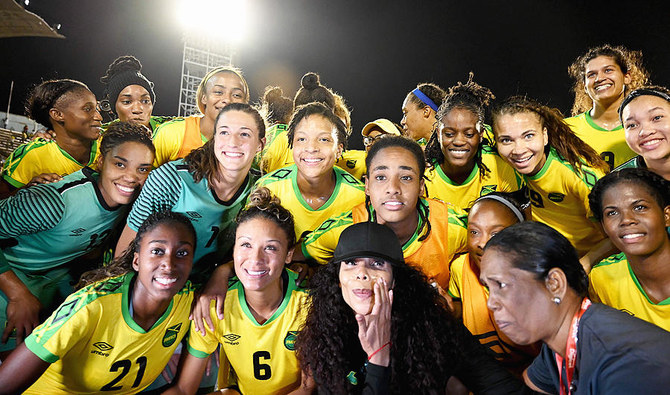
KINGSTON, Jamaica: They don’t have tons of money, sponsors or flashy practice facilities but they didn’t let that stop them: Jamaica’s ‘Reggae Girlz’, the women’s national football team that did not even exist a few years ago, are heading to France to do battle for the World Cup.
With the help of the daughter of late reggae legend Bob Marley, the team — the first from the Caribbean to make it to the finals — are ready to compete for the sport’s Holy Grail.
Before heading to France, the Reggae Girlz gave their fans something to celebrate with a 3-1 victory over Panama at the National Stadium in Kingston on May 19.
The friendly was only part of the day, which turned into a colorful Sunday street party, complete with blaring vuvuzelas and blasting dancehall music.
But the festivities did not mask the difficult task ahead — the Reggae Girlz stand only 53rd in the world in FIFA’s rankings, and on paper, they are clearly the weakest squad in the draw.
The players are certainly aware of their humble pedigree: the stadium’s malfunctioning scoreboard and malfunctioning sound system symbolize where they stand in terms of the world’s top teams.
But the women are used to playing through adversity — until just before the friendly with Panama, they were not even paid by their home federation.
“It’s a milestone — they deserve it. Obviously it took the World Cup to get us to this point but we got it done,” head coach Hue Menzies, who has helped the women negotiate their contracts, told AFP.
“We had the boxing gloves on,” Menzies added.
The Reggae Girlz are a young team, made up mainly of players who competed at the university level in the United States.
On a Friday in mid-May, they launch into a practice without Menzies, who is going to argue with the federation on their behalf. They play on a field at a college campus in Kingston that is way too dry and covered with divots.
Players carry their own water and equipment to the field from the bus. It’s a far cry from what awaits them in France.
By qualifying for the World Cup, the Reggae Girlz have duplicated the feat achieved in 1998 by the Reggae Boyz, who went to the men’s World Cup that year — also in France.
But their path to the tournament was far more challenging.
“Of course, (it was harder) because we qualified with little resources,” said 22-year-old striker Khadija Shaw, one of the team’s stars, who is rumored to be drawing interest from French professional clubs.
“Coming from where the women’s program was a few years ago, it’s great.”
A few years ago, there simply was no program.
After Jamaica failed to qualify for the 2008 Summer Olympics in Beijing, the national federation effectively disbanded the team.
By not playing internationally, the Reggae Girlz tumbled down the FIFA rankings and eventually fell off the list entirely in 2011.
Enter Cedella Marley, the daughter of Jamaica’s most famous son, who himself was a super-fan of the game. In 2014, the businesswoman and singer found sponsors for the team and organized fundraisers.
She breathed new life into the program, and became its de facto ambassador in the process.
In football circles on the island, her name is said with near-sacred reverence.
“They needed help. They are women — they were being told they couldn’t play a sport that they love. So we got involved and here we are,” Marley told AFP after receiving an ovation from the crowd at the friendly against Panama.
The logo of the Bob Marley Foundation figures prominently on the Jamaican team’s jerseys.
Menzies has nothing but praise for Marley, noting: “She stuck her neck out for us. She has been here from day one.”
The coach’s personal investment in the team, which has received less media attention, has helped keep the Reggae Girlz going.
Menzies activated his network in US college circles to help find schools for his players.
“We took players out of Jamaica and placed them in different parts of the world so they could develop,” Menzies said.
“We have better resources in America and Europe. And it benefited us. We turned the negative to the positive,” he added.
“We did it for more than football. We wanted to change our mindsets and the way we look at female football and females in sports in general.”
For Cedella Marley, “there is lots of progress to be made all over the world, not just in Jamaica and the Caribbean... we can do whatever the boys do!“
The Reggae Girlz, who are thrilled to be where they are, want to set an example.
“For younger kids in Jamaica and all of the Caribbean, it means a lot because we are the stepping stone to show them there is a lot to achieve,” said 21-year-old team captain Konya Plummer.
“They can follow their dreams like we did and create history.”
For the women’s World Cup this time around, FIFA doubled the money allocated to teams that qualified, from a total of $15 million to $30 million.
Last year, for the men’s World Cup, the total was $400 million.


Jamaica’s underdog ‘Reggae Girlz’ ready to take on World Cup
Jamaica’s underdog ‘Reggae Girlz’ ready to take on World Cup

- Reggae Girlz tumbled down the FIFA rankings and eventually fell off the list entirely in 2011, but now they are back.

Russell, Antonelli lead Mercedes in one-two qualifying positions for F1’s Australian GP
- Russell topped all three sessions in F1’s knockout qualifying format, finally casting aside questions of where Mercedes team was in the new-era pecking order
MELBOURNE: Mercedes has revealed its dominant hand during qualifying for Sunday’s Formula 1 Australian Grand Prix.
George Russell earned his ninth-career pole position Saturday ahead of his teammate Kimi Antonelli for the team’s 83rd front-row lockout and its first since the 2024 British Grand Prix.
Russell topped all three sessions in F1’s knockout qualifying format, finally casting aside questions of where Mercedes team was in the new-era pecking order. His pole time, at 1 minute, 18.518 seconds, was almost eight-tenths faster than the nearest non-Mercedes challenger, Red Bull rookie Isack Hadjar, who completed the top three.
“It was a great day, we knew there was a lot of potential in the car, but until we get to this first Saturday of the season, you never know,” Russell said. “But it really came alive this afternoon, especially when the track temperatures cooled, we know we tend to favor those conditions.”
Antonelli was relieved to have made it onto the front row alongside his teammate after a crash in final practice at the exit of turn two meant it was a race in the Mercedes garage to get him out for qualifying.
“It’s been a very stressful day. Unfortunately, I went into the wall (in FP3),” he said. “But the guys (in the garage) were the heroes today to put the car back on track.”
Hadjar was impressive by qualifying third on debut for Red Bull, his highest-ever grid position.
“The only thing I can do is take them at the start, but they’re just too fast at the moment,” Hadjar said of Mercedes. “I want to keep my position and a second podium would be cool.”
Ferrari showed it’s neck-and-neck with McLaren on pace, with just one and a half tenths seconds covering the four drivers just beyond the top-three — with Charles Leclerc qualifying fourth, McLaren’s Oscar Piastri and Lando Norris in fifth and sixth respectively, and Lewis Hamilton in seventh.
Racing Bulls showed they’ve taken a step forward over the winter, with New Zealander Liam Lawson eighth ahead of his highly-rated rookie teammate Arvid Lindblad.
The big surprise of the session came from four-time F1 world champion Max Verstappen, who triggered red flags at Melbourne’s Albert Park after he lost control of his Red Bull car in braking for turn one in the first half of Q1 and ended in the barriers.
The Dutchman, who was unhurt from the crash, though upset that his brakes locked up, will now start from the back of the grid.
F1 heads into a new era this year, with unprecedented changes across the chassis (car) and power unit, which now feature an almost 50:50 output split between the turbo 1.6-liter V6 engine and electrical energy harvested from the brakes, one that requires a new, often counterintuitive driving style from the drivers.


