

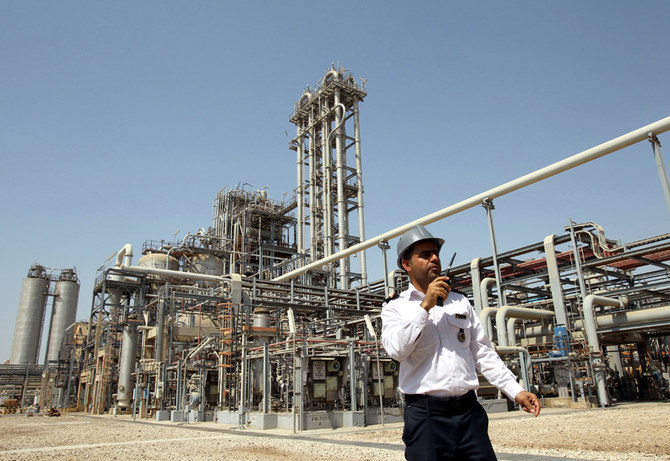

JEDDAH: The US imposed new sanctions on Friday on Iran’s petrochemical industry because of its financial support for the Islamic Revolutionary Guard Corps (IRGC).
The sanctions target the Persian Gulf Petrochemical Industries Company and its network of 39 subsidiary companies and foreign-based sales agents. “By targeting this network we intend to deny funding to key elements of Iran’s petrochemical sector that provide support to the IRGC,” US Treasury Secretary Steve Mnuchin said.
In April, the US declared the IRGC a foreign terrorist organization. The Pentagon has also accused the Guards of carrying out attacks off the UAE coast on May 12 that damaged two Saudi tankers, an Emirati vessel and a Norwegian tanker.
The UAE told UN Security Council members late on Thursday that the attacks bore the hallmarks of a “sophisticated and coordinated operation,” probably by a state actor.
Divers placed limpet mines on the vessels under the waterline to incapacitate but not sink them, according to the preliminary findings of a joint investigation by the UAE, Saudi Arabia and Norway.
The report did not name Iran – but Saudi Arabia’s ambassador to the UN, Abdallah Al-Mouallimi, said there was no doubt about who was to blame. “We believe the responsibility for this action lies on the shoulders of Iran. We have no hesitation in making this statement,” he said.
The IRGC specializes in such tactics, the security analyst Dr. Theodore Karasik told Arab News. “It’s part of part of Iran’s larger asymmetric warfare approach,” said Karasik, senior adviser at Gulf State Analytics in Washington, DC.
“A small team within a command-and-control structure is deployable quickly and quietly, as we saw on the night of the attacks, and is a continuing danger in sealanes. That command-and-control structure goes straight up the leadership chain.”


