

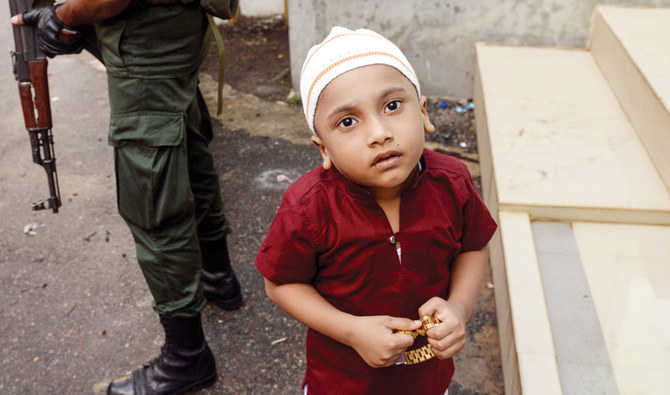

COLOMBO: Tough security measures and a climate of fear marked Eid Al-Fitr in Sri Lanka, as authorities tried to contain an anti-Muslim backlash sparked by suicide bombings in April.
Muslims have been targeted in anti-terror operations and by angry mobs after extremists carried out attacks on churches and hotels that killed 258 people earlier this year.
Worshippers were unable to perform Eid prayers at Colombo’s Galle Face Green on Wednesday, where more than 2,000 Muslims had congregated, as the government enforced a ban on open-air prayers during Eid.
There are around 2,000 mosques in Sri Lanka, which has a Muslim population of around 2 million. Colombo has around 150 mosques.
Ashraff Samad, a civil servant, said many people had been heading to Galle Face Green for their Eid prayers.
“It is sad that worshippers were denied the opportunity of praying on open grounds due to the current security situation. It was a pleasant environment to meet and greet one another on this holy and auspicious day,” he told Arab News.
Bangladesh High Commissioner to Sri Lanka Riaz Hamidullah, who performed his Eid prayers at the Jawatte Mosque in Colombo, told Arab News he was happy that everything had gone smoothly.
N. M. Ameen, chief editor of Navamani newspaper, said Muslims celebrated the end of Ramadan on a somber note, adding that the government had taken maximum precautions against any “vindictive and racist” violence.
The island nation has been under a state of emergency since the bombings. Troops and police have been patrolling parts of Sri Lanka as Colombo comes under increasing international pressure to contain anti-Muslim riots that killed one man and damaged property and mosques. There have also been curfews to stem the violence.
Muslim ministers resigned on Monday in protest at the harassment faced by the community since the bombings. They included Cabinet ministers, their deputies and non-Cabinet ministers.
One of them, Rauff Hakeem, said Sri Lanka’s Muslims were observing Eid in “troubled times.”
“Ending a month’s fasting and worship in troubled times, we unite in deep reflection today. The Easter Sunday carnage has developed into an existential threat and remonstration for the Muslims of Sri Lanka. We uphold our faith and reverence for the good and truth for peace,” he said after the Eid prayer.
The Easter bombings were blamed on a local extremist group, National Thowheed Jamath, which pledged allegiance to Daesh and Muslims have been bracing themselves for revenge attacks ever since. There has been a ban on face coverings and house-to-house searches are frequent.
British High Commissioner to Sri Lanka James Dauris tweeted: “The political and religious incitement we are seeing against Muslims in Sri Lanka should worry people of every faith. It can only work against the mutual respect that serves the best interests of every community.”
US Ambassador to Sri Lanka Alaina B. Teplitz tweeted: “This Eid in #SriLanka is a moment for all Sri Lankans, especially political and faith leaders, to reinforce the need for peace and unity and to reject violence and hostility. A peaceful Eid to all who celebrate #lka.”
IT worker Raees Hussein said there was still a climate of fear even though prayers had gone ahead as scheduled.
“The Easter bombings have created a wedge between the Muslim and the Sinhalese community since it was carried out by Muslim extremists,” he told Arab News. He urged the government and NGOs to carry out an awareness program that the wider Muslim community should not be punlished for the actions of a few people.
The Organization of Islamic Cooperation Countries in Sri Lanka said that communal violence targeting Muslims had regional and global security implications.
“We all know that even the smallest incident in an isolated Sri Lankan village can be recorded and shared online for mass viewership, stoking widespread violence and counter-violence,” it said.


