LONDON: British economic growth almost halted last month as a modest expansion in the services sector barely offset weakness among manufacturers and construction firms caused by the Brexit crisis and weaker global growth, a business survey showed.
The IHS Markit/CIPS services Purchasing Managers’ Index (PMI) edged up to 51.0 from 50.4 in April, its strongest reading in three months and slightly above economists’ average forecast in a Reuters poll.
Equivalent PMI surveys for manufacturing and construction published earlier this week unexpectedly fell deep into contractionary territory, however, and taken together, the three PMIs gave one of their weakest readings since 2012.
“The PMI surveys collectively indicated that the UK economy remained close to stagnation midway through the second quarter,” IHS Markit economist Chris Williamson said.
Official data showed Britain’s economy grew a robust 0.5 percent in the first quarter of the year, though much of that was driven by firms stockpiling ahead of a Brexit deadline of March 29, which has since been postponed until Oct. 31.
The Bank of England forecasts Britain’s quarterly economic growth rate will fall to 0.2 percent for the three months to June.
Many services firms said Brexit worries continued to hurt sales in Europe, echoing a concern voiced by manufacturers on Monday.
“Domestic political uncertainty remained a key factor holding back their growth expectations for the year ahead,” IHS Markit said, adding that Brexit concerns were weighing on business investment and consumer spending.
Prime Minister Theresa May announced her resignation in May ahead of a heavy defeat for her Conservative Party in European Parliament elections, triggering a leadership contest that could open the way for a successor with a tougher line on Brexit.
Nonetheless, the survey found optimism among services firms rose to its highest since September 2017 and hiring was the strongest since November.
BoE officials have said that in an uncertain business environment, British firms tend to meet expansion needs by hiring staff — who can be easily sacked in a downturn — rather than make long-term investments that are costly to reverse.

UK economy close to stagnation due to Brexit, weak global demand: PMI
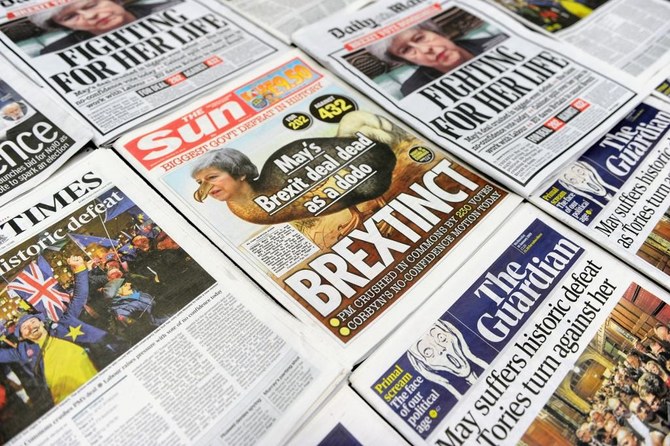
- The Bank of England forecasts Britain’s quarterly economic growth rate will fall to 0.2 percent for the three months to June
- Many services firms said Brexit worries continued to hurt sales in Europe
Kuwait to boost Islamic finance with sukuk regulation
- The move supports sustainable financing and is part of Kuwait’s efforts to diversify its oil-dependent economy
RIYADH: Kuwait is planning to introduce legislation to regulate the issuance of sukuk, or Islamic bonds, both domestically and internationally, as part of efforts to support more sustainable financing for the oil-rich Gulf nation, Prime Minister Sheikh Ahmad Abdullah Al-Ahmad Al-Sabah said on Wednesday.
Speaking at the World Governments Summit in Dubai, Al-Sabah highlighted that Kuwait is exploring a variety of debt instruments to diversify its economy. The country has been implementing fiscal reforms aimed at stimulating growth and controlling its budget deficit amid persistently low oil prices. Hydrocarbons continue to dominate Kuwait’s revenue stream, accounting for nearly 90 percent of government income in 2024.
The Gulf Cooperation Council’s debt capital market is projected to exceed $1.25 trillion by 2026, driven by project funding and government initiatives, representing a 13.6 percent expansion, according to Fitch Ratings.
The region is expected to remain one of the largest sources of US dollar-denominated debt and sukuk issuance among emerging markets. Fitch also noted that cross-sector economic diversification, refinancing needs, and deficit funding are key factors behind this growth.
“We are about to approve the first legislation regulating issuance of government sukuk locally and internationally, in accordance with Islamic laws,” Al-Sabah said.
“This enables us to deal with financial challenges flexibly and responsibly, and to plan for medium and long-term finances.”
Kuwait returned to global debt markets last year with strong results, raising $11.25 billion through a three-part bond sale — the country’s first US dollar issuance since 2017 — drawing substantial investor demand. In March, a new public debt law raised the borrowing ceiling to 30 billion dinars ($98 billion) from 10 billion dinars, enabling longer-term borrowing.
The Gulf’s debt capital markets, which totaled $1.1 trillion at the end of the third quarter of 2025, have evolved from primarily sovereign funding tools into increasingly sophisticated instruments serving governments, banks, and corporates alike. As diversification efforts accelerate and refinancing cycles intensify, regional issuers have become regular participants in global debt markets, reinforcing the GCC’s role in emerging-market capital flows.
In 2025, GCC countries accounted for 35 percent of all emerging-market US dollar debt issuance, excluding China, with growth in US dollar sukuk issuance notably outpacing conventional bonds. The region’s total outstanding debt capital markets grew more than 14 percent year on year, reaching $1.1 trillion.


