

Gunman kills 4 in attack on Tripoli security patrol

1 / 2
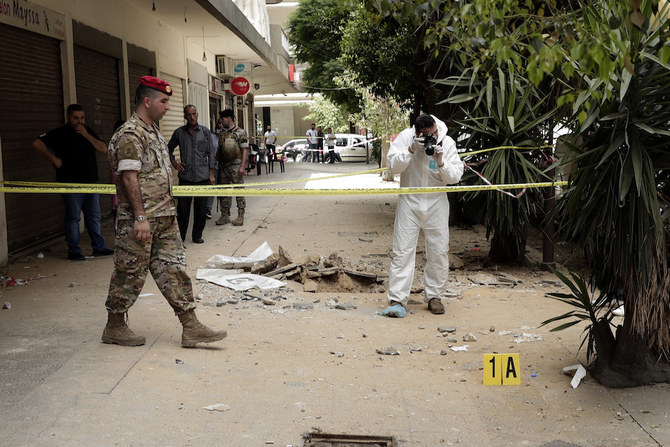
Lebanon's Interior Minister Raya Al-Hassan visits the scene where a militant attacked a security forces patrol on Monday night, in Lebanon's northern city of Tripoli. (Reuters)
2 / 2
A Lebanese Army investigator takes photos outside a building where clashes erupted between Lebanese troops and a a former member of the Islamic State group, who had engaged in an hours-long shootout with the security forces, in Tripoli, Lebanon. (AP)
Updated 04 June 2019
Follow

Gunman kills 4 in attack on Tripoli security patrol

  • Tripoli has prevailed because of coordination between the security and military forces
  • The US Embassy in Lebanon said that it “stands by the legitimate security institutions in their war on terror

BEIRUT: A lone gunman who killed an army officer and three Lebanese security personnel in Tripoli had been released from prison on terror charges in mid-2017, Interior Minister Raya Al-Hassan said.

The “lone wolf” attacker, Abdul Rahman Mabsout, struck shortly before midnight on Monday, killing a Lebanese army officer and three Internal Security Forces (ISF) personnel.

Mabsout was known to security and judicial services in Lebanon. He had fought with the Daesh terror group in Syria and was arrested in Lebanon in early 2016 where he was imprisoned for 18 months before being released in mid-2017.

“Lone wolves are a new type of terrorism and security services are doing their best to prevent such attacks,” said Al-Hassan, who went to Tripoli after the incident.

According to Lebanon’s army command, the militant was riding a motorcycle when he opened fire on a Bank of Lebanon branch and an adjacent ISF post, killing one soldier and wounding several others.

He then moved to another area and threw a bomb at an ISF patrol before shooting and killing two security personnel and fleeing.

Security forces chased and exchanged gunshots with the terrorist, who barricaded himself in an apartment after forcing a woman occupant to flee. 

The man is believed to have killed himself by detonating an explosive belt when security forces raided the property, though earlier reports said he was killed by a grenade blast as security forces stormed the building.

“Tripoli has prevailed because of coordination between the security and military forces, and thanks to the Lebanese,” Al-Hassan told a press conference. 

The four men who died in the attacks were Lt. Hassan Farahat, 29, Pvt. Ibrahim Saleh, 21, Sgt. Johnny Khalil, 26, and Cpl. Yousef Faraj, 36.

Defense Minister Elias Bou Saab said the attack was likely to be part of a wider terrorist plot.

“However, there are still unanswered questions about the attacks,” he said.

Bou Saab linked the incident to benefit cuts imposed on retired soldiers in the 2019 budget. “The army is sacrificing its blood for the homeland and we hope everyone appreciates the value of these sacrifices,” he said.

MP Hikmat Deeb, from the Free Patriotic Movement bloc, said on Twitter that terrorism should not be tolerated, stressing that “amnesty for the killers of security personnel facilitates terrorism.”

“Lone wolves are a new type of terrorism and security services are doing their best to prevent such attacks.”

Raya Al-Hassan, Interior minister

In an interview with Arab News, former Lebanese MP Mustapha Allouch said: “I am surprised that this terrorist could be released from prison. He fought in the ranks of Daesh in Syria, but this incident should not be linked to Islamic detainees because some of them are oppressed.”

He said: “Someone may have encouraged Mabsout to carry out the attacks. Poverty and resentment may have been his motives. Or he may have found that the other world was better than his current life, so he did what he did. We do not know. We have to wait for investigations.”

Allouch described Tripoli as “the weakest link to carry out this attack. I do not think what happened is an accident.” 

Tripoli MP Mohammed Kabbara said the incident involved the “direct targeting of Tripoli.”

“Conspiracies want to drain it, distort its image and weaken it. What happened has serious implications, because the perpetrators are people who were deceived by one or more parties in the context of using Tripoli as a mailbox to send bloody messages.”

The US Embassy in Lebanon said that it “stands by the legitimate security institutions in their war on terror.”

More than 1,200 prisoners, including 700 Lebanese, are being held in Roumieh prison on terror-related charges. About 500 detainees have been accused of murder or attempted murder.

For years, families of detainees have been pressuring the Lebanese government to issue a general amnesty or speed up prisoners’ trials and ensure proper humanitarian conditions in the prison.

President Michel Aoun hailed “the lives of the martyrs of the army and ISF” after the Tripoli attack.

“Any tampering with security will receive a quick and decisive response,” he said. “What happened in Tripoli will not affect stability in the country.”

Prime Minister Saad Al-Hariri, who is in Saudi Arabia, called Al-Hassan, Army Commander Gen. Joseph Aoun and Director General of the ISF Maj. Gen. Imad Othman following terrorist attack.

According to his press office, Al-Hariri stressed that “all measures that protect the security of Tripoli and its people must be taken and the remnants of terrorism must be uprooted.”


US says it destroyed 16 mine-laying vessels as Iran threatens to block Gulf oil exports

Updated 4 sec ago
Follow

US says it destroyed 16 mine-laying vessels as Iran threatens to block Gulf oil exports

DUBAI, United Arab Emirates: The US said it took out more than a dozen mine-laying Iranian vessels Tuesday, and the Islamic Republic vowed to block the region’s oil exports, saying it would not allow “even a single liter” to be shipped to its enemies.
As concerns grew about the war’s effect on a strategic waterway, the American military said it destroyed 16 minelayers, though President Donald Trump said in social media posts that there were no reports of Iran planting explosives in the Strait of Hormuz, through which 20 percent of the world’s oil is shipped.
The American military released the figure, along with unclassified footage of some of the vessels, after Trump threatened to hit Iran at “a level never seen before” if the country failed to immediately remove any mines it might have deployed in the channel.
Both sides sharpened their rhetoric as the war entered its 11th day. US Defense Secretary Pete Hegseth promised the most intense strikes yet while the Pentagon detailed the broader toll of injuries sustained by US troops.
The conflict’s effects rippled across the Middle East and beyond. Iranian leaders ruled out talks, threatened Trump and launched new attacks against Israel and Gulf Arab countries.
In Iran, residents of Tehran said they experienced some of the war’s heaviest strikes. A woman said she saw a residential building get hit. She and others reached by The Associated Press spoke on condition of anonymity to prevent reprisals. Tens of thousands of Iranians have sought shelter in the countryside.
Lebanon reports more deaths
Multiple Israeli strikes across southern Lebanon killed seven people, the Lebanese Health Ministry said early Wednesday.
Other deaths included a Red Cross member who died early Wednesday after an Israeli strike targeted his team Monday while they were rescuing people following an earlier attack, the health ministry said. On Tuesday, Israeli airstrikes killed four people, including a paramedic who worked for the Hezbollah-affiliated Islamic Health Authority who was treating the wounded.
Also Tuesday, an Israeli strike killed a Lebanese soldier, the Lebanese army said, bringing the number of troops killed there to five since the conflict began.
Israel said it was working to intercept missiles from Iran and Hezbollah, which began firing on Israel after the start of the war.
Saudi Arabia’s Defense Ministry said early Wednesday that it intercepted multiple missiles launched toward several sites, including Prince Sultan Air Base, a major US- and Saudi-operated air facility. The ministry said it also destroyed drones near two major cities and more headed toward the kingdom’s vast Shaybah oil field in the Empty Quarter desert.
In Iraq, drones targeted military bases inside Baghdad International Airport late Tuesday, two security officials told AP on condition of anonymity because they were not authorized to speak to the press. Some drones fell near Iraqi security positions, while others landed near logistical support sites used by US-led coalition forces, one official said.
The United Arab Emirates said early Wednesday that its air defenses were firing at incoming Iranian fire. The wealthy Gulf nation — home to the business and travel hub of Dubai — said Iranian attacks have killed six people and wounded 122 others.
Bahrain sounded sirens early Wednesday, warning of an incoming Iranian attack. The warnings came a day after an Iranian attack hit a residential building in the capital, Manama, and killed a 29-year-old woman and wounding eight people.
Pentagon says 140 US troops wounded since war began
Gen. Dan Caine, chairman of the Joint Chiefs of Staff, said US forces hit more than 5,000 targets.
The Pentagon separately said Tuesday that about 140 US service members have been wounded in the war, and the “vast majority” of the injuries were minor, with 108 service members already back on duty. Eight US service members suffered severe injuries, and seven have been killed.
In Iran, at least 1,230 people have been killed, while the death toll is more than 480 in Lebanon and 12 in Israel, according to officials.
Iran’s leaders have remained defiant after days of heavy strikes targeting the country’s leadership, military, ballistic missiles and its disputed nuclear program. Iran’s parliament speaker, Mohammad Bagher Qalibaf, said on X that Iran was “definitely not looking for a ceasefire.”
“We believe that the aggressor should be punched in the mouth so that he learns a lesson so that he will never think of attacking our beloved Iran again,” he said.
A top Iranian security official, Ali Larijani, posted a warning to Trump, writing on X that “Even those bigger than you couldn’t eliminate Iran. Be careful not to get eliminated yourself.” Iran has been accused of plotting attempts to kill Trump in the past.
The Trump administration, meanwhile, faced growing scrutiny at home about the war.
“I’m not sure what the end game is, or what their plans are,” Democratic Sen. Jacky Rosen of Nevada said after a classified briefing that the Trump administration held Tuesday for some lawmakers.
Saudi Arabia’s oil giant says tankers being rerouted to avoid Strait of Hormuz
Iran has repeatedly targeted energy infrastructure with attacks that appear aimed at generating enough global economic pain to pressure the US and Israel to end their strikes. It has also fired on Israel and US military bases in the region.
The US stock market held steadier Tuesday as Wall Street waited for the next clue on when the war with Iran may end.
Oil prices, meanwhile, remained well below their peaks hit on Monday. Such spikes have been rocking financial markets worldwide because of worries that the war could block the global flow of oil and natural gas for a long time.
Iran’s paramilitary Revolutionary Guard said it “will not allow the export of even a single liter of oil from the region to the hostile side and its partners until further notice.”
Amin Nasser, the president and CEO of Saudi Arabia’s oil giant Aramco, said tankers were being rerouted to avoid the strait, and that the company’s east-west pipeline would reach its full capacity this week of 7 million barrels a day being brought to the Red Sea port of the Yanbu.
“The situation at the Strait of Hormuz is blocking sizable volumes of oil from the whole region,” he said. “If this takes a long time, that will have serious impact on the global economy.”
Foreign nationals get out of region
The UN refugee agency said Tuesday that more than 667,000 people in Lebanon had registered as displaced — an increase of over 100,000 since a day earlier — and more than 85,000 people from Lebanon, mostly Syrians, had entered neighboring Syria.
The British government said the number of commercial flights from the UAE to the UK is returning to normal levels, with 32 flights operated Monday from Dubai to Britain and another 36 scheduled Tuesday. British Airways, however, said it suspended flights to and from Jordan, Bahrain, Qatar, Dubai and Tel Aviv until later this month.
Many foreign nationals have been getting out of the Arabian Gulf region since the war began, including over 45,000 UK citizens, the British Foreign Office said. Some 40,000 people returned to the United States, according to the State Department.