JERUSALEM: US President Donald Trump’s son-in-law and adviser Jared Kushner has suggested in an interview that the Palestinians are not ready to govern themselves ahead of the expected release of his peace plan.
Speaking to US news site Axios, Kushner also said he was not concerned over whether the Palestinians do not trust him since they will base their decisions on whether the plan will improve their lives.
“The hope is, is that over time, they can become capable of governing,” Kushner said when asked if he believes the Palestinians can govern themselves without Israeli interference.
According to excerpts from the interview published late Sunday on the Axios website, Kushner said the Palestinians “need to have a fair judicial system... freedom of press, freedom of expression, tolerance for all religions” before the Palestinian territories can become “investable.”
Kushner told Axios that the Palestinians “should have self-determination,” without saying whether that would mean an independent state or some lesser form of autonomy.
He has previously hinted that the plan will not endorse creating a Palestinian state.
In the Axios interview, Kushner said “I think that it’s a high bar” when asked if the Palestinians could expect freedom from any Israeli governmental or military interference.
“If you don’t have a proper government structure and proper security when people are living in fear of terror, that hurts Palestinians,” he said.
The Palestinian leadership has already dismissed the upcoming peace plan, saying Trump’s actions so far have shown him to be blatantly biased in favor of Israel.
Those actions include declaring the disputed city of Jerusalem Israel’s capital, cutting hundreds of millions of dollars in Palestinian aid and closing the Palestinians’ de facto embassy in Washington.
“I’m not here to be trusted,” Kushner told Axios, adding he differentiates between the Palestinians and their leaders.
He said he believes the Palestinian people will look at “the facts and then make a determination: Do they think this will allow them to have a pathway to a better life or not?“
The interview was recorded before Kushner’s visit to Jerusalem last week, a trip that also included stops in Morocco and Jordan.
The peace plan was previously delayed over Israel’s April 9 general elections and could now face further postponements related to Israeli politics.
Israel will go to the polls again on September 17 after Prime Minister Benjamin Netanyahu failed to form a governing coalition, and such a plan is considered too sensitive by many analysts to introduce during an electoral campaign.

Kushner suggests Palestinians not ready to govern themselves
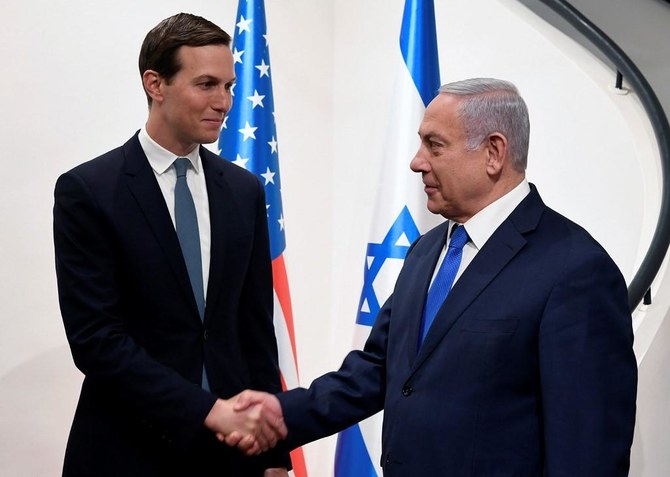
- Kushner said he isn’t concerned if Palestinians trust him or not
- He previously hinted the new plan would not include the creation of a Palestinian state
Sudan defense minister dismisses ‘intelligence document’ as fabrication after convoy strike
- Gen. Hassan Kabroun tells Arab News claims that army hid weapons in aid convoy are “completely false”
RIYADH: Sudan’s defense minister has firmly denied reports attributed to Sudanese intelligence alleging that a convoy targeted in North Kordofan was secretly transporting weapons under the cover of humanitarian aid.
Gen. Hassan Kabroun described the claims as “false” and an attempt to distract from what he called a militia crime.
The controversy erupted after news reports emerged that a document attributed to Sudan’s General Intelligence Service claimed the convoy struck in Al-Rahad on Friday was not a purely humanitarian mission, but was instead carrying “high-quality weapons and ammunition” destined for Sudanese Armed Forces units operating in the state.
The report further alleged that the convoy had been outwardly classified as humanitarian in order to secure safe passage through conflict zones, and that the Rapid Support Forces had destroyed it after gathering intelligence on its route and cargo.
Kabroun categorically rejected the narrative.
“First of all, we would like to stress the fact that this news is false,” he told Arab News. “Even the headline that talks about the security of the regions, such as Al-Dabbah, is not a headline the army would use.”
He described the document as fabricated and politically motivated, saying it was designed to “cover up the heinous crime they committed.”
The minister affirmed that the area targeted by drones is under full control of the Sudanese Armed Forces and does not require any covert military transport.
“Second, we confirm that the region that was targeted by drones is controlled by the army and very safe,” Kabroun said. “It does not require transporting any military equipment using aid convoys as decoys because it is a safe area controlled by the army, which has significant capabilities to transport humanitarian aid.”
According to the minister, the Sudanese military has both the logistical capacity and secure routes necessary to move equipment openly when needed.
“The army is professional and does not need to deliver anything to Kadugli or Dalang on board aid convoys,” he said. “The road between Dalang and Kadugli is open. The Sudanese forces used that road to enter and take control of the region. The road is open and whenever military trucks need to deliver anything, they can do so without resorting to any form of camouflage.”
Kabroun further rejected any suggestion that the military uses humanitarian operations as cover.
“Aid is transported by dedicated relief vehicles to the areas in need of this assistance,” he said. “Aid is not transported by the army. The army and security apparatus do not interfere with relief efforts at all, and do not even accompany the convoys.”
He stressed that the Sudanese Armed Forces maintains a clear institutional separation between military operations and humanitarian work, particularly amid the country’s crisis.
“These are false claims,” he said. “This fake news wanted to cover up the heinous crime they committed.”
Sudan has been gripped by conflict since April 2023, when fighting broke out between the Sudanese Armed Forces and the Rapid Support Forces, plunging the country into what the United Nations has described as one of the world’s worst humanitarian disasters.
The latest dispute over the convoy comes amid intensified fighting in South Kordofan, a strategically sensitive region linking central Sudan with the contested areas of Darfur and Blue Nile.
The false report suggested that intelligence monitoring had enabled the RSF to strike what it described as a military convoy disguised as humanitarian aid. But Kabroun dismissed that version outright.
“The intelligence agency is well aware of its duties,” he said. “The Sudanese Army has enough weapons and equipment to use in the areas of operations. These claims are completely false.”
He argued that the narrative being circulated seeks to shift blame for attacks on civilian infrastructure and humanitarian movements.
“This shows that they are trying to cover up the atrocities,” he added, referring to the militia.
Kabroun maintained that the army has regained momentum on multiple fronts and remains fully capable of sustaining its operations without resorting to deception.
“The region is secure, the roads are open, and the army does not need camouflage,” he said. “We are operating professionally and transparently.”
“These claims are completely false,” Kabroun said. “The Sudanese Army does not use humanitarian convoys for military purposes.”


