

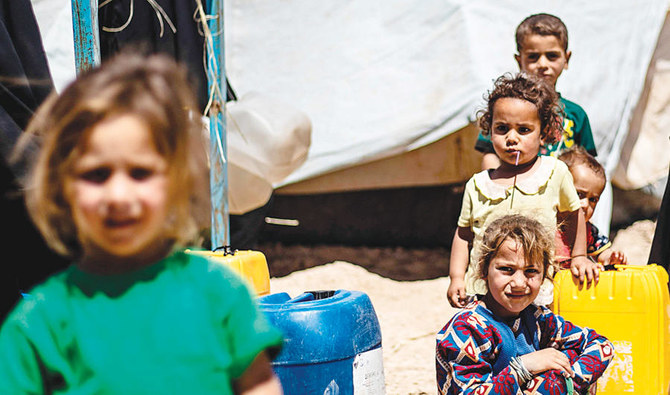

BAGHDAD: The Iraqi Supreme Judicial Council has asked embassies and consulates operating in Iraq to look after the children of convicted mothers from their countries who were involved with Daesh and arrested in Iraq, Iraqi officials said on Sunday.
Daesh is one of the most bloody radical organizations in modern history and gained control over almost one-third of Iraqi territory, in the Sunni-dominated northern and western parts of the country, in summer 2014 when the Iraqi army had dramatically collapsed due to the financial and administrative corruption rampant in the security establishment.
Seizing vast areas extending across the Iraqi-Syrian border and gaining tremendous financial and oil resources, the organization was encouraged to declare a 7th century state-style Islamic caliphate and called on its supporters around the world to join the “State of Caliphate.” Thousands of foreigners traveled through Turkey and Syria to join the declared state, either to fight “the unbelievers” or to provide the required support.
Iraqi security forces, backed by the Shiite-dominated paramilitary troops and US-led military coalition, had launched wide military campaigns late in 2014 to liberate the areas-seized by Daesh inside Iraq. The military liberation operations ended in December 2017 when Mosul, the capital of the State of Caliphate and the last stronghold of the organization in Iraq, was liberated.
Thousands of Daesh fighters, including foreigners, were either killed or arrested by the Iraqi security forces during these operations. The families of local fighters who have no direct link to Daesh were relocated in camps settled on the edges of the liberated cities, especially in Anbar and Mosul, while the families of the foreign fighters were arrested and sent to Baghdad to be investigated and tried.
The Baghdad’s Central Criminal Court is trying to extradite more than 1,000 foreign children, mostly from Eastern Europe, whose parents had joined Daesh and were arrested in Iraq during the past years, Iraqi officials told Arab News.
The children, who are held with their convicted mothers, are aged between several months and 15 years old. Not all of them have identity documents, so the Iraqi authorities get blood samples from their mothers to do a DNA test.
FASTFACT
• Thousands of Daesh fighters, including foreigners, were either killed or arrested by the Iraqi security forces during these operations.
• Some of those children’s mothers have been sentenced to death or life imprisonment for their involvement in terrorism activities.
Some of those children’s mothers have been sentenced to death or life imprisonment for their involvement in Daesh terrorism activities. Iraqi laws do not allow convicted mothers to retain their children above the age of 3 with them inside the jail, so they have to be handed to their families at home, officials said.
“The Supreme Judicial Council deals with this in accordance with international laws and agreements, as embassies were told to send their representatives to attend the trials conducted for their nationals by the Iraqi courts,” the Higher Judiciary System press office said, quoting an Iraqi judge involved in reviewing the cases of the Daesh children.
“All embassies and consulates of the countries that those convicted belong to have been reached to take over the children after completing the DNA verification procedures.”
Officials said that many embassies have already received children belonging to their nations.
On Saturday, the Turkish Embassy received 122 children under the supervision of the Iraqi prosecutor and the Iraqi Ministry of Justice, a statement issued by the ministry of Justice read. Earlier, Tajikistan government received 90 of their convicted citizens’ children, Russia 77, German 10, France 5 and Sweden 3, officials said.
SPEEDREAD
The Baghdad’s Central Criminal Court is trying to extradite more than 1,000 foreign children, mostly from Eastern Europe, whose parents had joined Daesh.
The return of foreign Daesh fighters and their children represents a big problem for some governments, which have refused to deal with it.
Iraqi officials told Arab News that many European and Arab governments refuse to attend the hearings of their nationals and they refuse to accept their children and do not want to have any connection with them.
“Some countries reject to receive the children of their citizens. They do not want to deal with them or hear anything about them,” a senior Iraqi security official told Arab News.
“Some Arabic countries are in front of these countries especially Jordan, Syria and Egypt.”


