

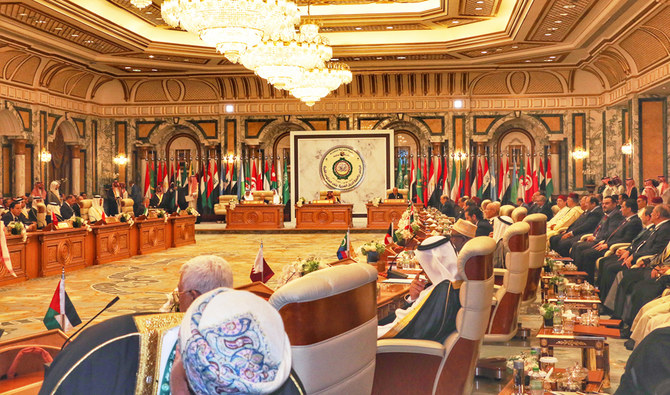
‘Criminal’ Iran condemned at Makkah summit

King Salman said: "Iran's criminal acts... require that all of us work seriously to preserve the security and achievements of GCC (Gulf Cooperation Council)." (SPA)
Updated 02 June 2019
Follow

‘Criminal’ Iran condemned at Makkah summit

  • With the exception of Iraq, participants urge world to curb Tehran

JEDDAH: Arab and Muslim states rallied solidly behind Saudi Arabia on Friday as King Salman presented a foolproof case against Iran for its "criminal" actions in the region and beyond.

King Salman told an emergency Arab summit in Makkah on Friday that decisive action was needed to stop Iranian "escalations" following attacks on Gulf oil installations.

A joint statement issued by Arab leaders condemned "acts by the terrorist Houthi militias supported by Iran who (sent) aircraft that crossed into Saudi Arabia to two oil pumping stations and acts of sabotage that affected commercial ships in territorial waters of the United Arab Emirates."

They said Iran's behavior "poses a direct and serious threat" and called on "the international community to take a firm stand to confront Iran and its destabilizing acts in the region."

The summits convened by Saudi Arabia in the holy city of Makkah saw near total isolation of Iran.

"The absence of a firm deterrent stance against Iranian behavior is what led to the escalation we see today," King Salman told the two late-night consecutive meetings.

King Salman said: "Iran's criminal acts... require that all of us work seriously to preserve the security and achievements of GCC (Gulf Cooperation Council)."

King Salman called on the international community to thwart Iran's behaviors and for "using all means to stop the Iranian regime from interfering in the internal affairs of other countries, harboring global and regional terrorist entities and threatening international waterways."

The right of Saudi Arabia and the UAE to defend their interests after the attacks on the oil pumping stations in the Kingdom and tankers off the UAE were supported in a Gulf Arab statement and a separate communique issued after the wider summit.

He added that Saudi Arabia is keen to protect the region from the scourge of war and that its "hand remains extended for peace."

"The kingdom is keen to preserve the stability and security of the region, to spare it the scourge of war and to realize peace and stability," King Salman said.

Egyptian President Abdel Fattah El-Sisi told the summit that this month's attacks provided an impetus to renew discussions on joint Arab defense mechanisms.

The Gulf Arab communique, carried by Saudi state news agency SPA, said the six nations had discussed the GCC defense mechanism during their meeting.

The unified Arab stand was welcomed by security and international affairs analysts.

Dr. Hamdan Al-Shehri, a Riyadh-based Saudi political analyst and international relations scholar, said Iran faced total isolation in the Muslim world.

"A message has gone to Iran that it stands isolated for what it has unleashed in the Arab and Muslim world. Iran is responsible for the chaos in many Arab and Muslim states. Its militias have created havoc. It poses a great danger to the safety and security of the region and the world at large," he told Arab News. "King Salman has made a good case against Iran and explained to the Arab and Muslim world how Iran is sowing division and playing with fire."

Al-Shehri said he was happy to see the Arab and Muslim world putting up a united front against Iran and its machinations. "Iraq was the only exception last night, but by and large the Arab and Muslim world have stood by Saudi Arabia. To have assembled the leaders of the Arab and Muslim world at such a short notice is a great diplomatic achievement of Saudi Arabia and indicates the respect that Saudi Arabia commands in the Arab and Muslim world."

Salman Al-Ansari, president and founder of the Saudi American Public Relation Affairs Committee (SAPRAC), said the criucial summits in Makkah highlighted a kind of political diplomacy, particularly in regard to sending clear messages to those — foremost Iran — who threaten regional and global security.

"Iran continues its hostile policy of feeding and fuelling sectarianism and spreading unrest among the countries of the region including Yemen, Lebanon, Syria, Iraq, and others. Violations are apparent to every observer in the world. The danger posed by Iran goes beyond the Gulf and threatens the security of the whole world," he said.

Driving his point home, he said: "I would like to ask a question of European and American citizens with Arab citizens listening: Can you imagine awakening one day to the news of no oil in your country when you know that oil is the most important fuel in your daily life? The answer will certainly be a nightmare, especially since all the elements of life in the world depend mainly on energy, and basically on oil."

He said all Saudi Arabia was doing was trying to tell the world that the Iranian threat is not only affecting the Kingdom but also threatens the most important sources of energy in the world. 

"The Tehran regime threatens the most important international shipping lanes in the world through which giant oil tankers move to provide European countries, America and the rest of the  world with the necessities for maintaining the sustainability and continued growth of their countries."
He said the Iranian threat was not only affecting Saudi Arabia or the Gulf region but also affecting everyone in the world. "The Iranian regime is behaving irresponsibly by threatening the largest and most important sources of energy and oil in the world. The threat comes from Iranian ballistic missiles which support the terrorist militias in Yemen. Iran threatens the oil tankers in the Bab Al-Mandab and the Strait of Hormuz which are "the most important international shipping lanes in the world."

"Iran's behavior amounts to a confrontation of the international community and its major responsibility. Do you want peace, security, and development? Or ruin, poverty, and disorder? The answer is yours."


India and Saudi Arabia share robust defense partnership anchored in mutual trust, ambassador says

Updated 6 sec ago
Follow

India and Saudi Arabia share robust defense partnership anchored in mutual trust, ambassador says

RIYADH: India and Saudi Arabia share a robust and steadily expanding defence partnership anchored in mutual trust, Indian Ambassador Suhel Ajaz Khan said.

Speaking to Arab News ahead of the World Defense Show in Riyadh, which will feature a major Indian presence, the ambassador said: “Saudi Arabia is one of India’s most trusted and valued strategic partners. Our ties are rooted in a rich tapestry of civilizational, cultural, and commercial connections that date back centuries. In recent years, the relationship has grown exponentially, evolving into a robust strategic partnership.

“The landmark state visit of Prime Minister Narendra Modi to the Kingdom in April 2025 was a true reflection of this deepening bond. He and Crown Prince Mohammed bin Salman had highly productive engagements in Jeddah, resulting in key outcomes — including the agreement on establishment of two India-Saudi joint venture refineries in India, and MoUs in space cooperation, health, sports, and postal cooperation, the envoy said. 

“The second leaders’ meeting of the India-Saudi Arabia Strategic Partnership Council was also co-chaired by the two leaders during this visit. The council reviewed the work of the various committees, subcommittees and working groups under the SPC,” he added.

“On the defense side, India and Saudi Arabia share a robust and steadily expanding partnership, anchored in mutual trust and based on the Defense Cooperation Agreement signed in 2014 during the India visit of the then crown prince and defense minister King Salman,” Khan said.

“Over the past few years, this cooperation has deepened through regular high-level engagements, and enhanced interactions between the armed forces of both countries,” he said.

The most significant development has been the addition of a Ministerial Pillar of Defence Cooperation to the Strategic Partnership Council, chaired by the defense ministers, announced during the Jeddah visit of the Indian prime minister.

Seven rounds of discussions under the Joint Committee on Defense Cooperation have been held so far. The continued exchange of senior defence delegations reflects the priority accorded to defence cooperation under the framework of the Strategic Partnership Council. 

“Over the last few years, we have seen two editions of naval exercises, Al Mohed Al Hindi and the first land forces exercises, Sada Tanseeq. There have also been regular port calls by Indian naval and coast guard vessels,” Khan said.

After a gap of nearly 12 years, the first ministerial delegation on the defence side visited Riyadh for WDS 2024, the delegation was headed by Minister of State for Defense Ajay Bhatt. 

During that visit, an agreement was signed by Munitions India Ltd. for defence exports from India to Saudi Arabia worth $225 million, Khan said.

India will feature prominently at WDS 2026 being held from Feb. 8-12.

“We congratulate the Kingdom for its organization of WDS in recent years, which has grown significantly since its inception. While preparations are underway, we expect a high-level delegation for this event. The senior leadership of Indian Armed Forces will also be part of the delegation. There will be an India Pavilion set up by our Ministry of Defense in the show.

“While earlier, a number of Indian companies have participated in the WDS, this will be the first time an India Pavilion will be set up and will showcase India’s growing defence manufacturing capabilities,” the envoy said.

The past year has been particularly productive for India–Saudi defence relations. 

“We witnessed, for the first time, service-to-service level staff talks, along with high-level visits from both sides, including the first visit of the Chief of General Staff of the Saudi Armed Forces Gen. Fayyad bin Ruwaili, to India in December 2025,” Khan said.

He noted that there are several areas between the two sides that reflect the depth of the partnership, one of the primary fields being military-to-military cooperation, including joint exercises, training exchanges, and service-to-service engagements.

“Amongst them maritime and naval cooperation is key, reflecting our shared interest in the security of the Indian Ocean region, the Red Sea, and critical sea lines of trade and communication. The two rounds of the naval exercises Al Mohed Al Hindi have provided an excellent base for continued collaboration in this area,” Khan said.

“Another rapidly expanding area of engagement is defence industry and industrial collaboration. India’s growing defense manufacturing ecosystem driven by the motto of ‘Make in India, Make for the World’ aligns closely with Saudi Arabia’s Vision 2030,” he added. 

India’s defence industrial capabilities have grown exponentially in recent years, crossing $15 billion, with exports upwards of $2.7 billion. 

“We have a large number of products which we can offer to the Saudi side,” the ambassador said.

Saudi Arabia has been sending cadets to India for training with the Indian Navy and the National Defense Academy, marking a significant boost in bilateral defense cooperation.

Khan said: “Training and capacity-building cooperation has emerged as an important pillar of the defence partnership between India and Saudi Arabia. The participation of Saudi cadets in professional military training institutions in India reflects the high level of trust and confidence between our armed forces.”

As part of a landmark initiative, six instructors and 55 cadets from the King Fahd Naval Academy of the Royal Saudi Naval Forces participated in Afloat Summer Training with the Indian Navy at Kochi in 2023, he said. 

This was followed by an expanded engagement in 2024, when five instructors and 76 cadets from the same academy undertook similar training. 

“We anticipate that this program will continue to grow and expand in the years ahead,” the ambassador said.

In 2023 and 2025, senior delegations from the National Defence College, New Delhi visited Saudi Arabia on study tours. 

Officers from the Saudi armed forces have also attended NDC courses in the past.

“These training exchanges not only contribute to professional skill development and interoperability but also foster enduring institutional linkages between our armed forces. We see this cooperation as a valuable investment in the long-term strength of the India–Saudi Arabia defence partnership," the ambassador said.