JERUSALEM: Israel embarked Thursday on an unprecedented snap election campaign — the second this year — after Prime Minister Benjamin Netanyahu failed to form a governing coalition and instead dissolved parliament.
In what seemed an improbable scenario just days ago, Israel’s newly elected Knesset dissolved itself in an early morning 74-45 vote and set a new election date for September 17.
The developments were a shocking setback for Netanyahu, who had appeared to secure a comfortable win in last month’s election. But he was unable to build a parliamentary majority needed to rule because a traditional ally, Avigdor Lieberman, refused to bring his Yisrael Beiteinu faction into the coalition.
Netanyahu, who has led Israel for the past decade, now faces another challenge to his lengthy rule. It comes as he prepares for a pre-indictment hearing before expected criminal charges against him in a series of corruption cases.
Assuming they would sweep into power again, Netanyahu’s allies in the ruling Likud Party had already begun drafting a contentious bill aimed at granting him immunity from the various corruption charges awaiting him. He was also looking to push legislation limiting the power of Israel’s Supreme Court and paving his path to many more years in office.
But it was a separate issue that sparked the unprecedented crisis, and for the first time in history thrust Israel into a repeat election before a new government was even formed.
Lieberman — a veteran nationalist and secular politician — demanded that current legislation mandating that young ultra-Orthodox men be drafted into the military run its course.
Years of exemptions for ultra-Orthodox men have generated widespread resentment among the rest of Jewish Israelis who serve. The ultra-Orthodox, backed by Netanyahu, refused to bend and the showdown quickly devolved into a full-blown crisis that imploded the perspective government.
“The public chose me, and Lieberman, unfortunately, deceived his voters. From the beginning he had no intention to do what he said,” Netanyahu said after the vote, accusing Lieberman of aligning with “the left.”
Lieberman, a former top aide to Netanyahu who has alternated between a close alliance and bitter rivalry with his former boss, retorted that the new election was a result of Netanyahu caving into the ultra-Orthodox.
“This is a complete surrender of Likud to the ultra-Orthodox,” he said.
A new election complicates Netanyahu’s efforts to pass the proposed bills to protect himself from prosecution.
Even if Netanyahu wins the election, it is unlikely he will be able to form a government and lock down the required political support for an immunity deal before an expected indictment. That would force him to stand trial, and in turn put heavy pressure on him to step aside. No one in Likud has yet challenged him publicly.
The US State Department said on Thursday that the US-led conference on economic aspects of a Middle East peace plan will go ahead next month in Bahrain despite Israel’s snap elections, .
“We are not anticipating any changes. It’s set for June 25 and 26,” State Department spokeswoman Morgan Ortagus told reporters.
Another US official, speaking on condition of anonymity, said that a separate rollout of the political elements of the plan would take place “when the timing is right.”
Jared Kushner, President Donald Trump’s son-in-law and adviser, had been preparing for months to unveil the peace plan but had said he was waiting for Israel’s elections in April as well as the end of the Islamic holy month of Ramadan.
The Bahrain conference is expected to look at economic opportunities for the Palestinians, through funding from Washington’s allies that are united with Israel and the United States in opposing Iran.
Kushner has hinted that the United States in turn will not push for the creation of a Palestinian state, a key goal of decades of US-led diplomacy, and Netanyahu during his last campaign threatened to annex parts of the West Bank.
The Palestinian Authority has already said it will boycott the Bahrain conference, not seeing Trump as an honest broker after his landmark recognition of Jerusalem as Israel’s capital.


![]()

Israel faces new elections after parliament dissolves
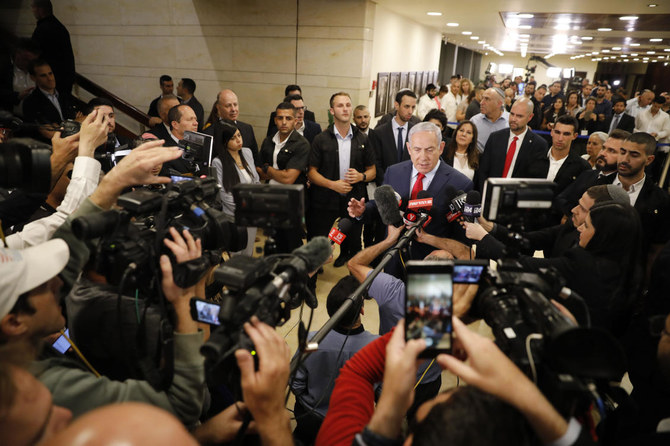
Israel faces new elections after parliament dissolves
- Israel’s newly elected Knesset dissolved itself in an early morning 74-45 vote and set a new election date for September 17
- Benjamin Netanyahu, who has led Israel for the past decade, now faces another challenge to his lengthy rule


Latest updates



© 2026 SAUDI RESEARCH & PUBLISHING COMPANY, All Rights Reserved And subject to Terms of Use Agreement.