Mobile barber cuts a dash with Afro-Caribbean Londoners

1 / 3
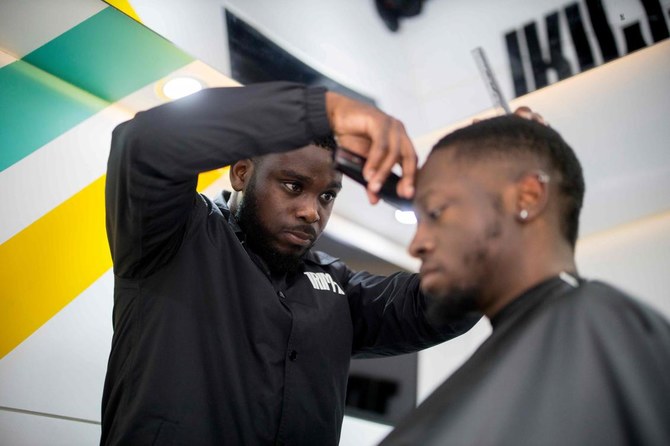
Full-time barber, Kris Roberton (R) trims a client's hair in the customized van of mobile barbershop, Trim-It, on the streets of south London on May 17, 2019. (AFP/Tolga Akmen)
2 / 3
A customized van of mobile barbershop, Trim-It, run by full-time barber, Kris Roberton, is parked on a street of south London on May 17, 2019. (AFP/Tolga Akmen)
3 / 3
Full-time barber, Kris Roberton (L) trims a client's hair in the customized van of mobile barbershop, Trim-It, on the streets of south London on May 17, 2019. (AFP/Tolga Akmen)
Updated 30 May 2019
Follow

Mobile barber cuts a dash with Afro-Caribbean Londoners

  • Opening the customised van’s sliding door reveals a silver barber’s chair, a large mirror, a hair dryer and drawers overflowing with scissors, clippers and hair products
  • Appointments are made via a mobile phone app, summoning a van to where the client is

LONDON: In a quiet street in south London’s trendy Brixton district, known for its ethnic diversity, 25-year-old Kristian Robertson parks his trailblazing mobile salon.
For a little over a year, he has worked for Trim-It — a start-up offering haircuts for people with Afro-Caribbean roots.
Opening the customised van’s sliding door reveals a silver barber’s chair, a large mirror, a hair dryer and drawers overflowing with scissors, clippers and hair products.
As he carefully prepared his equipment for the day’s first customer, the meticulously groomed Robertson said clients are “always amazed” when they see what is inside.
“Appearance is important, whenever you wanna go somewhere or even if you just wanna feel better about yourself, you get a haircut and it changes your whole day, changes your whole week even,” said Micah Henry, 24, one of Robertson’s ten-odd daily customers.
Henry, who uses Trim-It about once a month, said it was the “most convenient” hairdresser he had come across.
Appointments are made via a mobile phone app, summoning a van to where the client is.
The start-up’s founder, 24-year-old Darren TenQur’ang, said the intimate setting of a van helped forge close relationships between hairdressers and their clients.
“The relationship that you have with your barber is a very special one and I feel like this barber shop actually intensifies that because it’s so one-on-one so you can use your barber as a therapist,” he told AFP.
“You can talk to him about everything from your girlfriend issues to football to business.”
Born to Ghanaian parents, TenQur’ang was accustomed as a boy to visiting Brixton’s barber shops regularly with his father.
He said the business idea came to him after enduring many long waits.
TenQur’ang now wants to offer a faster service more adapted to the lifestyles of young people.
“We thought it was a good idea to put a barber shop in the back of a van and for an app to be able to book a barber shop to a location,” he said.
“For us, it’s all about making sure that the service is completely convenient and we sprinkle a little bit of premium (treatment) as well.”
The first van launched in February 2018 and the start-up now employs nine people and boasts five mobile salons covering most of London.
“I am just really surprised at how much it has actually taken off,” said the young entrepreneur.
“We’re definitely going to try to conquer London but our goal is to actually just take over the whole of the UK and thereafter, as everybody is saying, world domination!“


Arts festival’s decision to exclude Palestinian author spurs boycott

Randa Abdel Fattah. (Photo/Wikipedia)
Updated 12 January 2026
Follow

Arts festival’s decision to exclude Palestinian author spurs boycott

  • A Macquarie University academic who researches Islamophobia and Palestine, Abdel-Fattah responded saying it was “a blatant and shameless act of anti-Palestinian racism and censorship,” with her lawyers issuing a letter to the festival

SYDENY: A top Australian arts festival has seen ​the withdrawal of dozens of writers in a backlash against its decision to bar an Australian Palestinian author after the Bondi Beach mass shooting, as moves to curb antisemitism spur free speech concerns.
The shooting which killed 15 people at a Jewish Hanukkah celebration at Sydney’s Bondi Beach on Dec. 14 sparked nationwide calls to tackle antisemitism. Police say the alleged gunmen were inspired by Daesh.
The Adelaide Festival board said last Thursday it would disinvite Randa ‌Abdel-Fattah from February’s ‌Writers Week in the state of South Australia because “it ‌would not ​be ‌culturally sensitive to continue to program her at this unprecedented time so soon after Bondi.”

FASTFACTS

• Abdel-Fattah responded, saying it was ‘a blatant and shameless act of anti-Palestinian racism and censorship.’

• Around 50 authors have since withdrawn from the festival in protest, leaving it in doubt, local media reported.

A Macquarie University academic who researches Islamophobia and Palestine, Abdel-Fattah responded saying it was “a blatant and shameless act of anti-Palestinian racism and censorship,” with her lawyers issuing a letter to the festival.
Around 50 authors have since withdrawn from the festival in protest, leaving it in doubt, local media reported.
Among the boycotting authors, Kathy Lette wrote on social media the decision to bar Abdel-Fattah “sends a divisive and plainly discriminatory message that platforming Australian Palestinians is ‘culturally insensitive.'”
The Adelaide Festival ‌said in a statement on Monday that three board ‍members and the chairperson had resigned. The ‍festival’s executive director, Julian Hobba, said the arts body was “navigating a complex moment.”

 a complex and ‍unprecedented moment” after the “significant community response” to the board decision.
In the days after the Bondi Beach attack, Jewish community groups and the Israeli government criticized Prime Minister Anthony Albanese for failing to act on a rise in antisemitic attacks and criticized protest marches against Israel’s war in ​Gaza held since 2023.
Albanese said last week a Royal Commission will consider the events of the shooting as well as antisemitism and ⁠social cohesion in Australia. Albanese said on Monday he would recall parliament next week to pass tougher hate speech laws.
On Monday, New South Wales state premier Chris Minns announced new rules that would allow local councils to cut off power and water to illegally operating prayer halls.
Minns said the new rules were prompted by the difficulty in closing a prayer hall in Sydney linked to a cleric found by a court to have made statements intimidating Jewish Australians.
The mayor of the western Sydney suburb of Fairfield said the rules were ill-considered and councils should not be responsible for determining hate speech.
“Freedom ‌of speech is something that should always be allowed, as long as it is done in a peaceful way,” Mayor Frank Carbone told Reuters.