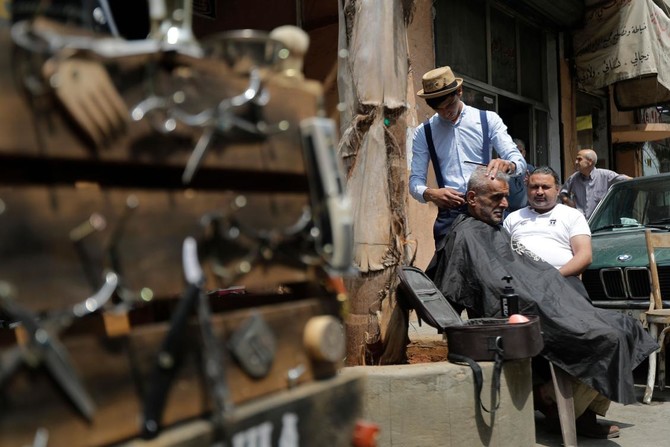
Beirut’s dapper barber-on-a-bike offers curbside cuts

1 / 3
Mohammed, a Lebanese roaming barber, better known as " Abo Tawila", rides his bicycle on the outskirts of the Palestinian refugee camp of Burj al-Barjaneh, south of the capital Beirut on May 29, 2018. (AFP)
2 / 3
Mohammed, a Lebanese roaming barber, better known as "Abo Tawila", gives a client a haircut on a steet in Beirut's southern suburbs on May 29, 2018. (AFP)
3 / 3
Mohammed, a Lebanese roaming barber better known as " Abo Tawila", gives a client a haircut on a sidewalk in the Lebanese capital Beirut's southern suburbs on May 29, 2018.(AFP)
Updated 30 May 2018
Follow

Beirut’s dapper barber-on-a-bike offers curbside cuts

BEIRUT: Dressed in an old straw hat and navy suspenders, Abo Tawila pedals around a southern district of Beirut. A rare sight in modern-day Lebanon, the young barber-on-a-bike is looking for his next customer.
Everything he needs for a trim on the pavement is in a handmade trunk attached to the back of his pushbike: scissors, combs, electric razors and brushes.
“It’s a beautiful idea because it’s a really old one,” says the dapper 18-year-old as he makes his way through the buzzing district of Burj Al-Barajneh.
His real name is Mohammad Khaled Jahjah, but he prefers the name Abo Tawila — “the Tall One” in Arabic.
“People like this, and I love everything old. If I ever have the chance to open a barbershop, it’ll be a vintage one,” he says.
Mobile barbers were once ubiquitous in Beirut, but regular salons have since become more popular.
Abo Tawila works in both, spending most of his day in a barbershop before hitting the tarmac on his bike.
Some stop him for a haircut, but others hail him down to catch up or introduce themselves.
“I used to love watching the barber near my parent’s house. I’d come back from school, drop off my backpack, and go to his shop,” Abo Tawila says.
“He told me to come to the salon after school if I like this job. But I decided to leave school altogether to work with him. He taught me the trade and introduced people to me.”
The handsome hairdresser has become something of a celebrity in southern Beirut. He is slender, stylishly dressed, and has a sharp wit.
“I’m so happy he’s here,” says Abo Saeed, one of his favorite curbside customers.
“He’s talented and always available. When I have some time, I call him and he comes immediately, so I never have to leave work to go to the barber,” he tells AFP.
“On top of all of that, he reminds us of the barbers of the old days.”
Abo Tawila wakes up at 9:00am every day, puts together an outfit and goes down to the coffee shop near his house before beginning his day at the salon.
In his free time or when his shift is done, he heads out on his bike to find customers, grooming between five and 30 people a day.
“The situation changes depending on the day,” he says.
“There’s not much work now during Ramadan, because people are waiting for Eid,” the feast which marks the end of the Islamic fasting month and triggers a flurry of trade.
“Before Eid, we have three days where we don’t sleep from all the customers coming in,” he says.
While he dreams of opening his own shop, Abo Tawila insists he’ll stay loyal to his bike.
“If I open a salon, I’ll still keep it, because that’s what got me here,” he says.


Cambodia takes back looted historic artifacts handled by British art dealer

Updated 28 February 2026
Follow

Cambodia takes back looted historic artifacts handled by British art dealer

  • The objects were returned under a 2020 agreement between the Ministry of Culture and Fine Arts and the family of the late Douglas Latchford, a British art collector and dealer who allegedly had the items smuggled out of Cambodia

PHNOM PENH, Cambodia: Cambodian officials on Friday received more than six dozen historic artifacts described as part of the country’s cultural heritage that had been looted during decades of war and instability.
At a ceremony attended by Deputy Prime Minister Hun Many, the 74 items were unveiled at the National Museum in Phnom Penh after their repatriation from the United Kingdom.
The objects were returned under a 2020 agreement between the Ministry of Culture and Fine Arts and the family of the late Douglas Latchford, a British art collector and dealer who allegedly had the items smuggled out of Cambodia.
“This substantial restitution represents one of the most important returns of Khmer cultural heritage in recent years, following major repatriations in 2021 and 2023 from the same collection,” the Culture Ministry said in a statement. “It marks a significant step forward in Cambodia’s continued efforts to recover, preserve, and restore its ancestral legacy for future generations.”
The artifacts were described as dating from the pre-Angkorian period through the height of the Angkor Empire, including “monumental sandstone sculptures, refined bronze works, and significant ritual objects.” The Angkor Empire, which extended from the ninth to the 15th century, is best known for the Angkor Wat archaeological site, the nation’s biggest tourist attraction.
Latchford was a prominent antiquities dealer who allegedly orchestrated an operation to sell looted Cambodian sculptures on the international market.
From 1970 to the 1980s, during Cambodia’s civil wars and the communist Khmer Rouge ‘s brutal reign, organized looting networks sent artifacts to Latchford, who then sold them to Western collectors, dealers, and institutions. These pieces were often physically damaged, having been pried off temple walls or other structures by the looters.
Latchford was indicted in a New York federal court in 2019 on charges including wire fraud and conspiracy. He died in 2020, aged 88, before he could be extradited to face charges.
Cambodia, like neighboring Thailand, has benefited from a trend in recent decades involving the repatriation of art and archaeological treasures. These include ancient Asian artworks as well as pieces lost or stolen during turmoil in places such as Syria, Iraq and Nazi-occupied Europe. New York’s Metropolitan Museum of Art is one of the prominent institutions that has been returning illegally smuggled art, including to Cambodia.
“The ancient artifacts created and preserved by our ancestors are now being returned to Cambodia, bringing warmth and joy, following the country’s return to peace,” said Hun Many, who is the younger brother of Prime Minister Hun Manet.