

Solar, onshore wind to fall below cost of fossil fuel for first time

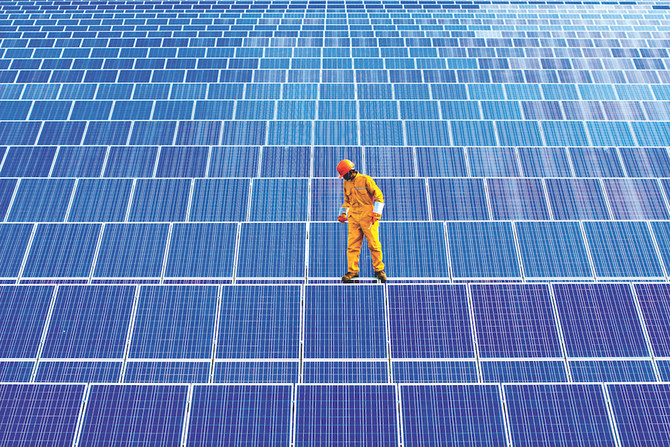
Four fifths of large-scale solar capacity to be commissioned next year shows lower prices than the cheapest new coal-fired, oil or natural gas sources. (Shutterstock)
Updated 29 May 2019
Follow

Solar, onshore wind to fall below cost of fossil fuel for first time

  • Record low solar auction prices in Saudi Arabia and UAE reflect falling cost of renewables

LONDON: Electricity generated by onshore wind and solar photovoltaic (PV) technologies will in the next year be consistently cheaper than from any fossil fuel source, a report showed on Wednesday, boosting the case for energy sources that do not emit carbon.
The trend for cut-price renewable energy is already set but the report by the International Renewable Energy Agency (IRENA) gives fresh evidence of the speed of the decline, driven by increased production runs and technology improvements.
“Onshore wind and solar PV are set by 2020 to consistently offer a less expensive source of new electricity than the least-cost fossil-fuel alternative without financial assistance,” said IRENA, a government-backed body that aims to support countries in their transition to sustainable energy sources.
The global weighted average cost of electricity generated by concentrated solar power fell by 26 percent last year from a year earlier, data compiled by the agency showed. Bioenegy fell by 14 percent, solar PV and onshore wind by 13 percent, hydropower by 12 percent and geothermal and offshore wind by 1 percent.
Costs of $0.03 to $0.04 per kilowatt hour (kWh) for onshore wind and solar PV are already possible in some parts of the world.


Record-low auction prices for solar PV over the past couple of years in Chile, Mexico, Peru, Saudi Arabia, and the United Arab Emirates for example have seen a cost as low as $0.03/kWh, IRENA found.
More than three quarters of onshore wind and four fifths of large-scale solar PV capacity to be commissioned next year shows lower prices than the cheapest new coal-fired, oil or natural gas sources, the report said.
At the start of last year, IRENA forecast the global average cost of electricity could fall to less than $0.049/kWh for onshore wind and $0.055/kWh for solar PV by 2020.
“A year later, the potential value for onshore wind in 2020 has dropped a further 8 percent to $0.045/kWh, while that of solar PV has dropped 13 percent to $0.048/kWh,” said the report, based on data from IRENA’s own members, business journals, industry groups, consultancies, governments, auctions and tenders.
As well as 160 countries, IRENA’s membership includes utilities, project developers, research institutes and companies, all of which provided data for its Renewable Cost Database. 

FASTFACTS

26 %

The global weighted average cost of electricity generated by concentrated solar power fell by 26 percent last year from a year earlier.


Fiscal discipline critical as high interest rates persist: Saudi finance minister  

Updated 22 sec ago
Follow

Fiscal discipline critical as high interest rates persist: Saudi finance minister  

RIYADH: Saudi Arabia’s finance minister warned that both advanced and emerging economies risk long-term instability if governments rely on borrowing and optimistic assumptions instead of disciplined fiscal management, as global interest rates are likely to remain elevated for years.  

Speaking during a panel at the annual AlUla Conference for Emerging Market Economies, Mohammed Al-Jadaan said countries are unlikely to see meaningful monetary easing in the near term, underscoring the need to preserve fiscal space and prioritize spending that supports sustainable growth.   

“We are unlikely to see an easing in monetary policy in the few years to come,” he said, adding that while interest rates may come down from current levels, they are “not too much lower” than where they are now, reinforcing the need to focus on fiscal policy.  

Al-Jadaan cautioned that some advanced economies are now repeating mistakes long associated with emerging markets. “Some advanced economies are going through the same struggles because they are falling into the same trap that emerging economies fell into, thinking they could live through it, and unfortunately, it is not sustainable,” he said.  

He said that unless governments treat fiscal policy as a serious balance-sheet issue rather than a cash-flow exercise, they risk falling into the trap of spending whenever they can borrow money, noting that countries can become insolvent even while holding cash if liabilities outpace assets.  

Al-Jadaan emphasized the importance of building fiscal buffers during periods of economic strength. “Where you fail is when you are in good times and fail to build the buffers,” he said, adding that inflated revenue assumptions often lead governments into debt when anticipated income does not materialize.  

The importance of buffers was echoed by Pakistan’s Finance Minister Muhammad Aurangzeb, who said the issue is far from academic for Pakistan. “The bane of our country has been the twin structural deficits, so we need to religiously guard the progress we have made over the last two to three years in terms of successive primary surpluses,” Aurangzeb said.  

He pointed to a sharp improvement in Pakistan’s fiscal position. “We hit about 8 percent fiscal deficit, and we are now at about 5.4 percent, and the current trajectory looks good in terms of bringing it even below 5 percent,” he said, citing gains across revenue, expenditure, and debt management.  

Aurangzeb said recent climate shocks had underscored the value of fiscal space. “Three years back we had a catastrophic flood and had to go into international appeal, but with the fiscal space we had available last year, we could muster our own resources to absorb that shock,” he said, adding that buffers allow governments to respond to exogenous events without destabilizing public finances.  

Both ministers warned against using borrowing as a shortcut to growth. “You don’t finance growth by throwing more money and borrowing more money,” Al-Jadaan said, calling for prioritization and efficiency in spending and treating fiscal space as a strategic asset.  

Al-Jadaan also distinguished between productive and unproductive deficits, warning that “bad deficit is a deficit that is not going to yield any growth and instead yields a liability for the future,” particularly when it finances consumption or recurring operating costs. By contrast, he said investment in infrastructure such as airports, ports, and railroads can act as a catalyst for private sector investment.  

Aurangzeb said Pakistan is pursuing reforms to support that approach, including expanding the tax base and reducing governance leakages. “We were below 10 percent tax to GDP and are now close to 12 percent,” he said, adding that technology and AI-led monitoring are helping curb “leakage and theft,” which he described as a euphemism for corruption.  

He also pointed to progress on debt. “Our debt-to-GDP ratio was about 74 percent and is now down to 70 percent,” Aurangzeb said, noting that greater fiscal discipline could free up resources for sectors such as human capital, agriculture, and information technology.  

Al-Jadaan concluded by warning that even well-intentioned borrowing carries risks. “Even on the good deficit side, markets are brutal,” he said, cautioning that excessive borrowing at a rapid pace can push up funding costs across the wider economy.