BERLIN: German Chancellor Angela Merkel’s “climate cabinet” meets Wednesday to discuss combatting global warming as her government struggles to convince voters it is willing and able to address the crisis.
Strong gains by the Greens at the expense of Germany’s two ruling parties in Sunday’s European Parliament elections were seen as an indictment of Berlin’s policy on climate change.
Merkel, in a CNN interview Tuesday, acknowledged that “we have to give better answers” to the planetary challenge.
Her conservative CDU/CSU bloc and their leftist junior partners the SPD suffered heavy losses Sunday while the Greens scored over 20 percent, becoming Germany’s second strongest party for the first time.
Young voters in particular — energised by the Fridays for Future school strikes, anti-coal protests and blockades, and by a passionate campaign from leading YouTube stars — abandoned the mainstream parties in droves.
Germany was long seen as a clean energy pioneer, and Merkel dubbed the “climate chancellor,” for pushing renewables while committing to phase out nuclear power by 2022 and now coal by 2038.
However, green activists now feel that progress has stalled and demand a far earlier end to coal and the combustion engine, as well as dramatic shifts in transport, agriculture and building insulation.
Germany is now set to miss its target of cutting CO2 emissions by 40 percent by 2020 from 1990 levels. It is currently on course for only a 32-percent reduction.
Since the election, criticism has been raining down from all sides — even from Friedrich Merz, a conservative former investment fund manager with designs on Merkel’s job.
“After this European election, the CDU must ask itself why, after 14 years of having a ‘climate chancellor’, we are missing our climate targets, burdening households and companies with the highest electricity prices in Europe and at the same time losing strategic and cultural control over the issue,” he told news site Der Spiegel.
The coalition’s poll debacle and perceived loss of touch with young voters have again heightened tensions between the two parties who were forced into their unhappy marriage by poor poll results in 2017.
The new political turbulence has also added fresh urgency to the coalition’s plodding progress on forging a complex new “climate law” before the end of the year.
A day after the ballot box drubbing, the SPD Environment Minister Svenja Schulze voiced her frustration about the CDU’s foot-dragging on her climate bill.
She complained that Merkel’s office had failed to respond to the proposed law since February and took the unusual step of instead sending the bill directly to other ministries.
“We need more commitment on climate protection,” she tweeted. “I cannot take responsibility for further delays.”
The CSU’s Georg Nuesslein attacked Schulze for her “panic-driven maneuver” and charged that “the SPD is obviously losing its nerve, which is little wonder given its election results.”
Schulze’s proposed Climate Protection Act would set binding targets in areas such as energy generation, industry, transport, housing, agriculture and waste management.
In the scheduled 90-minute “climate cabinet” meeting Wednesday, CDU Economy Minister Peter Altmaier, the CSU’s Transport Minister Andreas Scheuer and others are expected to outline their plans for CO2 emission cuts.
Germany’s declared goal for 2030 is a 55-percent reduction from 1990 levels.
And by mid-century, Germany would aim for a 95-percent cut under the new law, surpassing earlier pledges.
Where Germany fails and is punished at the EU level, the government would pass the penalties on to the ministries responsible.
The CSU’s Nuesslein has already attacked the bill as a blueprint for a communist-style “climate-planned economy.”
He also opposed SPD proposals for a CO2 tax that would discourage, for example, petrol cars and oil heating.
The CDU’s Joachim Pfeiffer meanwhile voiced skepticism about the new enthusiasm for climate protection, charging that for many it had become a “substitute religion.”


![]()

Merkel team talks climate as voters turn up heat
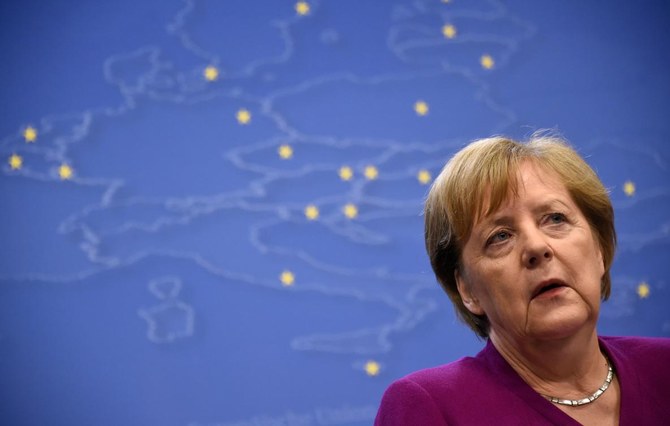
Merkel team talks climate as voters turn up heat
- Merkel acknowledged that “we have to give better answers” to the planetary challenge
- Germany is now set to miss its target of cutting CO2 emissions by 40 percent by 2020 from 1990 levels


Latest updates


Recommended


© 2026 SAUDI RESEARCH & PUBLISHING COMPANY, All Rights Reserved And subject to Terms of Use Agreement.